00:00 / 03:27
00:00 / 03:27

Feste Spars With Viola About Words, Explained

Twelfth Night · 2012

Chapter 14 of 25 · 3'27"

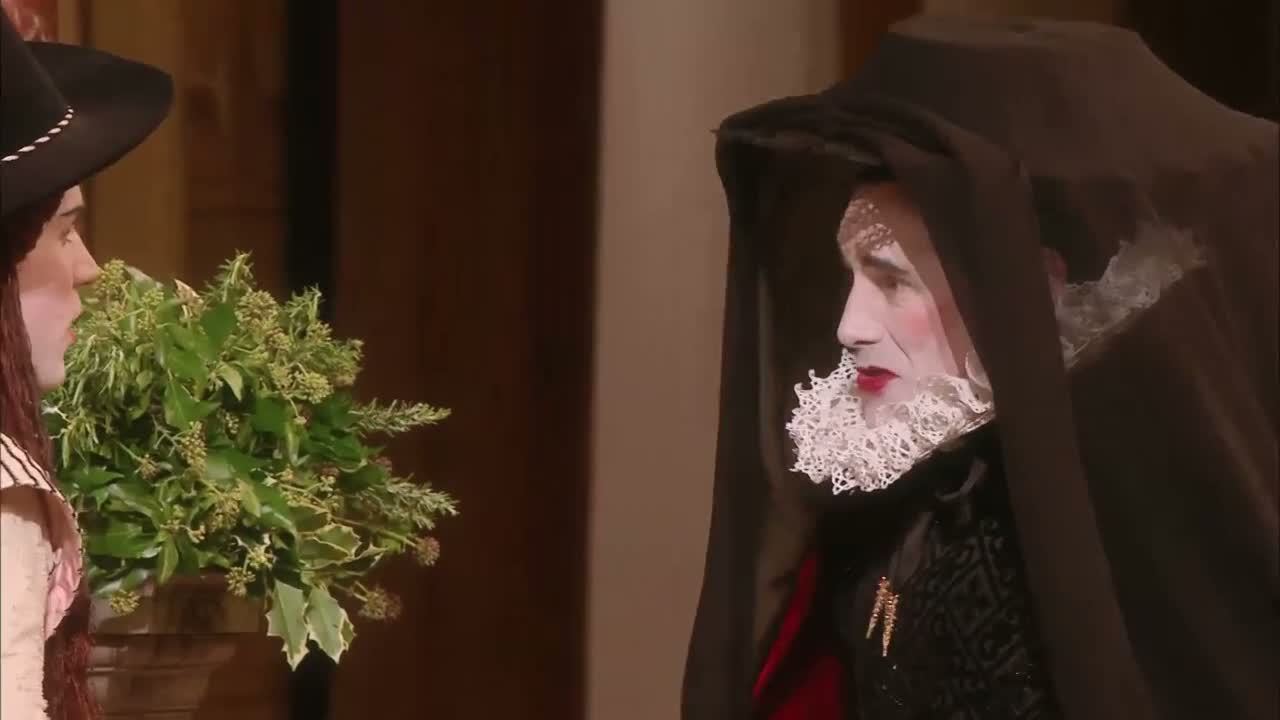
Feste and Viola trade wits before Olivia's house, and words themselves become the subject: a sentence is like a leather glove you can turn inside out. "Words are grown so false," the fool says, "I am loath to prove reason with them." It is a comic duel in which the servant out-talks his betters.

TeasingSmall talkTeasingExplainingStrangersC2fastbritishClean

Key moments

Start here, then watch the full scene
  1. ❝ Monologue · 7 lines Viola on the Fool's Real Wisdom

    2:40–3:07
    27s
  1. ❝ MonologueOn playing the fool7 linesPractice page ↗

Feste Spars With Viola About Words, explained

What happens

Feste meets Cesario outside Olivia's house and they fence with words. The fool argues that anyone good with language can twist a sentence like a soft glove, until words themselves turn into liars: 'words are grown so false, I am loath to prove reason with them.' He denies being a fool and calls himself a corrupter of words, then wheedles coins from Cesario.

What's really going on

This is the play's wittiest scene about wit itself. Feste refuses to be called a fool, but his defence is a performance: he proves his cleverness by playing with the very words he says he distrusts, comparing a sentence to a 'cheveril glove' that a sharp mind can turn inside out. His line 'words are grown so false, I am loath to prove reason with them' is both a joke and a warning — in a play built on disguise, letters and mistaken identity, language is exactly what cannot be trusted. Viola, who is herself a living deception, hears the joke better than anyone and answers with the scene's best summary: 'This fellow is wise enough to play the fool.' The fool and the disguised woman recognise each other as performers.

Key lines & what they mean

“A sentence is but a cheveril glove to a good wit.”
A clever speaker can stretch and turn any sentence to fit his purpose, like a soft glove that flips inside out.
“And words are grown so false, I am loath to prove reason with them.”
Feste says language has become so unreliable that he dislikes using it to argue a point.
“But wise men, folly fallen, quite taint their wit.”
A warning that when intelligent people act foolishly, they ruin their own reputation for sense.
“They that dally nicely with words may quickly make them wanton.”
Those who toy too cleverly with words will soon make them wild and unreliable — overplaying language corrupts it.
“Foolery, sir, does walk about the orb like the sun.”
Foolishness is everywhere, shining on everyone the way the sun circles the earth — nobody is exempt.

Theme

  • Identity — Viola is disguised while the fool talks about words hiding their meaning; both live by playing a role.
  • Philosophy — The scene debates whether language can be trusted, and the fool argues words are instruments of deception.

What this chapter teaches

Teaching points

Review right after watching
My level0/8

A1–C2 is the CEFR scale. Cards above the level you pick fade, and playback will not auto-pause on them.

Twelfth Night: your progress

Chapter 14 of 25 · about 36 min to go

← Previous
Up next · 15I am not what I amThe scene: Olivia Confesses to Cesario

Takeaways

What you walk away with
  1. The whole scene runs on words meaning two things at once.
  2. Feste wins by refusing to answer straight.
  3. The page ends by praising the fool's real wisdom.
  4. Even a gate question becomes a duel of wit.

People also search

Questions, then the lines
Why does Feste say he is not a fool?

He plays the professional fool, but he insists he is not foolish. He calls himself 'a corrupter of words,' meaning his real skill is twisting language rather than being simple-minded.

Why does Feste distrust words?

He says people twist words to mean whatever they want, and since contracts and bonds misuse them, he finds language too false to argue with. That is why he jokes that words are rascals.

What does 'out of my welkin' mean?

Welkin is an old word for the sky, so being 'out of my welkin' means beyond my world or my concern. Feste uses it to say who Cesario is and what he wants are not his business.

Why does Cesario call Feste wise?

Watching the fool joke and dodge, Cesario sees that playing the fool well takes real intelligence. He says the fellow is 'wise enough to play the fool.'

What does Feste do with the coins Cesario gives him?

He jokes about making the money breed by pairing the coins, and plays a literary game about Cressida and Troilus, turning his tip into a performance of begging.