“Infirmity, that decays the wise, doth ever make a better fool.”
He frames decay as a craft: weakness wears down the wise and only improves the fool.
literary
Chapter 4 of 25 · 3'42"
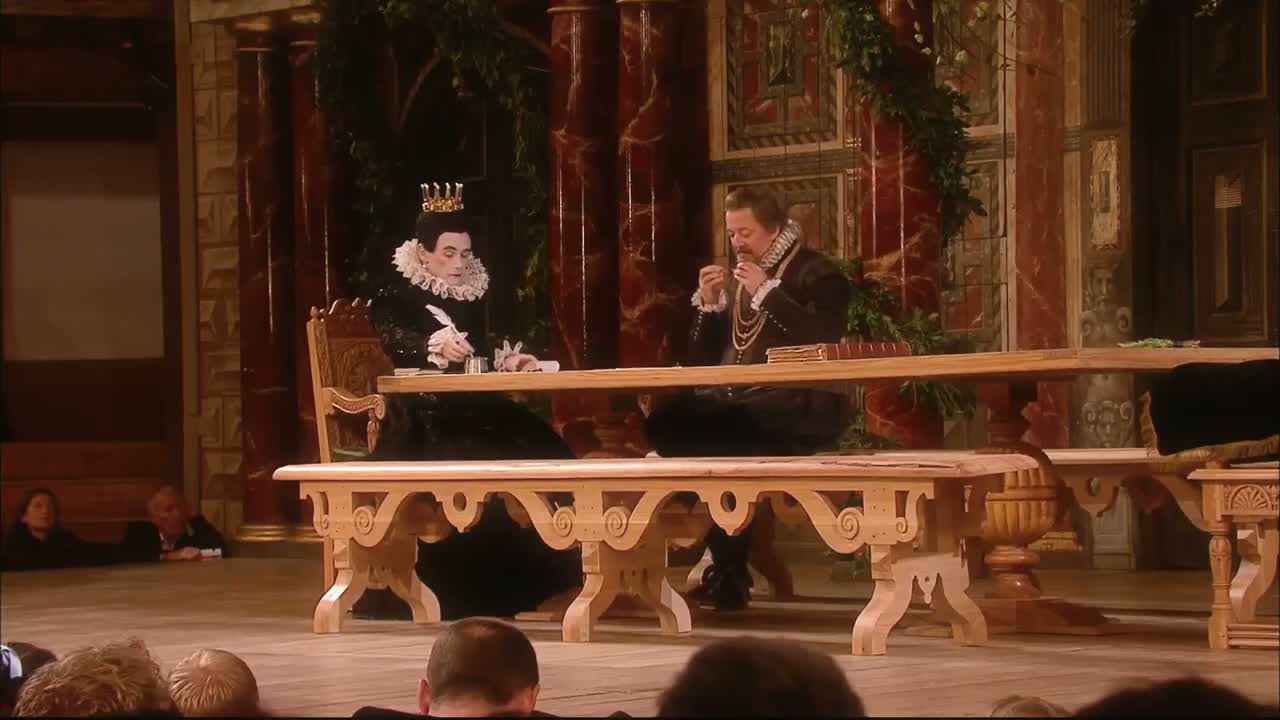
Feste trades insults with his mistress and wins. Called a 'dry fool,' he answers with a Latin tag and a claim: "I wear not motley in my brain." Then he proves Olivia the real fool for mourning a brother whose soul is already in heaven. "The more fool, madonna..."
❝ Monologue · 13 lines The fool's syllogism
He builds a mock-syllogism so tidy it seems to prove the lady herself the fool.
Feste Proves Olivia Is the Fool
Malvolio Sneers, Olivia Defends the Fool
At Olivia's house, the fool Feste arrives to entertain her but is dismissed as 'a dry fool.' He protests that a fool's coat does not mean a foolish brain, and offers to prove that Olivia herself is the fool. Asked why she mourns, she says for her brother's death; Feste answers that she is the more foolish for grieving a soul already in heaven.
The scene is a contest, and the fool wins it by refusing to be the fool. Olivia opens with an insult — 'you're a dry fool' — and Feste answers by separating costume from mind: 'I wear not motley in my brain.' His proof is a piece of verbal jujitsu: if her brother's soul is in heaven, then mourning him is the real folly, and the fool is the one doing the grieving. Olivia, to her credit, enjoys being beaten. The second half turns the same razor on Malvolio, who sneers at Feste as a 'barren rascal' and is told he is 'sick of self-love, and taste with a distempered appetite.' The wit isn't decoration; it is how the low character gets to speak truth to the high ones, and the play says so outright: 'There is no slander in an allowed fool.'
A1–C2 is the CEFR scale. Cards above the level you pick fade, and playback will not auto-pause on them.
“Infirmity, that decays the wise, doth ever make a better fool.”
He frames decay as a craft: weakness wears down the wise and only improves the fool.
literary
“The more fool, madonna, to mourn for your brother's soul being in heaven.”
He turns a comforting premise into a paradox: mourning a soul in heaven is the greater folly.
literary
“There is no slander in an allowed fool,”
It grants the licensed fool a freedom of speech no one else dares claim.
literary
“Good, madonna, give me leave to prove you a fool.”
A courteous request before the insult: the fool's timing is the whole joke.
Informal
“I know his soul is in heaven, fool.”
Certainty aimed at grief: comfort and a jab separated by one word.
Informal
To faults, madonna, that drink and good counsel will a amend. For give the dry fool drink, then is the fool not dry. And bid the dishonest man mend himself. If he mend, he is no longer dishonest. If he cannot, let the botcher mend him. Anything that's mended is but patched. Virtue that transgresses is but patched with sin. And sin that amends is but patched with virtue. If that this simple syllogism will serve, so. If it will not, what remedy? As there is no true cuckold but calamity, so beauty is a flower. And the lady bade take away the fool. Therefore, I say again, take her away.
Up next · 05fortified against any denialThe scene: Cesario Arrives to Woo OliviaHe asks why she mourns; she says for her brother's death. He replies that if the brother's soul is in heaven, mourning him is the real folly — 'the more fool' is the one who grieves.
Dry can mean dull or, literally, lacking drink. She is dismissing his wit as flat, and he turns the word into a joke about giving the fool a drink.
Motley is a fool's patchwork costume. Feste says that wearing the outfit does not make his mind foolish — he is only dressed as a fool.
Malvolio calls Feste a 'barren rascal' and says a duller fool once out-talked him. Olivia answers that Malvolio is 'sick of self-love' and takes no pleasure in anything not his own.
He thinks Feste is a worthless scold who only shines when others laugh and feed him lines. Without an audience, he says, the fool is 'gagged.'