
“If ever thou shalt love, in the sweet pangs of it, remember me.”
Why it's great
It defines love as sweet pain, so the speaker sounds both experienced and still aching.
Register
literary
Use it yourself
If ever you succeed, remember me.
Chapter 10 of 25 · 3'35"
Orsino tries to describe what love does to a person — "unstaid and skittish in all motions else" — and then decides his young servant must be in love too. His theory hardens into a sad maxim: "For women are as roses whose fair flower being once displayed, doth fall that very hour." Then he calls for an old song.
❝ Monologue · 4 lines Orsino's Speech About True Lovers
❝ Monologue · 5 lines The duke's rose speech
His advice about age dissolves into the rose image, tender and fatal at once.
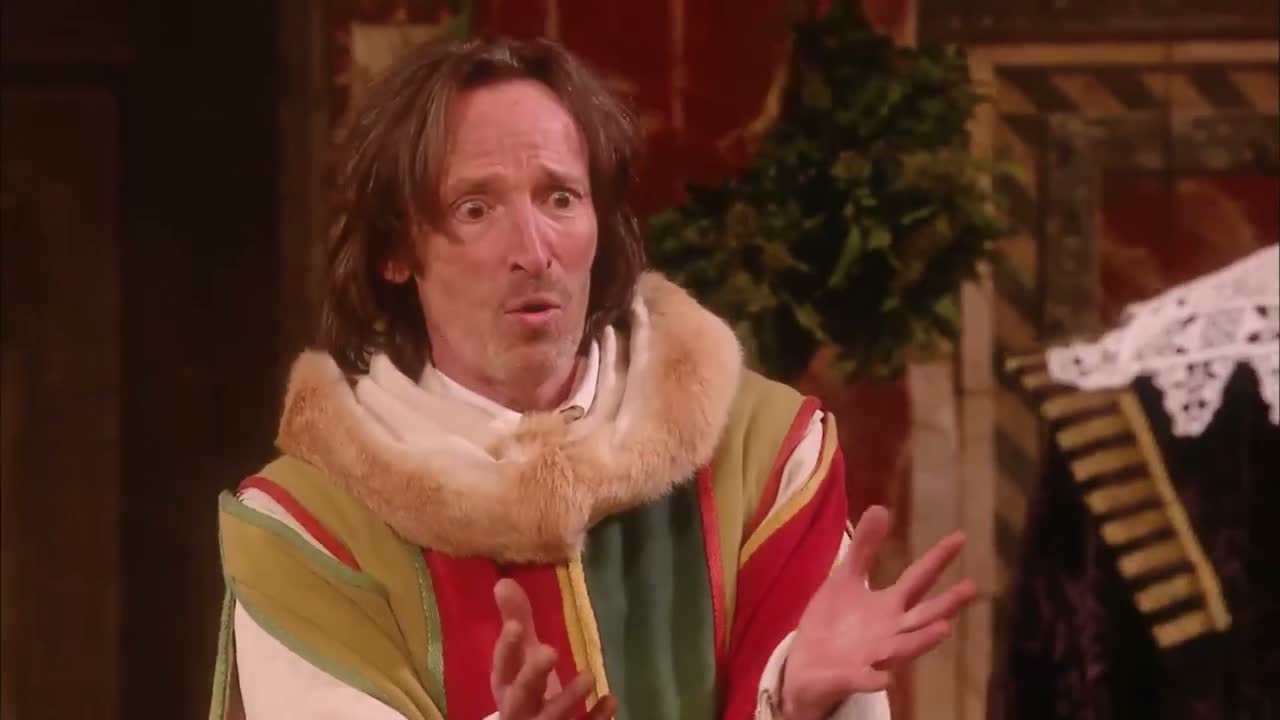
Duke Orsino calls Cesario close and talks about love: true lovers are restless and changeable except in the fixed image of the beloved. He guesses that Cesario's eye has already rested on someone, and when the servant admits a little, Orsino argues women are like roses that fall the hour they bloom. He then asks for an old, plain song.
The scene reveals Orsino's idea of love more than it advances the plot. He speaks of lovers as unstable creatures fixed only on one image — 'unstaid and skittish in all motions else' — which is a fair description of himself. Then he turns the talk into an argument about age and sex: women fade like roses, so a wife should marry an older man. It is beautiful and a little self-serving, and Viola, who is secretly in love with him, can only agree and tease. When the song comes, its refrain — 'I am slain by a fair cruel maid' — says exactly what the disguised Viola cannot: that love can wound and even kill the one who feels it. The poetry covers an ache the character dares not speak aloud.
A1–C2 is the CEFR scale. Cards above the level you pick fade, and playback will not auto-pause on them.
“If ever thou shalt love, in the sweet pangs of it, remember me.”
It defines love as sweet pain, so the speaker sounds both experienced and still aching.
literary
“For women are as roses whose fair flower being once displayed, doth fall that very hour.”
The rose image makes beauty and loss happen in the same instant, so the praise carries a warning.
literary
“I am slain by a fair cruel maid.”
The death-wound metaphor turns heartbreak into a ballad image, fatal and a little theatrical.
literary
“Or such as I am, all true lovers are...”
Or such as I am turns one person's state into a rule: lovers' confident, fragile logic.
literary
“Oh, she is not worth thee then.”
Worth turns courtship into scales: a light, worldly dismissal.
literary
If ever thou shalt love, in the sweet pangs of it, remember me. Or such as I am, all true lovers are... unstaid and skittish in all motions else save in the constant image of the creature that is beloved. How dost thou like this tune?
Then let my love be younger than thyself, or thy affection cannot hold the bent. For women are as roses whose fair flower being once displayed, doth fall that very hour. And so they are. Alas, that they are so... to die even when they to perfection grow.
 Up next · 11prove much in our vowsThe scene: Viola Argues Women Love as Deeply
He treats Cesario as a confidant and enjoys discussing love. At the same time he suspects the young servant is in love, so he turns the talk into gentle probing.
He argues that women are like roses, blooming and fading quickly, so a woman should marry an older man and a man should choose a younger wife. It is his own theory, not the play's truth.
It means the bittersweet ache of love, the pleasure and pain mixed together. Orsino uses it to describe the feeling of falling in love.
An old, plain song that the spinning maids used to sing. It is the mournful 'Come away, death,' which Feste performs and which fits Orsino's lovesick mood.
Its refrain, 'I am slain by a fair cruel maid,' expresses the hidden love and pain Viola cannot say aloud while disguised as a boy.