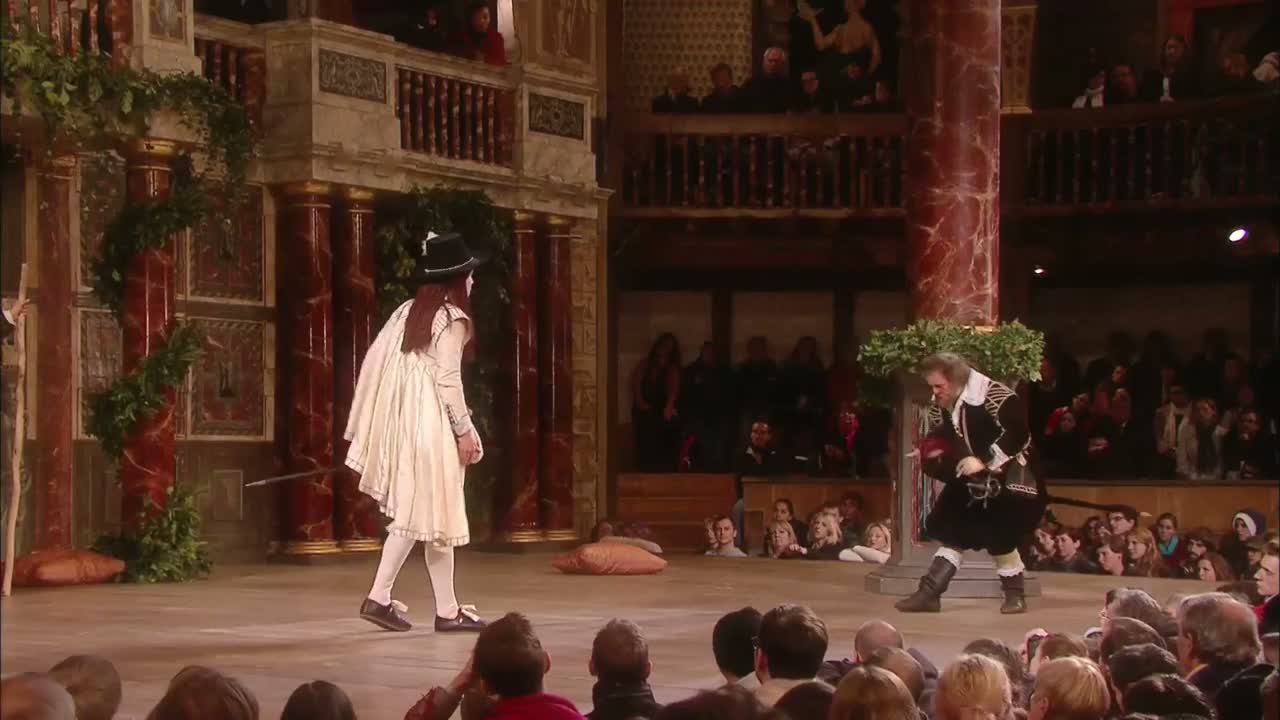
“If this were played upon a stage now, I could condemn it as an improbable fiction.”
He judges the real mess by the standard of theatre and finds it too far-fetched to stage.
literary
Chapter 18 of 25 · 3'30"
Malvolio storms off, and the plotters decide to lock him in a dark room. Then they read Sir Andrew's challenge letter aloud, relishing every clumsy insult. Fabian sums up the absurdity: "If this were played upon a stage now, I could condemn it as an improbable fiction."
❝ Monologue · 4 lines Fabian Calls It an Improbable Fiction
Sir Andrew's Challenge, Read Aloud
Malvolio leaves in a fury, calling the others idle and shallow, and Sir Toby's group plans to lock him in a dark room as punishment. The mood turns to the duel plot: they read out Sir Andrew's challenge to Cesario, mocking its clumsy threats. Fabian decides not to deliver it, saying the letter would not frighten anyone.
The scene runs on the gap between what the plotters plan and how little their victims understand. Malvolio exits with real dignity and real anger, and the others immediately decide to 'have him in a dark room and bound' — treating a man's mind as a toy. Then the comedy shifts to Sir Andrew's challenge, a letter so badly written that Fabian calls it 'excellently ignorant.' Fabian points out the practical joke behind it: since the letter is absurd, it will only reveal the sender as 'a clodpole.' His best line is about the whole affair — 'If this were played upon a stage now, I could condemn it as an improbable fiction' — the play winking at its own artificiality. He then chooses to inflame the duel by word of mouth instead, keeping the chaos alive.
A1–C2 is the CEFR scale. Cards above the level you pick fade, and playback will not auto-pause on them.
“If this were played upon a stage now, I could condemn it as an improbable fiction.”
He judges the real mess by the standard of theatre and finds it too far-fetched to stage.
literary
“I warrant there's vinegar and pepper in't.”
Vinegar and pepper turn a sour, stinging letter into kitchen ingredients you can almost taste.
Informal
“My friend, as thou usest him, and thy sworn enemy, Andrew Aguecheek.”
The signature calls himself both friend and sworn enemy in one breath, which is why the threat reads as comedy.
literary
“You are idle shallow things.”
Two adjectives and no cushioning: contempt delivered straight.
literary
“You shall know more hereafter.”
Hereafter dangles the answer: authority and suspense left hanging in one line.
Formal
Go hang yourselves, all. You are idle shallow things. I am not of your element. You shall know more hereafter.
Up next · 19a pox on'tThe scene: Toby Scares Andrew About the DuelAs part of the prank. Since Olivia already thinks he is mad, Sir Toby suggests putting him 'in a dark room and bound' and treating his madness as entertainment.
Sir Andrew, prompted by Sir Toby, writes it to challenge Cesario to a duel. It is so clumsy that the others read it aloud for laughs.
He sees that Cesario is too sensible to be frightened by such a stupid letter; it would only reveal the sender as a fool. So he plans to provoke the duel by word of mouth instead.
Something too far-fetched to believe. Fabian uses the phrase to joke that the whole scheme looks like a badly written play.
It threatens to waylay Cesario on the way home and kill him 'like a rogue and a villain,' while staying on 'the windy side of the law.'