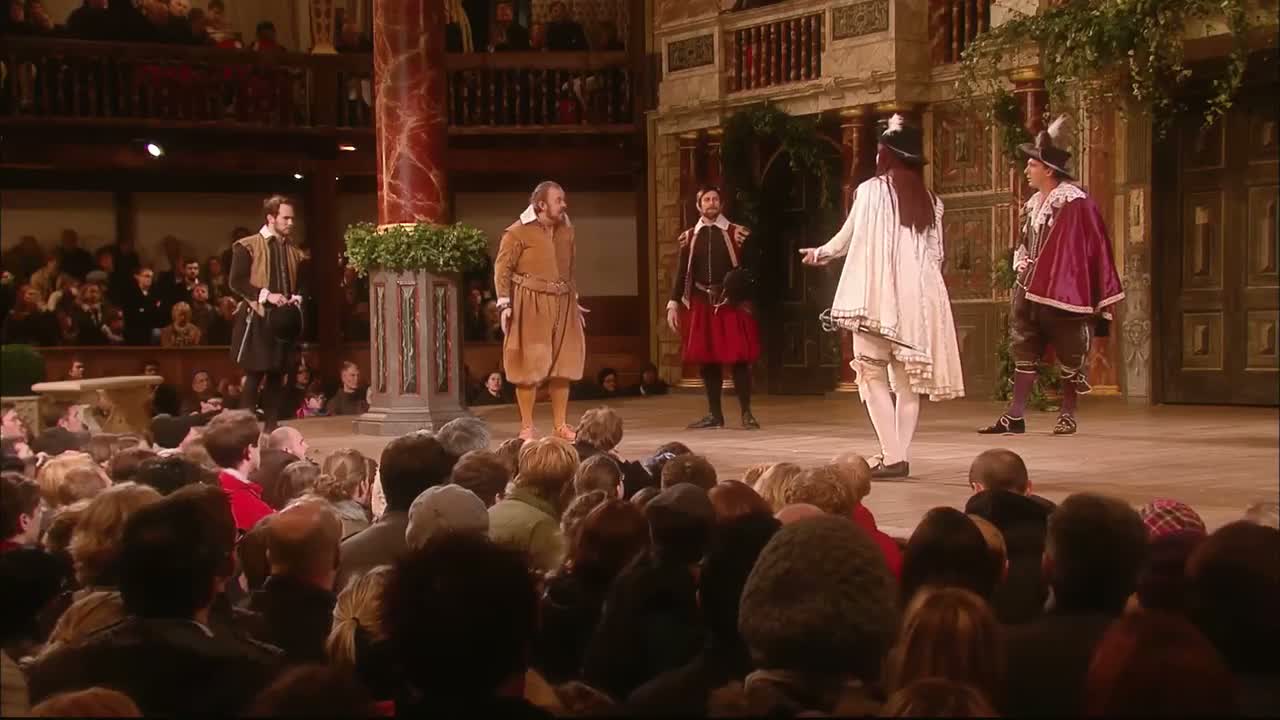
“And though 'tis wonder that enwraps me thus, yet 'tis not madness.”
He names the exact line between marvel and madness, and insists his joy is real.
literary
Chapter 22 of 25 · 3'33"
Sebastian wakes from a string of impossible events and decides he is not mad: "And though 'tis wonder that enwraps me thus, yet 'tis not madness." Olivia arrives and asks him to marry her in secret. Then the clown Feste turns up to tease and beg, arguing that friends flatter you while enemies tell the truth.
Sebastian Wonders If He Is Mad
❝ Monologue · 5 lines Feste Teases Sebastian for Money
Sebastian, dazed by his run of luck, insists he is not mad and wishes Antonio were there to advise him. Olivia arrives, asks him to promise his love before a priest, and arranges a secret marriage, which he accepts. The clown Feste then appears, joking that he does better with enemies than friends, and coaxes a second coin out of him.
Sebastian's speech is the mirror image of Viola's: a twin who cannot trust his senses yet refuses to call the truth madness. He looks for Antonio's advice, watches Olivia act with perfect command of her household, and decides 'there's something in't that is deceivable.' Olivia, meanwhile, reads his dazed agreement as the consent she has been begging for, and rushes him toward a secret wedding. The scene's comedy then arrives in Feste, who argues with perfect logic that he is 'the better for my foes and the worse for my friends' — flattery makes him a fool, honesty teaches him. Asked to put his conscience aside and hand over a second coin, he has the last joke: the man who would not be 'a double dealer' takes the money anyway.
A1–C2 is the CEFR scale. Cards above the level you pick fade, and playback will not auto-pause on them.
“And though 'tis wonder that enwraps me thus, yet 'tis not madness.”
He names the exact line between marvel and madness, and insists his joy is real.
literary
“Truly, sir, the better for my foes and the worse for my friends.”
A paradox that turns flattery into damage and praise into a weapon.
Neutral
“Put your grace in your pocket, sir, for this once.”
A witty way to tell someone to set aside his scruples just this once.
Informal
“This pearl she gave me, I do feel it and see it.”
Touch and sight offered as proof: the harder he argues, the more the mix-up aches.
literary
“This is to give a dog and in recompense desire my dog again.”
Giving a dog and asking it back: an absurd image that nails a hollow favor.
Informal
They praise me and make an ass of me. Now, my foes tell me plainly I am an ass. So that by my foes, sir, I profit in the knowledge of myself. And by my friends, I am abused. So that conclusions to be as kisses... if your four negatives make your two affirmatives, why then,
Up next · 23ripe in mischiefThe scene: Olivia Mistakes Sebastian for CesarioShe thinks she is speaking to Cesario, but it is Sebastian, Viola's twin. He is bewildered but accepts, and they agree to marry secretly before a priest.
Because the events are unbelievable yet real: the pearl is in his hand, and Olivia behaves with calm authority. He calls it wonder, not madness.
It means to make a fool of someone. Feste says his friends praise him and thereby 'make an ass of me,' while his enemies tell him the truth.
He pretends his frankness makes him the worse for friends, then asks Sebastian to set aside his conscience 'for this once' and give a second coin — which he does.
He says enemies tell him plainly that he is an ass, which helps him know himself, while friends only flatter him into foolishness.