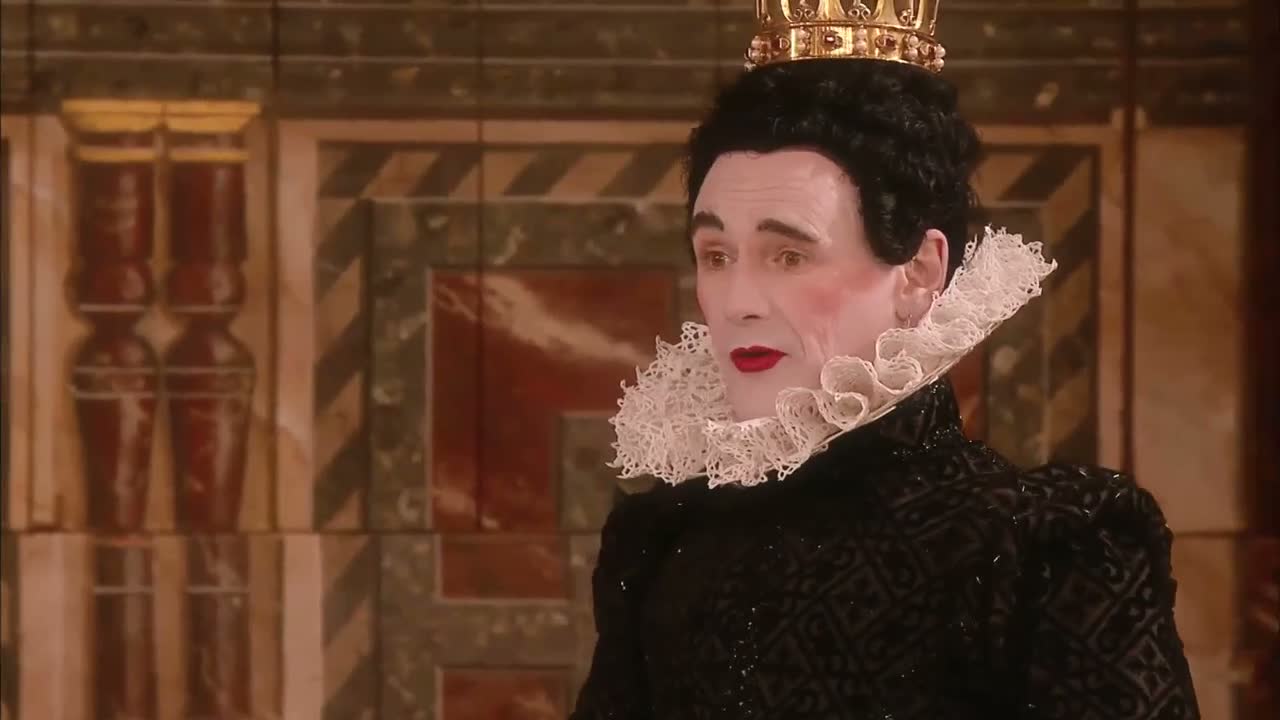
“And yet, by the very fangs of malice, I swear I am not that I play.”
She swears by malice's fangs that she is not the role she plays, splitting actor from part.
literary
Chapter 5 of 25 · 3'30"
A young man will not leave Olivia's gate, so she finally lets him in. It is Cesario, sent by Orsino with a polished speech. But the messenger keeps stumbling over his own lines: "I would be loath to cast away my speech," he says, and admits he is not the person he is playing.
The Messenger Who Won't Take No
❝ Monologue · 4 lines Cesario Stumbles Over His Speech
At Olivia's house, her people report that a young man at the gate refuses every excuse and insists on speaking with her. Olivia lets him in. It is Cesario — Viola in disguise — bringing Duke Orsino's elaborate love speech. Nervous and out of his depth, Cesario fusses over the words and jokes that the question asked is outside the part he prepared.
This is a comedy of a messenger who cannot keep up his own act. Olivia is in mourning and has sworn off men; she agrees to see the caller only to end the pestering. In comes Cesario, carrying Orsino's overblown praise — "Most radiant, exquisite, and unmatchable beauty" — and immediately starts to wobble. The joke is that he keeps saying he is not what he seems, and he is right: "by the very fangs of malice, I swear I am not that I play." Every audience in the theatre knows Viola is a woman playing a boy, which turns a tired flirtation speech into a joke about acting itself. Olivia, meanwhile, is drawn to the strange messenger and asks him to stay. The scene is doing two things at once: mocking the flowery language of courtship and starting the attraction that will drive the plot.
A1–C2 is the CEFR scale. Cards above the level you pick fade, and playback will not auto-pause on them.
“And yet, by the very fangs of malice, I swear I am not that I play.”
She swears by malice's fangs that she is not the role she plays, splitting actor from part.
literary
“For what is yours to bestow is not yours to reserve.”
It separates what you may give from what you may keep, turning a rebuke into a maxim.
literary
“as a squash is before 'tis a peascod or a coddling when 'tis almost an apple.”
He stacks half-ripe fruit into a picture of the awkward age between boy and man.
literary
“Tell him he shall not speak with me.”
Shall not turns refusal into a decree: the noble's cold dismissal in one line.
Formal
“I would be loath to cast away my speech.”
A reluctance to waste a memorized speech: the boy's fussy pride in one line.
literary
Most radiant, exquisite, and unmatchable beauty... I pray you tell me if this be the lady of the house, for I never saw her. I would be loath to cast away my speech. For besides that it is excellently well-penned, I have taken great pains to con it.
Up next · 06the dead of nightThe scene: Olivia Refuses the Duke's SuitA young stranger keeps asking to see Olivia. The servant says he is 'fortified against any denial,' turning away every excuse, so Olivia finally allows him in.
It is Cesario, who is really Viola in disguise. She has come from Duke Orsino to deliver his love speech to Olivia.
It means he is ready for every refusal and will not be turned away. It comes from fortifying a place for defense: he is armored against the word 'no.'
He is a disguised servant delivering a long, carefully written speech and does not want to embarrass himself. He frets that he must not 'cast away' his speech.
At first she only agrees to end the pestering, veiled and formal. But she is curious and drawn to the strange messenger, which begins the attraction at the heart of the play.