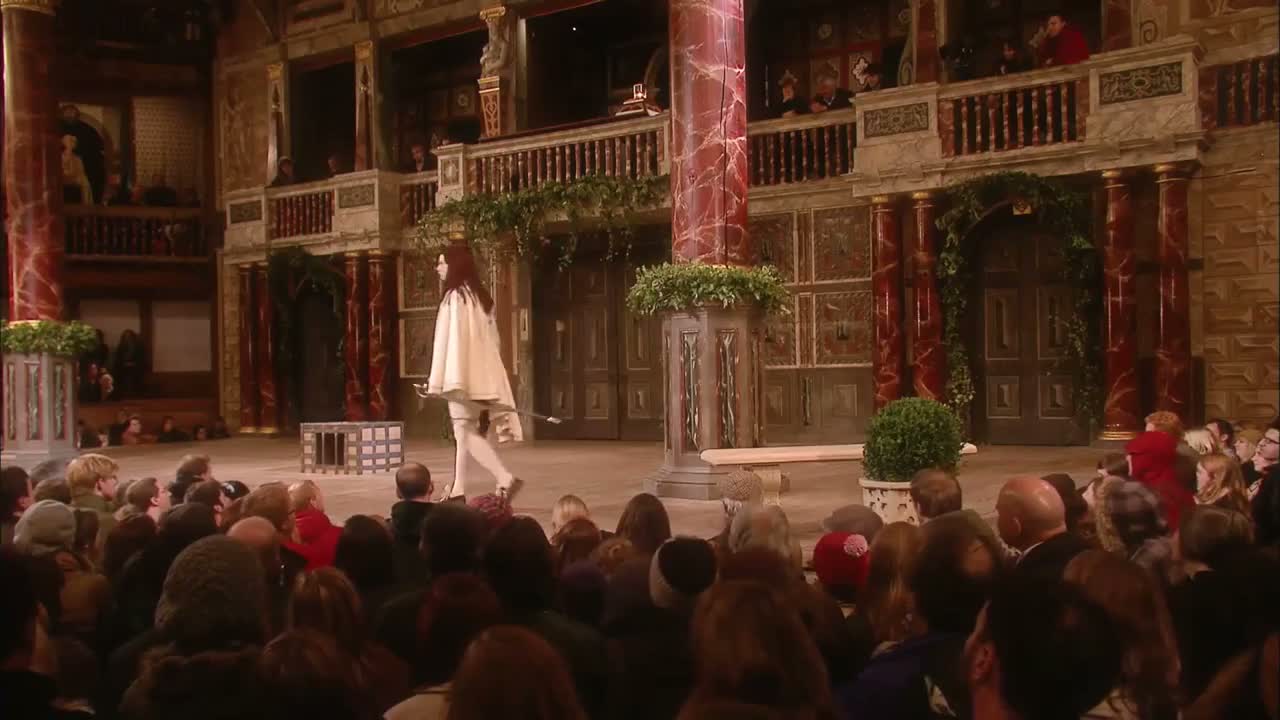
“I say there is no darkness but ignorance in which thou art more puzzled than the Egyptians in their fog.”
Darkness stops being a room and becomes a state of mind, so the insult doubles as philosophy.
literary
Chapter 21 of 25 · 3'38"
Disguised as Sir Topas the curate, Feste visits the locked-up Malvolio and argues that the room is not dark at all. Malvolio insists, "I am no more mad than you are," but his tormentor has an answer for everything: "there is no darkness but ignorance." The scene is a cruel joke dressed as a theological debate.
❝ Monologue · 4 lines Sir Topas passes sentence
It fakes a church sentence from a joke, solemn enough to be absurd.
Sir Toby Wants the Trick Over
Feste puts on a beard and gown and impersonates Sir Topas, a curate, to visit Malvolio in his dark cell. Malvolio protests that he is sane and that the room is pitch-dark, but Feste insists the windows are bright and that 'there is no darkness but ignorance.' Sir Toby, watching, admits he would be happy to be rid of the trick. Feste finally tells Malvolio to stay in darkness.
The scene turns a cruel prank into a parody of religious instruction. Feste, the licensed jester, dresses as a priest and uses theological language to torture a man who is already being punished for vanity. Malvolio's plea — 'I am not mad, Sir Topas' — is true, and that is what makes the scene uncomfortable: everyone knows he is sane, and the joke is to make him doubt it. Feste's line 'there is no darkness but ignorance' sounds profound but is nonsense in context, a deliberate mockery of learned-sounding talk. When Sir Toby says 'I would we were well rid of this knavery,' the play quietly signals that the fun has gone too far. The gulling that began as punishment for Malvolio's pride is becoming cruelty, and the audience is invited to notice it.
A1–C2 is the CEFR scale. Cards above the level you pick fade, and playback will not auto-pause on them.
“I say there is no darkness but ignorance in which thou art more puzzled than the Egyptians in their fog.”
Darkness stops being a room and becomes a state of mind, so the insult doubles as philosophy.
literary
“I am no more mad than you are.”
He refuses the label by handing the accuser's own yardstick straight back.
Neutral
“I would we were well rid of this knavery.”
A plain wish to be done with the prank, phrased so naturally it still works today.
literary
“I'm not tall enough to become the function well, nor lean enough to be thought a good student.”
Two not-enoughs mock the body and the role: self-deprecation with a wink.
Informal
“And I say this house is as dark as ignorant, though ignorance were as dark as hell.”
Darkness knotted to ignorance and escalated: sophistry that both mocks and scolds.
literary
Remain thou still in darkness. Thou shalt hold the opinion of Pythagoras ere I will allow of thy wits and fear to kill a woodcock lest thou dispossess the soul of thy grandam.
Up next · 22make an ass of meThe scene: Olivia Proposes to the Wrong TwinFeste and the others are continuing the trick on Malvolio. Dressing as a curate lets Feste 'visit' the prisoner and torment him under a disguise he cannot see through.
He is sane, and he knows the room is dark and that he has been wronged. He tries to prove his sanity by answering questions, such as the one about Pythagoras.
It claims that the only real darkness is ignorance, not lack of light. It sounds wise but is nonsense in this situation, used to confuse Malvolio.
He says he would be well rid of it, meaning he wants it over. He even suggests letting Malvolio go, because his own quarrel with Olivia makes it unsafe to continue.
He offers to be tested with a serious question. Feste asks about Pythagoras and whether souls can pass into birds, and Malvolio gives a sensible answer.