“Looks as if we have a pretty unpleasant thing on our hands in a few hours, doesn't it?”
He calls an execution an unpleasant thing, and the understatement is the horror.
Neutral
Chapter 14 of 17 · 2'19"
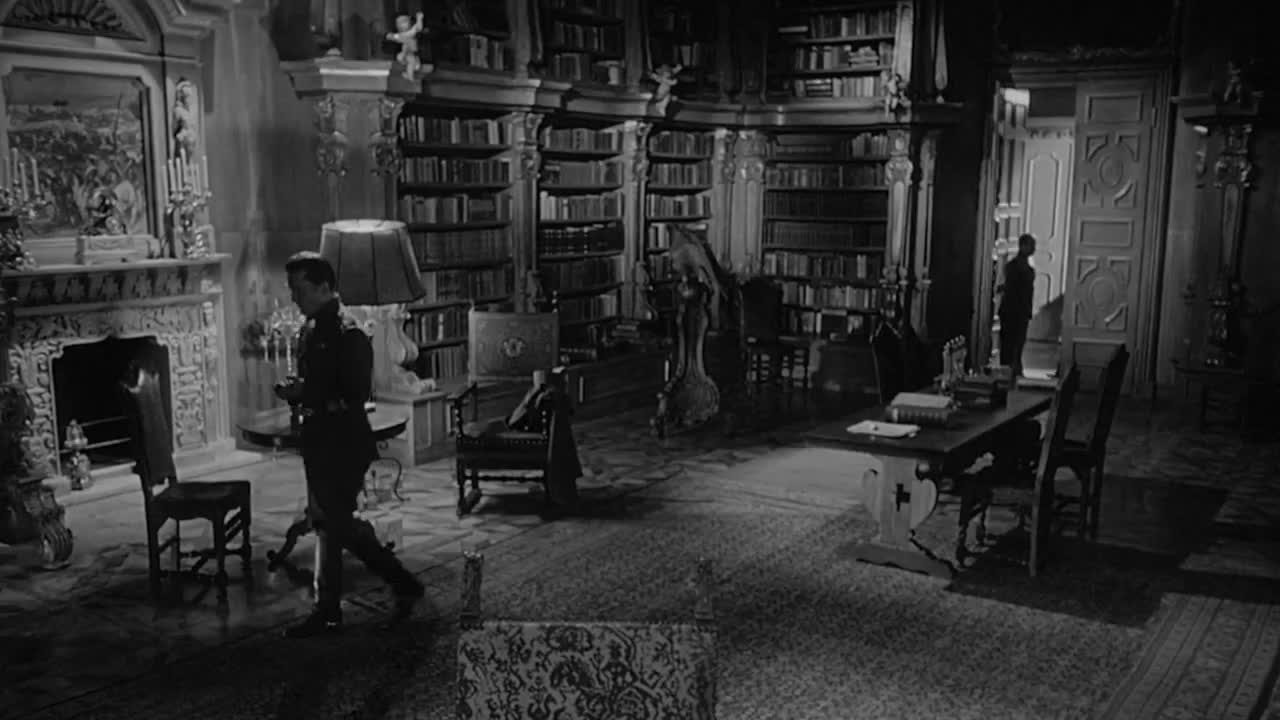
Dax orders Lieutenant Roget, the officer who chose Paris for the trial, to command the firing squad that will shoot him. Roget tries to refuse, citing his inexperience, but Dax denies the request and calmly walks him through the execution, treating it as nothing difficult. Then an artillery captain arrives with information about the court-martial.
❝ Monologue · 8 lines Dax Assigns Roget the Firing Squad
Roget Begs Off, Then a Captain Arrives
Hours before the execution, Dax summons Lieutenant Roget and assigns him to command the firing squad, since Roget is the one who picked Paris to die. Roget asked to be excused from the duty; Dax denies the request and explains the procedure step by step, ending with a bullet through each man's head. Then Captain Rousseau arrives with news about the court-martial.
The scene is revenge delivered as routine. Dax knows exactly why he chose Roget, and so does Roget, though neither says it plainly: 'You picked him because he was a coward, didn't you?' is the question Dax uses to make the appointment stick. The cruelty is in the calm voice — the execution is described like a checklist, from tying the men to the posts to the final shot, and capped with 'Oh, there's nothing to it.' Dax is not being sadistic for its own sake; he is forcing the man who selected a scapegoat to face the consequence. But the punishment also implicates Dax, who is carrying out the same unjust sentence he is trying to overturn, and Roget's pale, stammering refusal is the only protest left in the room.
A1–C2 is the CEFR scale. Cards above the level you pick fade, and playback will not auto-pause on them.
“Looks as if we have a pretty unpleasant thing on our hands in a few hours, doesn't it?”
He calls an execution an unpleasant thing, and the understatement is the horror.
Neutral
“How'd you happen to pick Corporal Paris?”
A casual 'how'd you happen to' hides a trap: he wants Roget to expose himself.
Informal
“You picked him because he was a coward, didn't you?”
The tag question hands Roget the answer and waits for him to sign it.
Informal
“I have to pick someone to be in charge of the firing squad tomorrow.”
He frames the execution as a staffing problem, quietly moving the guilt off himself.
Neutral
“Oh, there's nothing to it.”
Right after describing a killing, he shrugs that it is easy; the calm is the cruelty.
Informal
“I have something to tell you, sir, that may have a great bearing on the court-martial.”
A formal opener that quietly promises to change the whole trial.
Formal
Oh, there's nothing to it. First, you help the sergeant tie the men to the posts. Of course , you offer the men blindfolds. And, we ll, if they want them, you tie them on, see ? Now, you — you take your position with the firing squad... you raise your sword — "Ready, aim, fire." Then you draw your revolver out, you walk forward... and put a bullet through each man's head.
Up next · 15a perfect tonicThe scene: Dax Bargains for the Condemned MenBecause Roget is the one who picked Paris for the trial. Dax makes him carry out the execution of the man he selected, so he cannot avoid what he set in motion.
He has never commanded a firing squad and is clearly shaken. He asks to be excused from the duty, but Dax denies the request.
As a simple procedure: tie the men to the posts, offer blindfolds, give the order to fire, then walk forward with a revolver. He sums it up as nothing difficult.
He is an artillery captain who says he has information that may have a great bearing on the court-martial. He is the witness who can expose the order to fire on French troops.
Yes. He is cold and firm throughout, refusing the request and dismissing Roget. It reads as punishment for choosing a scapegoat.