
“But if he wants to be a soldier, then, by heavens, he's got to be one.”
Why it's great
A plain creed delivered with an oath; it leaves no room for half measures.
Register
Informal
Use it yourself
If you want to be a coach, then be one.
Chapter 2 of 17 · 2'40"
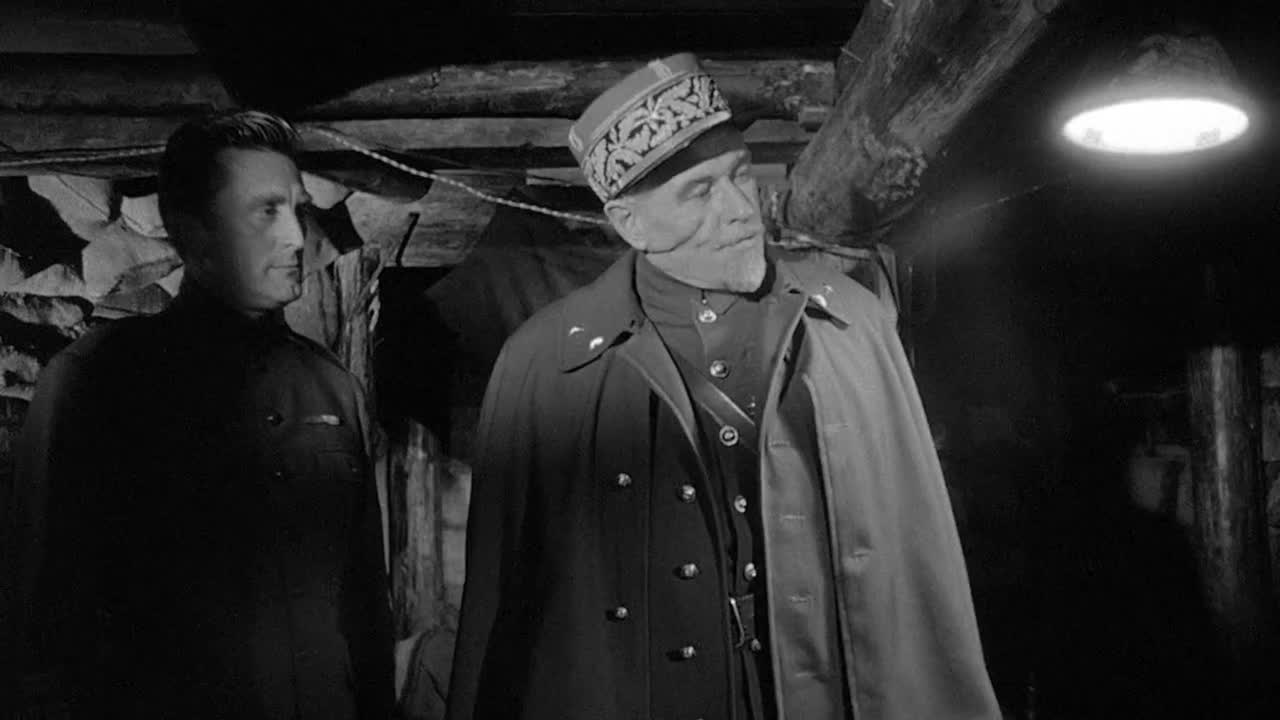
General Broulard tours Colonel Dax's command post and delivers a speech about soldiers who must be where the fighting is, mocking the 'armchair officers' who run the war from a desk. The two examine a position called the Anthill and trade gentle ironies, while the general's confidence sits oddly beside the twenty-nine casualties of last night's relief.
❝ Monologue · 12 lines Broulard's Speech About Soldiers
The General Eyes the Anthill
General Broulard arrives to inspect Colonel Dax's front-line post. After polite small talk, the general lectures about soldiers who belong where the fighting is and mocks 'armchair officers' who direct the war from a desk. The two then study a position called the Anthill, which the general calls pregnable, and discuss the casualties from the previous night's relief.
The scene is a study in command at a distance. Broulard has come to the front but talks about war as an idea — who deserves to be a soldier, why cowards should 'put on a dress and hide under the bed,' and how men in the rear should stay out of a fight. His slogan is earnest and self-flattering: 'But if he wants to be a soldier, then, by heavens, he's got to be one.' Dax agrees with perfect courtesy, and the agreement is the joke, because Dax is the one who actually holds the line and counts the dead. The Anthill, their next objective, is described as 'pregnable,' a word the general finds funny, and their exchange over it shows how easily the language of attack floats free of the men it costs. The report of twenty-nine casualties barely interrupts the talk.
A1–C2 is the CEFR scale. Cards above the level you pick fade, and playback will not auto-pause on them.
“But if he wants to be a soldier, then, by heavens, he's got to be one.”
A plain creed delivered with an oath; it leaves no room for half measures.
Informal
“He's got to fight, and he can't do that unless he's where the fighting is.”
The unless-clause makes the point airtight: no fighting without being at the front.
Neutral
“I can't understand these armchair officers...”
One compound noun paints the desk officer as useless; the contempt is instant.
Informal
“let him put on a dress and hide under the bed.”
Two absurd actions turn cowardice into a picture no insult could match.
Informal
“The Anthill. About as good a view as you can get without actually being there.”
It sums up the gap between a safe view and the real thing, with menace underneath.
literary
“All swarmed together like a bunch of flies, just waiting for someone to swat 'em.”
The fly image makes blind herd behaviour sound both fatal and contemptible.
Informal
I can't understand these armchair officers... fellows trying to fight a war from behind a desk... waving papers at the enemy... worrying about whether a mouse is going to run up their pants leg. I don't know, General. If I had the choice between mice and Mausers... I think I'd take the mice every time. You'll never make me believe that, Colonel. Seriously though, if a man's a ninny... let him put on a dress and hide under the bed. But if he wants to be a soldier, then, by heavens, he's got to be one. He's got to fight, and he can't do that unless he's where the fighting is. That's my credo.
 Up next · 03the last refuge of a scoundrelThe scene: Mireau Orders Dax to Take the Anthill
He comes to inspect the front before the coming attack, and uses the trip to restate his views about soldiering and to look at the objective, the Anthill.
He means officers who direct the war from a desk far from danger. He criticizes them, though he is himself only a brief visitor to the front.
With polite agreement. He says the general argues so convincingly that he must agree, and notes that he has never failed to live up to his credo.
It is the German position the French are expected to attack. Dax shows it from a distance, calling it the best view available without actually being there.
Twenty-nine men were lost in the relief, yet the general treats the losses as stupidity and talks about the troops like swarming flies, which exposes how little the dead weigh in his thinking.