
“They have skimmed milk in their veins instead of blood.”
Why it's great
One metaphor turns cowardice into thin, bloodless fluid, and it sticks.
Register
Informal
Use it yourself
He has excuses in his veins instead of effort.
Chapter 7 of 17 · 3'51"
The meeting after the failed attack turns into a fight over blame. Mireau wants the whole regiment punished; Dax defends the men as not cowards. Broulard ends the argument with a compromise: "All we want to do is to set an example," settling on three soldiers to be tried and shot.
Dax Disputes Mireau's Cowardice Charge
Dax Offers Himself as the Example
After the attack fails, Broulard and Mireau meet with Colonel Dax to fix responsibility. Mireau calls the troops cowards who never left the trenches; Dax insists they attacked but could make no headway, and that some were pinned down. Broulard rejects mass punishment, then proposes an example: three men, one from each company.
The scene stages the difference between an army's two jobs: winning and covering itself. Mireau needs the failure to be cowardice, because otherwise it is his plan that failed; that is why he calls the men scum and insists the trenches were full of shirkers. Dax answers with facts and then with sarcasm, asking why, if everyone is a coward, they should not shoot the entire regiment. Broulard, who cares only about appearances, cuts the argument short: "All we want to do is to set an example." The number shrinks from a whole regiment to twelve to three, as if justice were a matter of haggling. What is settled is not truth but the story that can be lived with.
A1–C2 is the CEFR scale. Cards above the level you pick fade, and playback will not auto-pause on them.
“They have skimmed milk in their veins instead of blood.”
One metaphor turns cowardice into thin, bloodless fluid, and it sticks.
Informal
“We can't leave it up to the men to decide when an order is possible or not.”
It states the military rule coldly: soldiers do not get to judge an order.
Formal
“We don't want to slaughter the French army. All we want to do is to set an example.”
The denial and the euphemism together show how casually lives are weighed.
Formal
“one man will do as well as a hundred.”
Reducing a life to an interchangeable number is the film's coldest arithmetic.
Formal
“Oh, well, if it's an example you want, then take me.”
Dax accepts their logic and offers himself, turning their euphemism back on them.
Neutral
“We're not talking about the past. We're talking about the present.”
A mirrored sentence cuts the debate down to the present, where the cost is real.
Neutral
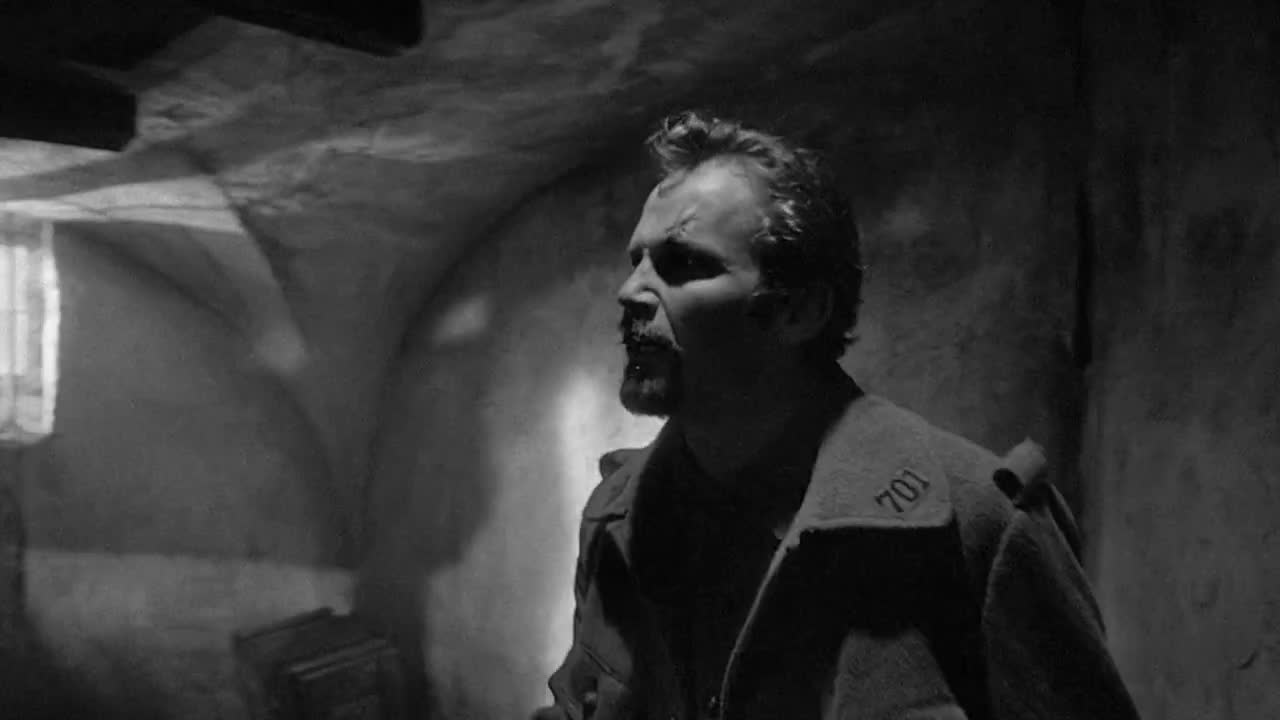 Up next · 08draw lotsThe scene: Dax Prepares the Accused Soldiers
He blames the failure on cowardice, claims half the men never left the trenches, and calls the regiment scum rather than take responsibility for the plan.
That they did attack but could make no headway under heavy fire, that some were pinned down, and that if they were not cowards, staying in the trenches must have been necessary.
He wants an example, not a massacre, and says they should not overdo it. The number is whittled down until one man from each of three companies is chosen.
It means punishing a few soldiers to warn the rest of the army, rather than for the sake of justice. Broulard uses it to justify selecting scapegoats.
To expose the logic of the meeting: if the point is an example and one man serves as well as a hundred, then the officer who ordered the attack is the more logical choice.