
“I mean, you ran like a rabbit after you killed Lejeune.”
Why it's great
The rabbit image brands him a coward in one stroke, with no room to explain.
Register
Informal
Use it yourself
When the alarm rang, he ran like a rabbit.
Chapter 4 of 17 · 2'36"
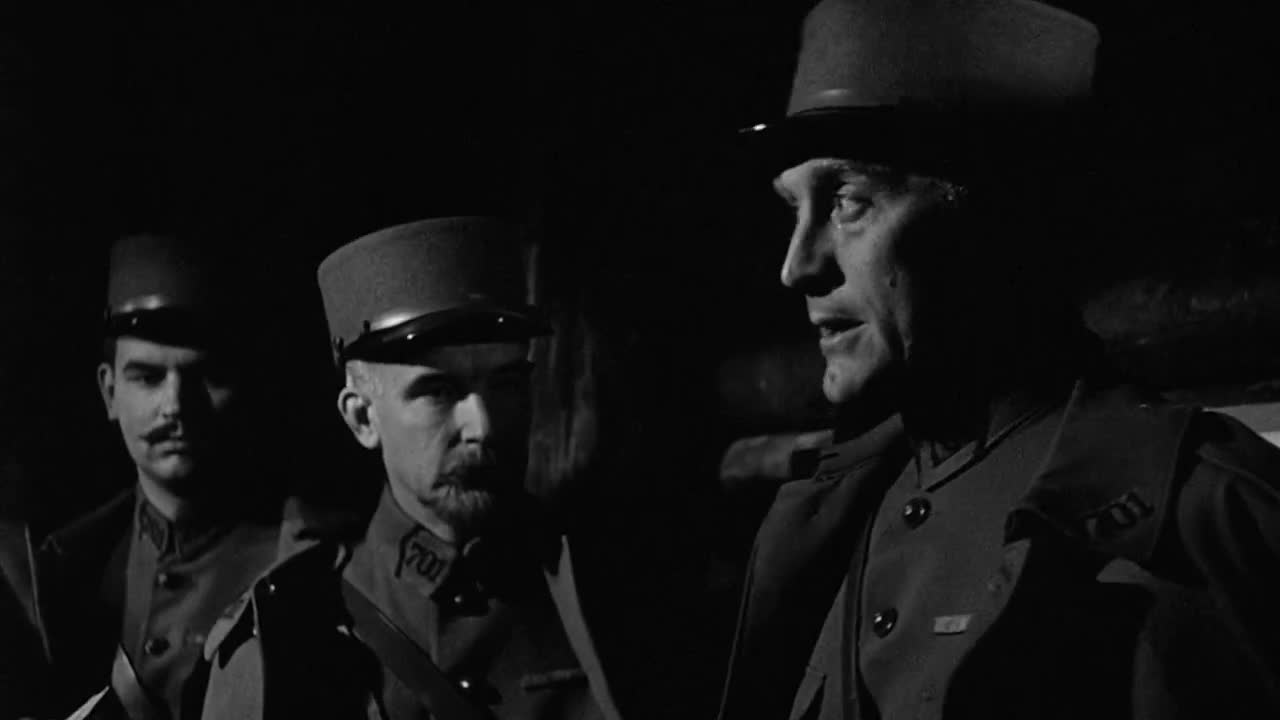
Back from a night patrol, Corporal Paris accuses Lieutenant Roget of killing Lejeune with a grenade and then running away. Roget answers with rank and threats — "You're speaking to an officer" — then quietly offers to rewrite the report so the death looks like an accident of war.
Paris Accuses Roget of Running
❝ Monologue · 10 lines Roget Offers to Rewrite the Report
After a night patrol, Corporal Paris confronts Lieutenant Roget: Roget threw the grenade that killed Lejeune, then fled. Roget threatens Paris with charges, then offers a deal — he will falsify the report so Lejeune's death looks like a patrol accident. Colonel Dax arrives and asks for the report.
The scene is a class war inside an army. Paris has the truth and none of the power; Roget has the rank and knows exactly how the system works. That is why he can say, "It's my word against yours," and mean it as a threat rather than a plea — a corporal's accusation against an officer will not survive paperwork. What makes Roget chilling is the way he moves from bullying to bargaining without a pause: first the list of charges, then the offer to rewrite the report so the killing disappears 'once and for all.' Paris refuses to be managed, insisting a man, not an officer, would not have done it. Then Colonel Dax walks in, and everything unsaid suddenly has to become a document.
A1–C2 is the CEFR scale. Cards above the level you pick fade, and playback will not auto-pause on them.
“I mean, you ran like a rabbit after you killed Lejeune.”
The rabbit image brands him a coward in one stroke, with no room to explain.
Informal
“It's my word against yours, you know.”
A common phrase for a proof-less standoff, and a quiet reminder of who has power.
Informal
“And whose word do you think they're gonna believe?”
The answer hides inside the question, and the question is the threat.
Informal
“Honestly, I know you don't like me, but what kind of a man do you think I am?”
He concedes the dislike, then makes the question itself his defence.
Neutral
“Should feel very proud of yourself. Go get some sleep.”
Praise laid over a cold act makes the irony land like a slap.
Informal
“You're speaking to an officer. Remember that.”
He leans on rank alone; the line is about power, not manners.
Formal
Philippe, have you ever tried to bring charges against an officer? It's my word against yours, you know. And whose word do you think they're gonna believe? Or l-let me put it another way. Whose word do you think they're going to accept? Now, I'll tell you what I'm willing to do. So far, all I have written in this report... is that you and Lejeune were killed while out on patrol. I'll fix this to read that you made your way back... after becoming separated during the skirmish.
 Up next · 05as clear as mudThe scene: The Night Before the Attack
He believes Roget threw the grenade that killed Lejeune on patrol, then ran back to the trench instead of staying or reporting it honestly.
To make the accusation costly. He lists insubordination, threatening an officer, and refusing orders, and points out how they would look in writing.
He offers to change the report so that Lejeune was killed and Paris was separated, which would end the matter and let everyone go on.
It means the truth comes down to two conflicting accounts, with no way to prove which is right. Here it is also a threat, because rank decides who is believed.
He asks for the patrol report. Roget stalls, saying it is not quite finished, and Dax orders him to bring it to his dugout immediately.