
“Corporal Paris, why didn't you leave the trenches?”
Why it's great
A calm question that quietly asks why this man is still alive to stand trial.
Register
Neutral
Use it yourself
Why didn't you call me when you landed?
Chapter 11 of 17 · 5'00"
The trial ends with two speeches. The prosecutor keeps it short — "this case speaks for itself" — and asks the court to find the accused guilty. Dax then protests the court itself, calls the charges "a mockery of all human justice," and begs the judges to show mercy.
Paris Explains Why He Stayed Down
❝ Monologue · 11 lines The prosecutor's charge
The prosecutor stacks flag and honor until a failed attack sounds like national treason.
❝ Monologue · 24 lines Dax Calls the Trial a Disgrace
At the close of the court-martial, the prosecutor argues briefly that the case speaks for itself and asks for a guilty verdict. Colonel Dax, defending, protests that no witnesses, written charges, or stenographic records were allowed, then delivers a closing plea: the trial is the true disgrace, and the court should show mercy.
The scene is built on contrast. The prosecutor needs only a few lines because the verdict is already decided: "this case speaks for itself," he says, as if the outcome had nothing to do with him. Dax answers with a long, disciplined protest, listing everything the court refused — no witnesses, no written charges, no record — and then reverses the prosecution's language: the attack was not the stain, this court-martial is. His plea rises to 'a mockery of all human justice,' and he ends by asking the judges to show mercy, knowing they will not. The tragedy is in the tone: everyone in the room understands that the speeches are not deciding anything.
A1–C2 is the CEFR scale. Cards above the level you pick fade, and playback will not auto-pause on them.
“Corporal Paris, why didn't you leave the trenches?”
A calm question that quietly asks why this man is still alive to stand trial.
Neutral
“No, sir. I guess everybody was too busy to notice me.”
He explains away his lack of witnesses as everyone being busy, and the calm hurts.
Informal
“But this court-martial is such a stain and such a disgrace.”
Dax takes the prosecutor's own word, disgrace, and throws it back at the court.
Formal
“The case made against these men is a mockery of all human justice.”
Dax never argues the facts; he argues the trial itself is a joke on justice.
Formal
“I can't believe that the noblest impulse of man — his compassion for another— can be completely dead here.”
The dash pauses on compassion, then asks whether it has died in this very room.
literary
“Gentlemen of the court, there are times when I'm ashamed...”
Opening on shame instead of anger makes the audience lean in before he accuses anyone.
Formal
Gentlemen of the court, there are times when I'm ashamed... to be a member of the human race... and this is one such occasion. It's impossible for me to summarize the case for the defense... since the court never allowed me a reasonable opportunity to present my case. Are you protesting the authenticity of this court? Yes, sir. I protest against being prevented from introducing evidence... that I consider vital to the defense. The prosecution presented no witnesses. There has never been a written indictment of charges made against the defendants. And lastly, I protest against the fact... that no stenographic records of this trial have been kept. The attack yesterday morning was no stain on the honor of France... and certainly no disgrace to the fighting men of this nation. But this court-martial is such a stain and such a disgrace. The case made against these men is a mockery of all human justice. Gentlemen of the court... to find these men guilty... would be a crime to haunt each of you... till the day you die. I can't believe that the noblest impulse of man — his compassion for another— can be completely dead here. Therefore, I humbly beg you... show mercy to these men.
Gentlemen of the court... this case speaks for itself . All of us witnessed the regrettable attack yesterday morning. And I submit that that attack... was a stain on the flag of France... a blot on the honor... of every man, woman and child in the French nation. It is to us that the sad, distressing... repellant duty falls, gentlemen. I ask this court to find the accused guilty... and impose the penalties prescribed by the Code of Military Justice.
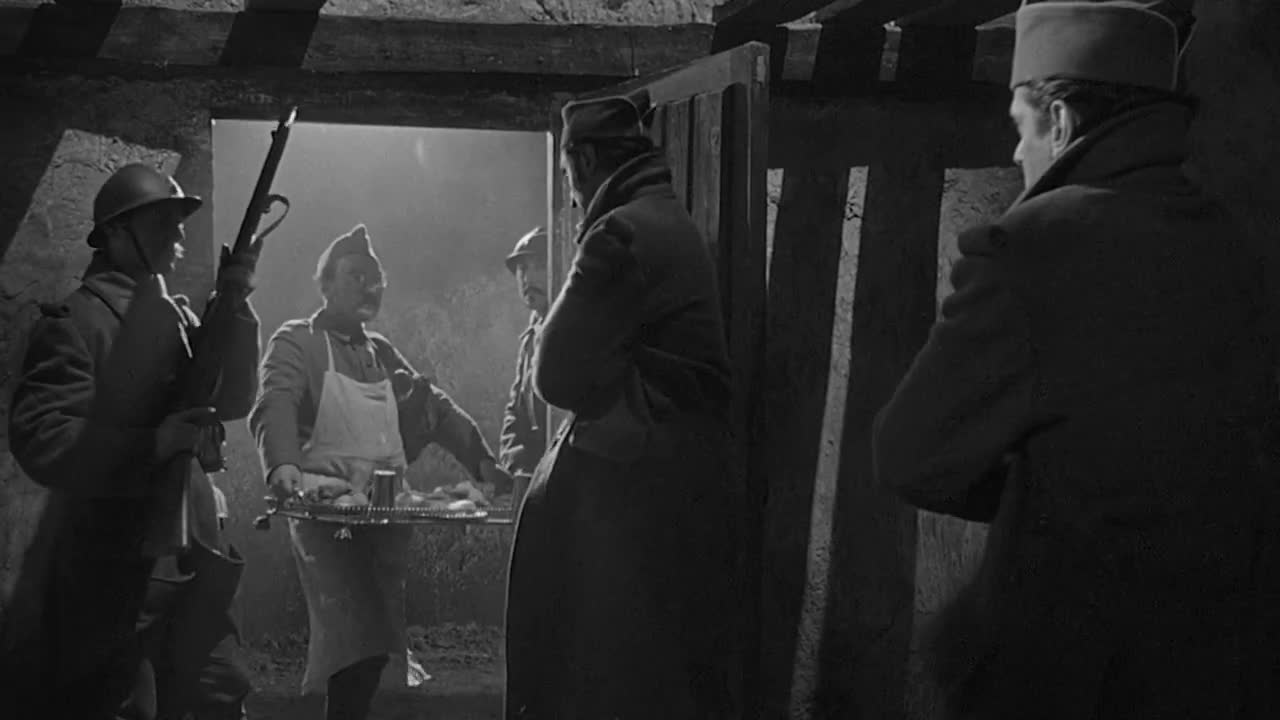 Up next · 12prepare for the worstThe scene: The Condemned Men Eat Their Last Meal
He keeps it very short, says the case speaks for itself, calls the attack a stain on France, and asks the court to find the accused guilty under military law.
That the trial itself is the disgrace, not the soldiers. He protests the lack of witnesses, written charges, and records, and calls the case a mockery of human justice.
Because of the trial he is watching: he cannot believe that compassion for others can be dead in the court, yet the verdict is being decided without real evidence.
It means a travesty or a make-believe version of something. Dax uses it to say the charges are a mockery of all human justice.
He begs the judges to show mercy to the accused, while making clear that the trial has already been decided against them.