
“No, sir. It was our wire.”
Why it's great
Three words quietly demolish the assumption that he reached enemy ground.
Register
Neutral
Use it yourself
No, sir. It was our budget, not theirs.
Chapter 10 of 17 · 2'54"
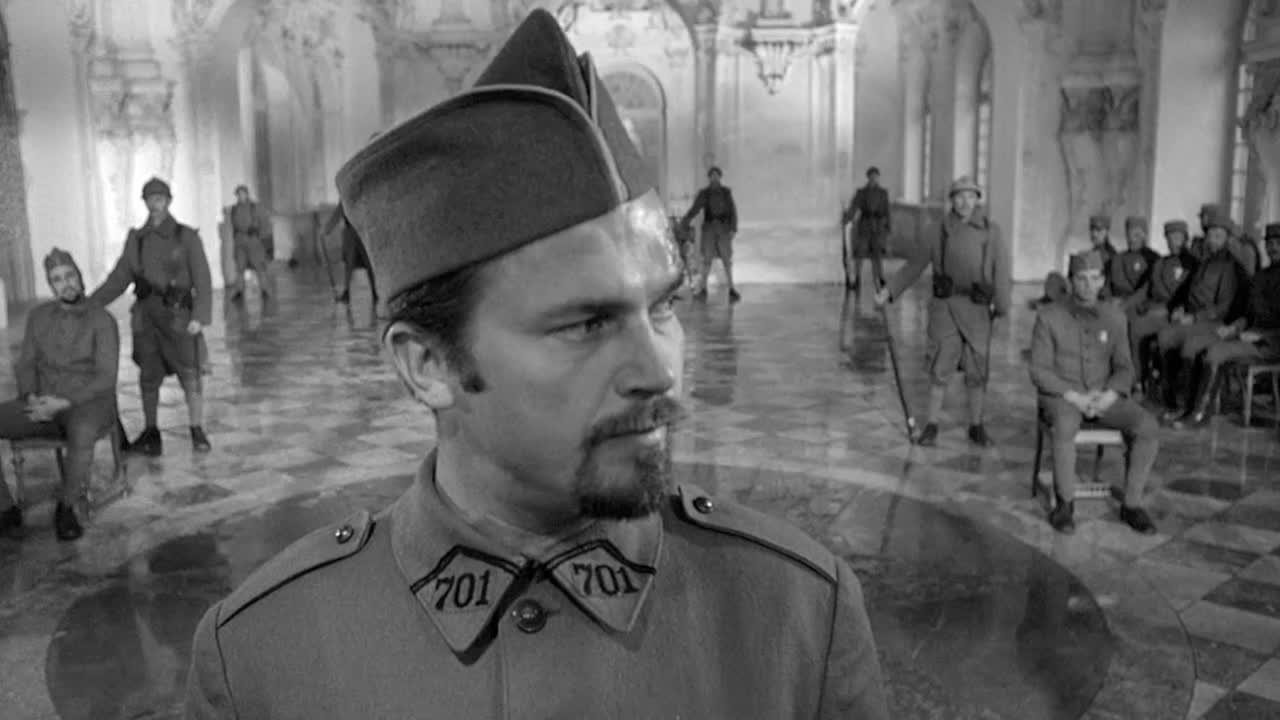
On the stand, Private Arnaud admits he never got past his own wire, and the prosecutor's incredulous question — 'You mean to tell me...' — becomes the trial's cruelest moment. The court rules his past bravery immaterial, and the prosecutor argues that choosing him by lot was fair. Dax can only point out that no one, himself included, reached the German wire.
Arnaud Says He Never Crossed the Wire
The Court Rules Bravery Immaterial
Arnaud takes the stand and is asked how far he advanced. He says he got as far as his own wire, no further, and did not urge the others on. The prosecutor suggests that picking him by lot was fair; the court refuses Dax's attempt to cite Arnaud's past bravery, calling it immaterial, and lets him only prove he did not reach the German wire.
The scene makes the absurdity of the trial visible in small details. Arnaud answers honestly and precisely, and that honesty destroys him: 'No, sir. It was our wire.' The prosecutor turns the truth into an accusation — 'You mean to tell me that you didn't advance any further than our wire?' — as if the wire were his fault. Then the court's logic becomes openly circular: because the whole company failed, picking him by lot was fair; because the accused is on trial for cowardice, his earlier bravery is immaterial. Dax's defense is stripped down to a single factual correction, that nobody reached the German wire, which the court duly ignores. What the trial protects is not the truth but the army's version of itself.
A1–C2 is the CEFR scale. Cards above the level you pick fade, and playback will not auto-pause on them.
“No, sir. It was our wire.”
Three words quietly demolish the assumption that he reached enemy ground.
Neutral
“You mean to tell me that you didn't advance any further than our wire?”
The rephrasing turns a plain fact into an accusation of cowardice.
Formal
“Most of them were dead or wounded before they got three steps beyond the trenches.”
Three steps makes the slaughter measurable and impossible to argue with.
Neutral
“was your behavior different in any respect from that of the other men in your company?”
The stilted phrasing is itself the insult: only a coward would stand out.
Formal
“picking by lot was eminently fair in this case.”
Calling a lottery eminently fair is the film's sharpest little joke.
Formal
“The accused is not being tried for his former bravery...”
Past courage is dismissed in one clause, and the trap closes.
Formal
 Up next · 11a stain on somethingThe scene: Dax's Final Plea at the Court-Martial
He says he went as far as his own wire and no further, because Captain Renouart ordered him back to the trenches. His honesty is then used against him.
He is not asking for information; he is framing Arnaud's answer as absurd in front of the court, turning a fact into a confession of cowardice.
It rules that the citations are immaterial, since he is being tried for recent cowardice, not for earlier courage. The defense is left with almost nothing.
He claims that because the whole company failed to advance, choosing an example by lot was fair and standard practice in the French army.
He says no one in the regiment, himself included, got near the German wire, so Arnaud's conduct was the same as everyone else's — an argument the court ignores.