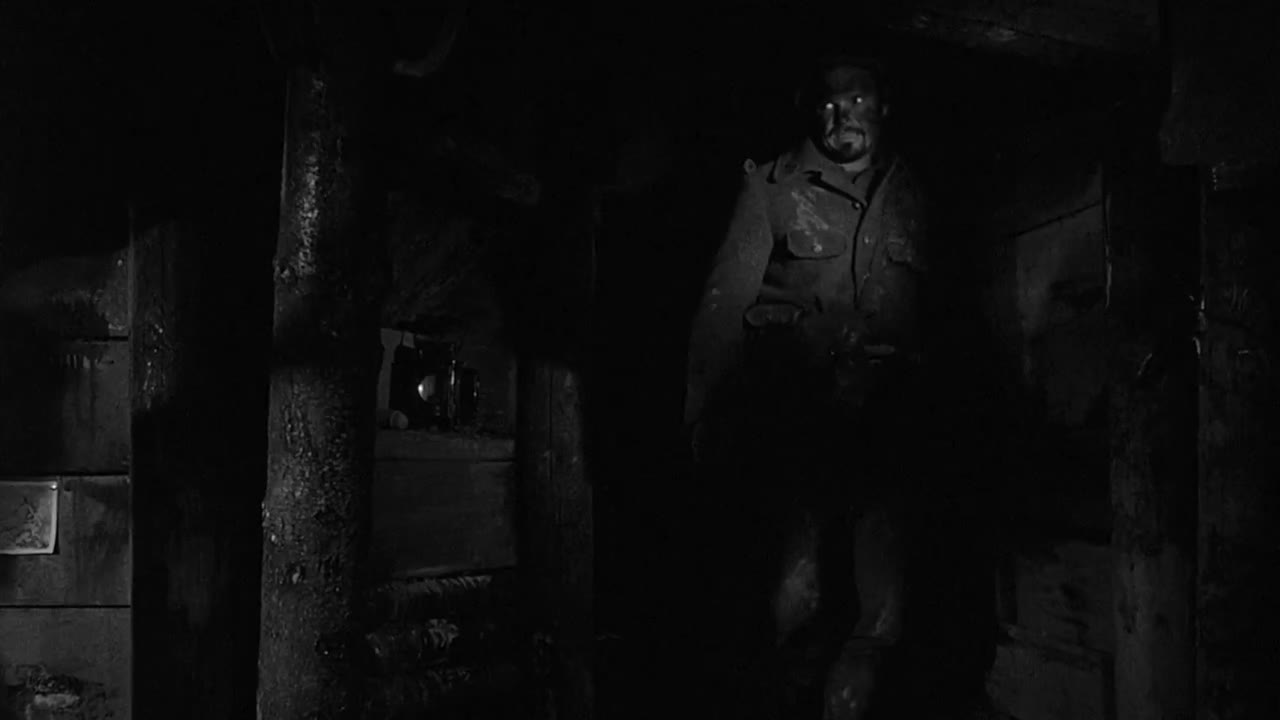
“I'm not a bull, General. I don't need a flag waved in front of me to get me to charge.”
He turns the bullfight metaphor back on the general and refuses to be provoked.
Informal
Chapter 3 of 17 · 2'42"
General Mireau orders Colonel Dax to capture the Anthill, calmly accepting that over half the men may die. Dax objects and, when the talk turns to patriotism, quotes Samuel Johnson: 'the last refuge of a scoundrel.' Offended, Mireau orders Dax on indefinite furlough, but Dax still promises to take the position.
Mireau Orders the Attack
❝ Monologue · 11 lines Dax Quotes Johnson on Patriotism
General Mireau tells Colonel Dax that his regiment will take the Anthill the next day. Dax warns him the men are in poor shape, but Mireau accepts heavy losses as necessary, offers no support, and estimates that more than half will be killed. After Dax quotes Johnson on patriotism, Mireau orders him on leave; Dax insists on staying and promises to capture the hill.
The scene is the film's moral engine. Mireau wants a victory and treats men as the price of it: 'Oh, naturally, men are going to have to be killed. Possibly a lot of them.' When Dax asks what support he will have, the answer is none; the attack is designed to be impossible, and the commander knows it. The argument then becomes a duel about language: Mireau says patriotism makes a man honest, and Dax answers with Johnson's line that it is 'the last refuge of a scoundrel.' The general's reaction is telling — he cannot rebut the quote, so he calls Dax tired and removes him on indefinite furlough. Defeated but not broken, Dax still promises to take the Anthill, and the promise is the tragedy: he will send men to die for a hill he does not believe can be held.
A1–C2 is the CEFR scale. Cards above the level you pick fade, and playback will not auto-pause on them.
“I'm not a bull, General. I don't need a flag waved in front of me to get me to charge.”
He turns the bullfight metaphor back on the general and refuses to be provoked.
Informal
“He said it was the last refuge of a scoundrel, sir.”
A borrowed quotation does the insulting, giving the jab a scholarly edge.
literary
“Patriotism may be old-fashioned, but show me a patriot, and I'll show you an honest man.”
It concedes a point, then turns it into a test: produce a patriot, and honesty follows.
Formal
“General, you're saying that more than half of my men will be killed.”
He restates the order as a body count, forcing the general to hear it.
Formal
“It's you who are exhausted, not your men.”
The cleft puts the blame squarely on Dax, politely and without mercy.
Neutral
“Not once have you said that your men can take the Anthill.”
The inverted negative lands like a blow: never, not even once.
Formal
You're tired, Dax. You're very tired. It's you who are exhausted, not your men. And it's my f ault. I've given you one impossible task after another. - You need rest. You need it badly. - I haven't said anything about needing rest, sir. And you never would either. Therefore, you're not going to have any say-so about it, Colonel. As from right now, I'm ordering you on indefinite furlough. General, you can't take me away from my men. You can't do that to me, sir. Not to you, Dax. For you. For your good and f or the good of your men. The good of my men, sir? If a commanding officer lacks confidence, what can we expect of his men? Naturally, I don't want to relieve you, but I must have your enthusiastic support.
Up next · 04my word against yoursThe scene: Paris Accuses Roget After the PatrolHe wants a victory for its own sake and treats the men as the price of it. When Dax asks what support he will get, the answer is none, which shows the attack is knowingly suicidal.
He means he will not be provoked into charging by patriotic symbols. He resents being treated like an animal that needs a flag waved at it.
Dax quotes Samuel Johnson's remark that patriotism is the last refuge of a scoundrel, which lands as a personal insult and attacks the general's own rhetoric.
He claims Dax is exhausted and lacks confidence, but really he wants a commander who will support the attack without doubt. The leave is a way of removing him.
No. He protests, but in the end he says the men will take the Anthill, choosing obedience to the mission over his own judgment of the general.