
“- Don't you believe me, sir? - Yes, I do, but who else will?”
Why it's great
The reply turns belief into loneliness: yes, but who else will?
Register
Neutral
Use it yourself
I believe you, but who else will?
Chapter 8 of 17 · 3'14"
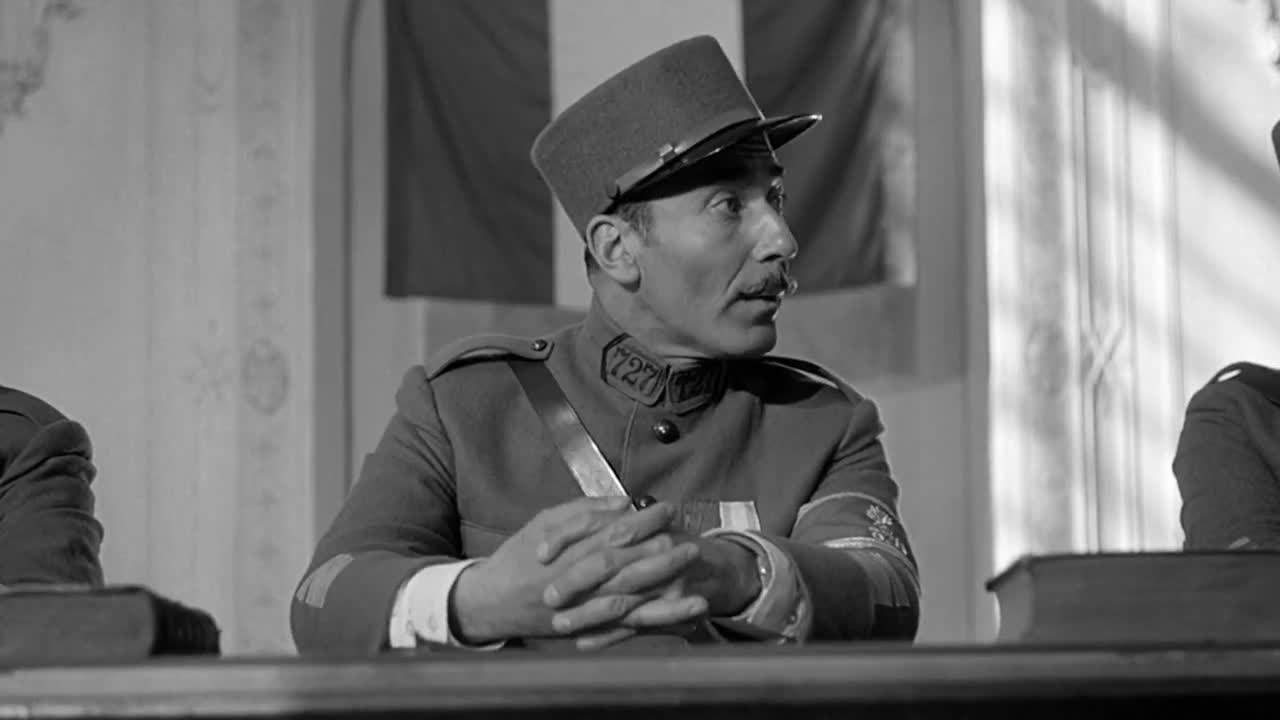
Before the court-martial, Dax coaches the three accused: stick to your story, look the judges in the eye, don't whine or make speeches. Paris tells him Roget shot Lejeune on patrol and then blackmailed him, but with no witnesses it is useless. The trial opens by skipping the indictment and charging them with cowardice.
Dax Coaches the Accused
The Court-Martial Opens
Dax visits the three condemned men before their trial. Paris accuses Lieutenant Roget of shooting Lejeune on patrol and then blackmailing him into silence; the others explain they were chosen by lot or because an officer disliked them. Dax tells them to stick to their stories and behave like brave soldiers, then the court-martial opens and charges them with cowardice.
The scene is where the film's sense of procedure meets its corruption. Dax's advice is almost theatrical — how to sit, where to look, how loudly to speak — because the trial is a performance whose verdict is already written: 'Whatever the reason, you're on trial for your lives.' Paris's accusation against Roget, that he killed a man and then blackmailed a witness, is true and irrelevant; Dax tells him so because 'that story has nothing to do with the charges you're being tried for.' The court then makes its contempt plain by refusing even to read the indictment, and Dax's objection is overruled before it can land. What the soldiers are defending is not their conduct but the general's reputation, and the law exists only to dress that up.
A1–C2 is the CEFR scale. Cards above the level you pick fade, and playback will not auto-pause on them.
“- Don't you believe me, sir? - Yes, I do, but who else will?”
The reply turns belief into loneliness: yes, but who else will?
Neutral
“Whatever the reason, you're on trial for your lives.”
It sweeps the excuses aside and names the real stake: their lives.
Formal
“so don't let it seem as if you're dropping your eyes in a hangdog manner.”
Hangdog names a whole posture of shame in one vivid word.
Neutral
“But that story has nothing to do with the charges you're being tried for.”
A calm cut between truth and charge shows how little the trial is about either.
Neutral
“Will the prosecutor question the witnesses without even reading the indictment?”
One polite question exposes a trial that skips its own rules.
Formal
“Don't whine, plead or make speeches. That's my job.”
Three verbs, then a dry handoff: the lawyer does the talking.
Informal
 Up next · 09no-man's-landThe scene: Ferol Testifies at the Court-Martial
They are on trial for their lives, and any change in their account would be used against them. Consistency is their only defense in a court that already favors the prosecution.
Roget shot Lejeune on the patrol and then blackmailed Paris into silence. Paris believes he was chosen for the trial because he knows the truth about Roget.
He has no witnesses. Dax explains that accusing an officer would only turn the court against him, and that the story has nothing to do with the charges.
Not by any real judgment: one is picked by lot, another because an officer called him a social undesirable. The selection is arbitrary, which is the point.
It opens by declaring a general court-martial and dispensing with formalities, then charges the men with cowardice without even reading the indictment to the defense.