
“We do not question the will of God, my son.”
Why it's great
A calm doctrinal line that answers raw fear with the unanswerable will of God.
Register
Formal
Use it yourself
We do not question the referee's decision, so we play on.
Chapter 16 of 17 · 2'40"
In their last hour, the condemned men break down, and Father Dupree can only offer faith. One soldier asks why he must die, protests that he fought, and says he is frightened; the priest answers that we do not question the will of God, tells him to brace himself, and promises paradise.
The Condemned Man Breaks Down
The Priest's Final Prayer and the March
As the execution nears, Father Dupree prays with the condemned. One man weeps and asks why he must die, insisting he fought in battle; the priest answers that God's will is not to be questioned and urges him to brace himself. The soldier repeats that he is scared and cannot help it, and military commands soon order the men toward the posts.
The scene is the human cost of the court-martial, concentrated into a few minutes. The men are not afraid in the abstract; they are terrified children, and the priest has nothing but ritual to answer with. 'We do not question the will of God, my son.' is a kindness and an evasion at once — it offers no explanation for an execution nobody can justify. The soldier's protest is the truth of the film: 'I fought on the battlefield.' He cannot reconcile having risked his life with being shot by his own army. The priest keeps saying 'Brace yourself,' and the repetition shows that comfort has run out of words; the only thing left is the wish that the man will somehow hold together long enough to be killed.
A1–C2 is the CEFR scale. Cards above the level you pick fade, and playback will not auto-pause on them.
“We do not question the will of God, my son.”
A calm doctrinal line that answers raw fear with the unanswerable will of God.
Formal
“Why don't they die? Why not put them to death?”
A dying man's plainest question turns his fear into an accusation of the men who sent him here.
Informal
“You showed courage in the face of the enemy, my son.”
The priest gives the man back his battlefield courage, offering dignity instead of excuses.
Formal
“Oh, Father, I'm scared. Oh, my God.”
Stripped to two cries, the line makes terror audible with no argument left in it.
Informal
“He said, "This day, thou shalt be with me in paradise."”
A quoted promise from the cross, borrowed to tell a condemned man he will not die alone.
literary
“Grant courage to this man who is about to die.”
The prayer asks not for rescue but for courage, which is what the scene really needs.
literary
“Why do I have to die, Father?”
The same plea returns at the end, worn down to four words of pure disbelief.
Informal
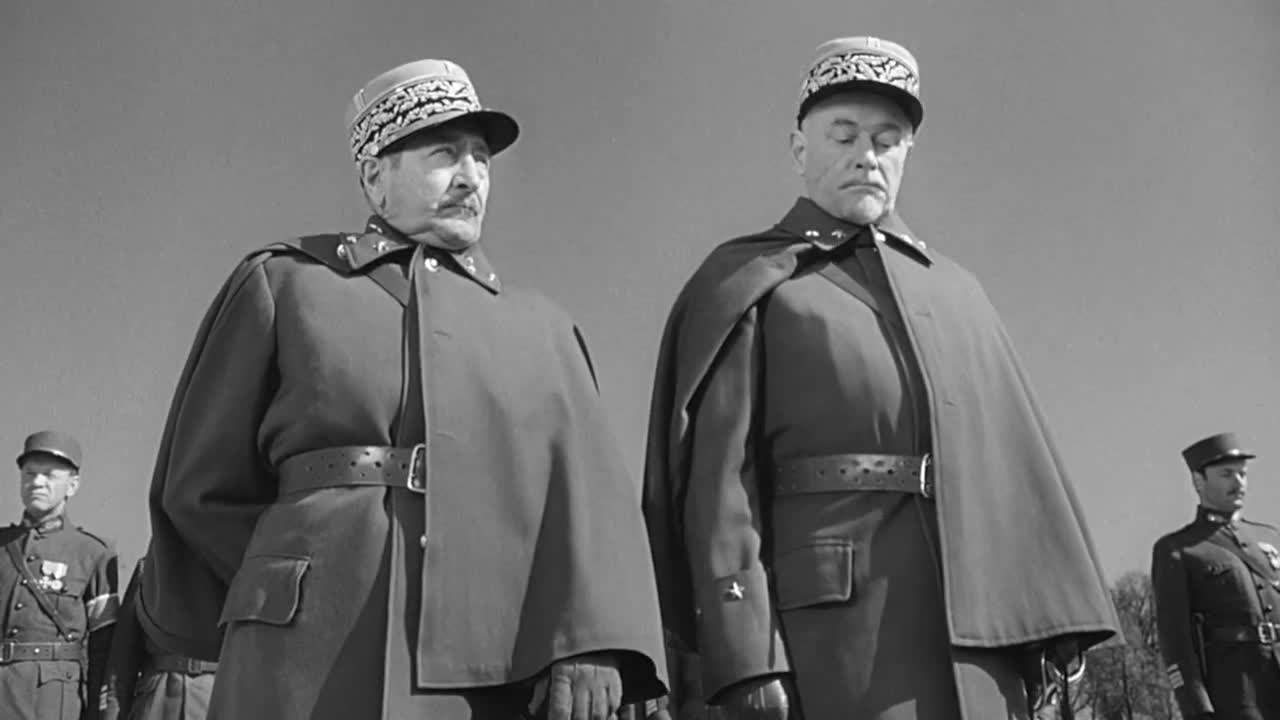 Up next · 17make me the goatThe scene: Broulard Makes Mireau the Goat
He cannot understand why he is being executed for cowardice when he risked his life on the battlefield. It is the film's central injustice stated by its victim.
It is the only comfort his faith offers. He cannot justify the execution, so he asks the man to accept what cannot be changed.
He quotes Christ's promise of paradise, telling the man that this day he will be in paradise. It is meant to give him courage at the end.
Because he is. The repetition strips away the army's words for courage and cowardice and leaves only a frightened man facing death.
Military orders. About face, forward march, and the detail halts at the posts, and one prisoner begs to be chosen instead — then the commands take over completely.