
“The biggest man-made explosion in history.”
Por qué es buena
A superlative delivered like a lab note, which makes the scale hit harder.
Registro
Formal
Úsala tú
That was the biggest kitchen disaster in history.
Capítulo 12 de 28 · 1'59"
A room full of physicists is being walked through fission when one of them admits to being bored and pitches something bigger: a fusion bomb. Use hydrogen, crush the atoms under enormous pressure, and the yield jumps from kilotons to megatons. "We all entered this room knowing a fission bomb was possible," he says, before offering the new idea.
❝ Monólogo · 6 frases Teller Pitches Fusion
A Small Fission Bomb
In a meeting at Los Alamos, the group is walked through how a fission bomb would work when Teller interrupts. He proposes using hydrogen instead of uranium or plutonium, crushing the atoms under great pressure to start a fusion reaction that would yield megatons, not kilotons. When asked how to generate the force, he answers: a small fission bomb.
The scene is about who gets to change the subject. A lecture is ticking along, explaining yield in terms of tons of TNT, and then boredom becomes a proposal: forget fission, use fusion. Teller's pitch is elegant and terrifying precisely because it is simple - a small fission bomb becomes the trigger for something far larger, and the scale jumps from kilotons to megatons. "We all entered this room knowing a fission bomb was possible," he says, which frames his idea as the natural next thought rather than a leap. The scene also quietly dramatizes how these scientists talk past the moral weight of what they are building; the meeting ends by returning to "the business at hand," as if nothing had changed. It has.
A1–C2 es la escala MCER. Las tarjetas por encima del nivel elegido se atenúan y la reproducción no se pausa en ellas.
“The biggest man-made explosion in history.”
A superlative delivered like a lab note, which makes the scale hit harder.
Formal
“We all entered this room knowing a fission bomb was possible.”
A shared premise stated as a boundary, clearing the way for a bigger ask.
Formal
“We compact the atoms together under great pressure to induce a fusion reaction.”
Apocalyptic ambition hidden inside calm technical prose.
Formal
“Well, since we're going to need one anyway, can we get back to the business at hand?”
Concede the future, redirect the present: a polite way to end a tangent.
Informal
Instead of uranium or plutonium, we use hydrogen. -Heavy hydrogen. -Hydrogen. Deuterium. You see? We compact the atoms together under great pressure to induce a fusion reaction. Then we'll get not kilotons, but megatons.
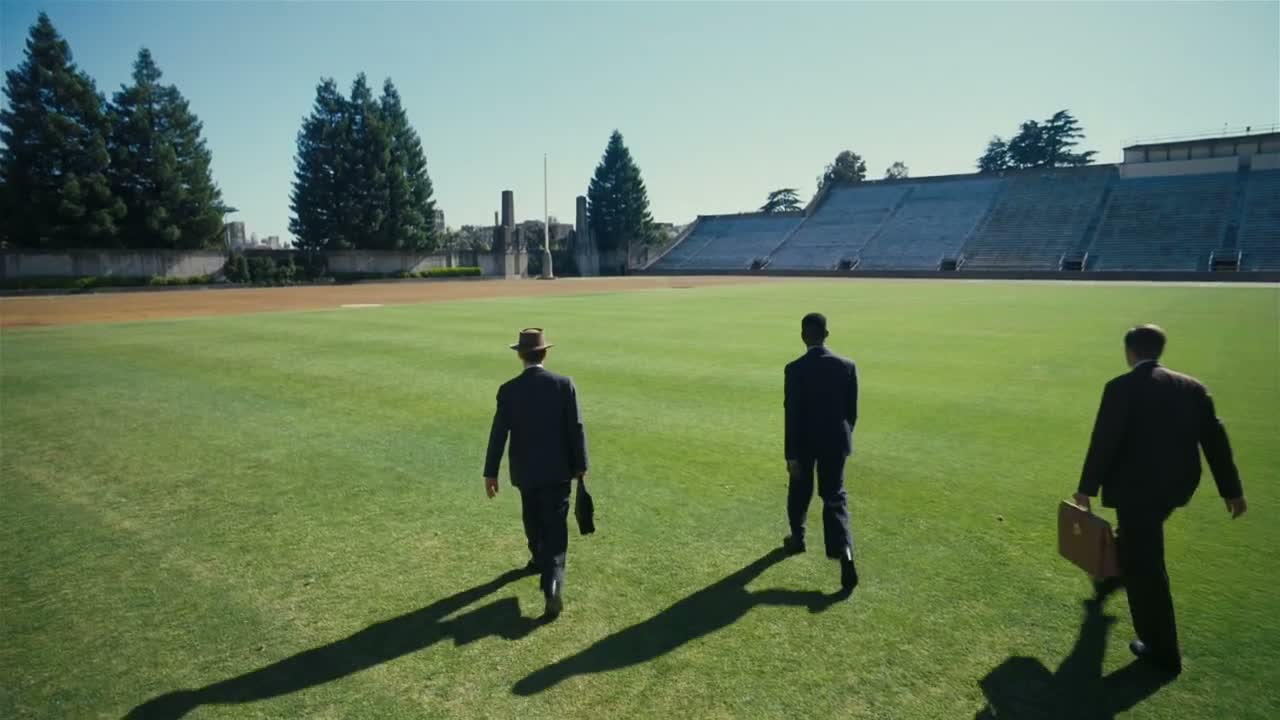 Siguiente · 13Thanks for nothingLa escena: Condon Quits Los Alamos
Instead of a fission bomb using uranium or plutonium, he proposes using hydrogen and crushing the atoms under great pressure to start a fusion reaction, which would produce megatons instead of kilotons.
The lecture is explaining a fission bomb he already assumes is possible. He wants the room to leave with something new, and his boredom is what drives the scene forward.
By a small fission bomb. When someone asks how to generate enough force to fuse hydrogen atoms, that is his answer.
Because even the new proposal depends on building a fission bomb anyway, so one of the scientists suggests going back to the original agenda.