
“Whatever way you say it, they know I'm Jewish.”
Por qué es buena
Self-aware and unapologetic: however you say it, they'll still know.
Registro
Informal
Úsala tú
Whatever way you say it, they know where I'm from.
Capítulo 2 de 28 · 3'04"
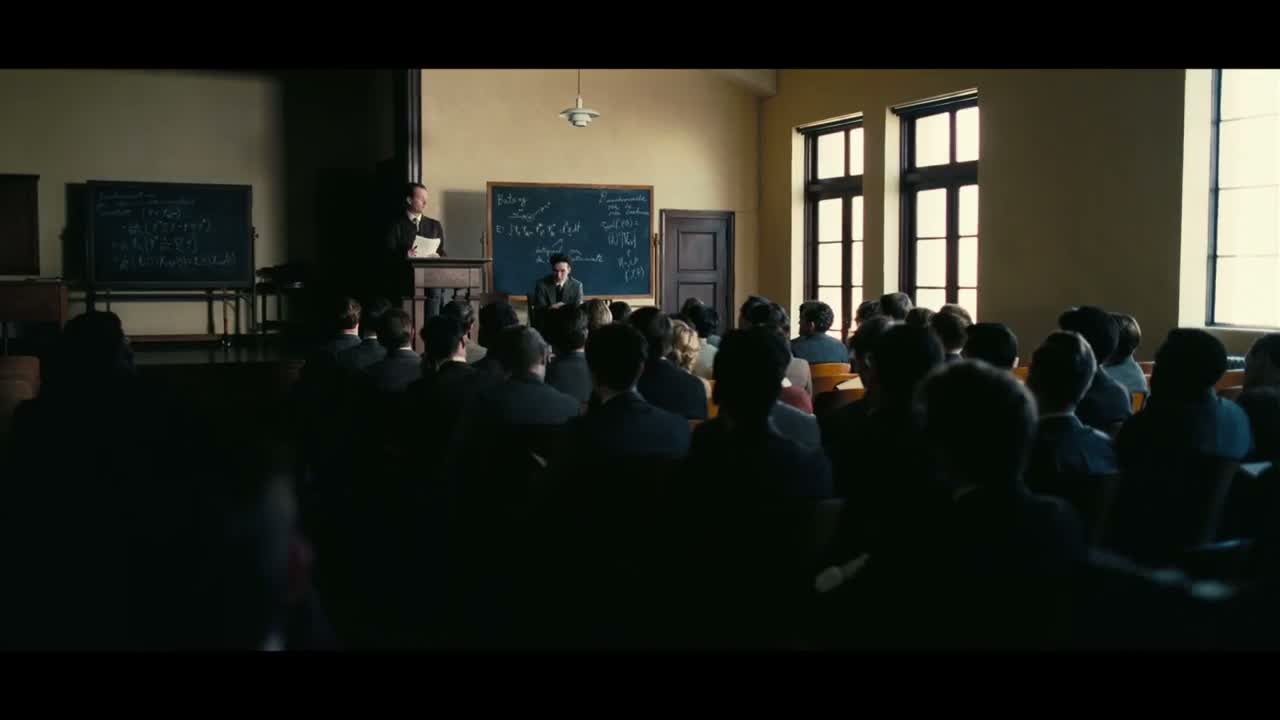
Strauss welcomes Oppenheimer, corrects how to say his own name, and works the room before offering him the institute. The flattery lands on a single line — "You are the man for the job" — though Oppenheimer answers that times change.
A Self-Made Man Who Sold Shoes
You Are the Man for the Job
Strauss greets Oppenheimer at the institute and opens with jokes about how to pronounce his own name. He admits he was never trained in physics and calls himself a self-made man, then shows Oppenheimer the office and makes his pitch: Oppenheimer is the man for the job.
The scene is an audition in reverse: the man doing the hiring spends most of it selling himself. Strauss opens with his own name, which sounds like a small joke and is really a claim about background, and he keeps circling the same themes, calling himself "a self-made man" and admitting he has no formal training. The flattery is careful. He praises Oppenheimer's work, name-drops Einstein, and frames the institute as high purpose: "a haven for independent minds." Then he delivers the offer and the line that seals it, "You are the man for the job." Oppenheimer's reply — "times change" — is polite and non-committal, and it is the first sign that these two will not stay on the same side.
A1–C2 es la escala MCER. Las tarjetas por encima del nivel elegido se atenúan y la reproducción no se pausa en ellas.
“Whatever way you say it, they know I'm Jewish.”
Self-aware and unapologetic: however you say it, they'll still know.
Informal
“Well, I had offers, but I chose to sell shoes.”
A whole character in one turn: offered more, he chose the shoe counter.
Informal
“Well, the purpose of this institute is to provide a haven for independent minds.”
An institution described as shelter: a haven for independent minds.
Formal
“That's you. You are the man for the job.”
Pointed praise: that's you, and no one else fits.
Neutral
“Why would I be worried after everything you've done for your country?”
Trust stated as a rhetorical question: after all that service, why doubt?
Formal
“No, I'm not trained in physics or anything else.”
Self-deprecation with a broad brush: trained in nothing, and fine with it.
Informal
 Siguiente · 03seek outLa escena: Rabi Meets Oppenheimer on a Train
The directorship of the Institute, which comes with a house for him and his family. Strauss calls it one of the most prestigious appointments in the country.
He insists his name is pronounced "straws," the Southern pronunciation. The joke lets him bring up that he is Jewish and then pivot to his own rise as a self-made man.
He does not accept on the spot. He says he will consider it and later answers with "times change," which sounds polite but keeps his distance from Strauss.
He says that, as chairman of the AEC, he has read Oppenheimer's file, which shows the trust he is extending even as he brings up Oppenheimer's past.