
“Because Robert never had anything to do with the Communist Party as such.”
Por qué es buena
A precise defense that doubles as a rebuke of the question itself.
Registro
Formal
Úsala tú
Our team never had anything to do with that vendor as such.
Capítulo 27 de 28 · 2'39"
Kitty takes the stand and refuses to be cornered. Asked about an old Party card, she answers "Haven't the slightest idea," then corrects her questioner's wording and insists Robert "never had anything to do with the Communist Party as such." Robb answers with a sneer.
Haven't the Slightest Idea
❝ Monólogo · 5 frases Kitty Won't Accept His Phrase
Kitty is called to testify about her husband's politics. Robb presses her on an old Communist Party card, and she deflects each question, even correcting his phrasing. She says Robert never truly belonged to the Party, that he gave money for Spanish refugees from time to time, and refuses to be drawn further.
The scene is a duel in which the witness has better control than the prosecutor. Robb tries to pin Kitty down with a yes-or-no question, but she answers only what she chooses and corrects his words instead of defending herself. Her sharpest move is to refuse the phrase he feeds her, then replace it with one that is more exact: Robert gave money to Spanish refugees, and he was interested in Communist ideas, but he "never had anything to do with the Communist Party as such." That word, as such, is the whole defense. Robb tries to mock it with a jab about intellectual Communists versus a regular Commie, and gets nothing back. The scene shows loyalty that is not sentimental — clear, precise, and impossible to turn into a confession.
A1–C2 es la escala MCER. Las tarjetas por encima del nivel elegido se atenúan y la reproducción no se pausa en ellas.
“Because Robert never had anything to do with the Communist Party as such.”
A precise defense that doubles as a rebuke of the question itself.
Formal
“You can answer that any way you wish.”
A courtesy that quietly removes every excuse.
Formal
“Well, in the days when I was a member, I thought they were definitely two things.”
An honest admission that quietly marks how far she has moved.
Neutral
“Intellectual Communists and your plain old regular Commie?”
A sneering either-or question that boxes the witness in.
Informal
'Cause I don't like your phrase. "Having anything to do with the Communist Party." Because Robert never had anything to do with the Communist Party as such. I know he gave money to Spanish refugees. I know he took an intellectual interest in Communist ideas...
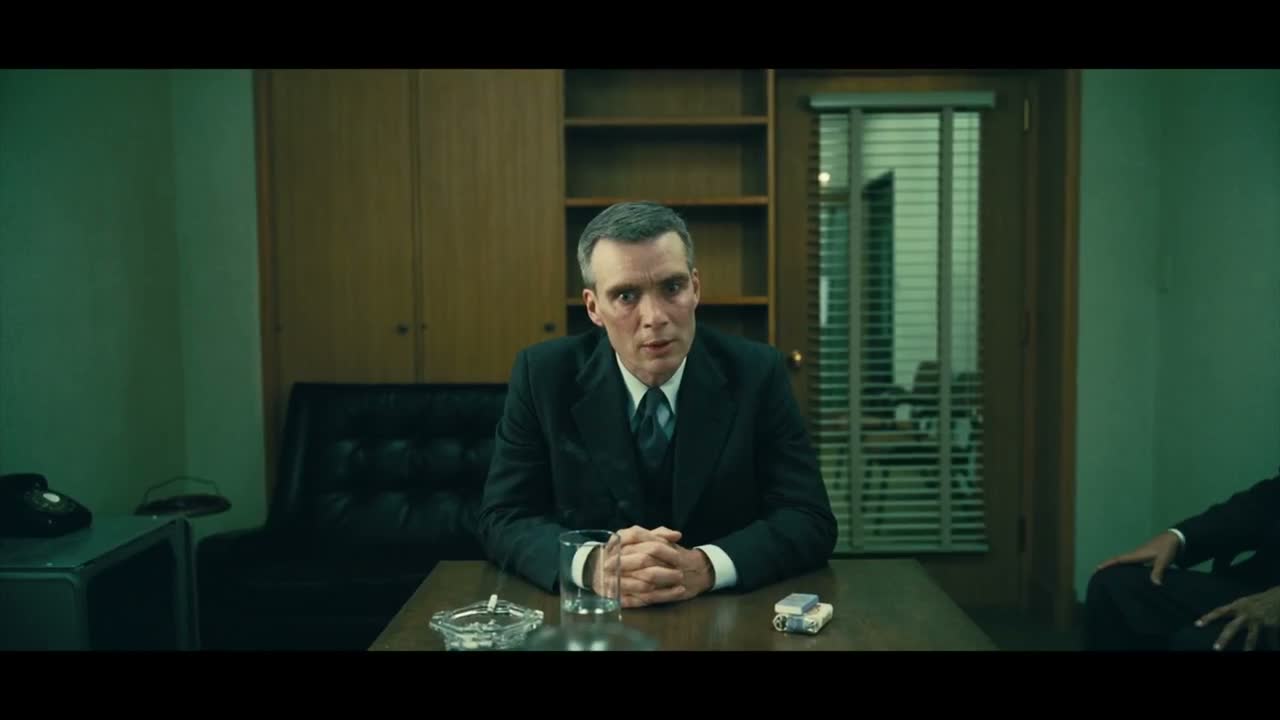 Siguiente · 28moral scruplesLa escena: Oppenheimer Is Cross-Examined
Because his phrase, having anything to do with the Communist Party, is vague enough to mean almost anything. She refuses it and gives a more exact version of the facts.
She says he gave money to Spanish refugees and took an intellectual interest in Communist ideas, but insists he never truly belonged to the Party as such.
He mocks her distinction by asking whether there are two kinds of Communists, intellectual ones and a regular Commie. Kitty says she cannot answer that.
It lets Kitty deny knowledge of the Party card without agreeing to the prosecutor's framing, keeping control of the exchange.