
“"This is just how the game is played."”
Por qué es buena
The rules of the game invoked to excuse what is done to you.
Registro
Informal
Úsala tú
Nobody explained it, but this is simply how things work here.
Capítulo 23 de 28 · 2'42"
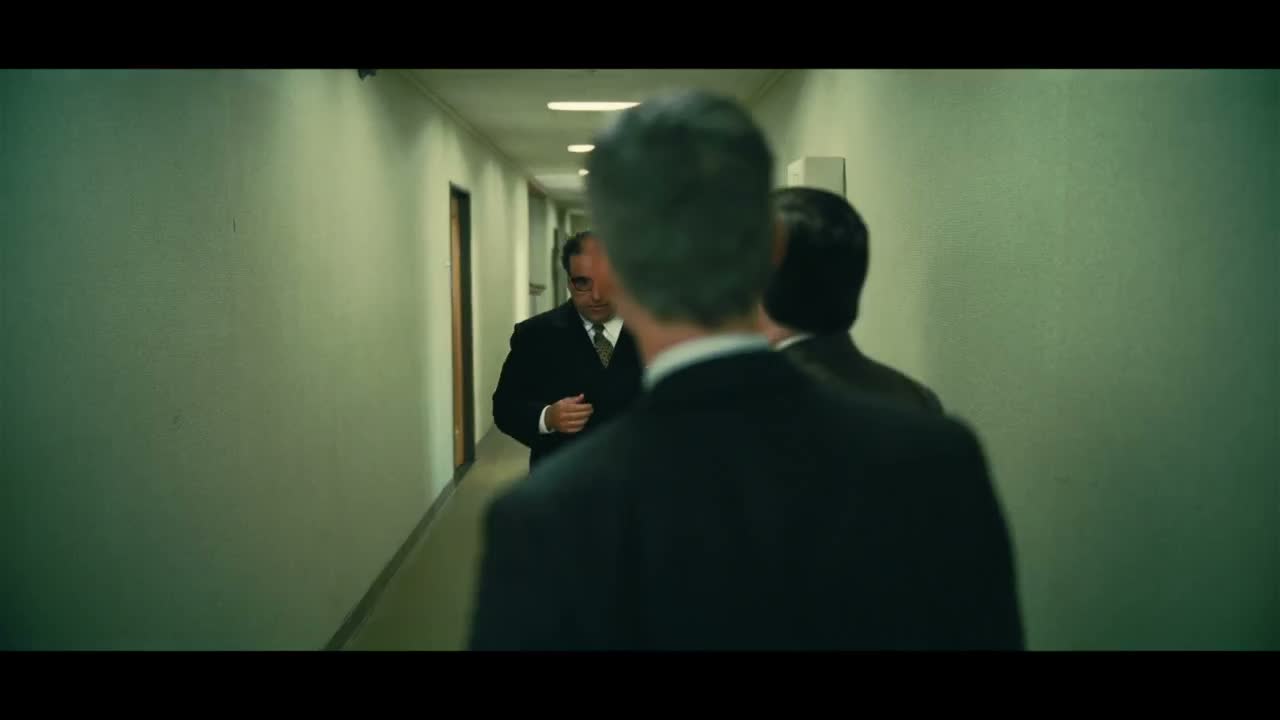
Strauss lays out the plan to destroy Oppenheimer without a trial, using a closed hearing and no need to prove anything: "We're not convicting. We're just denying." Later he tells Oppenheimer the decision is not yet signed and explains that power stays hidden.
❝ Monólogo · 8 frases Strauss writes the procedure
From the shabby room to the appeal, he scripts a killing as a renewal.
Power Stays in the Shadows
Strauss works behind the scenes to end Oppenheimer's career. He hands the file to Borden, keeps McCarthy away, and arranges a closed hearing with no audience, no reporters and no burden of proof. He refuses a trial because a platform could turn Oppenheimer into a martyr, then tells him his clearance is up for renewal.
The scene is a lesson in how power actually works. Strauss does not attack Oppenheimer in public; he builds a procedure that looks neutral and makes the outcome certain. There will be a hearing, but no trial, because a trial would give Oppenheimer a stage. There will be an indictment, but no burden of proof, because the goal is not to convict him but to deny him. That distinction is the whole plan, and Strauss states it plainly: "We're not convicting. We're just denying." The cruelty is bureaucratic, which makes it harder to fight. And when Oppenheimer notices that Strauss himself has stepped into the open, Strauss answers with the film's coldest line about survival: "Power stays in the shadows." It is a confession and a threat at once.
A1–C2 es la escala MCER. Las tarjetas por encima del nivel elegido se atenúan y la reproducción no se pausa en ellas.
“"This is just how the game is played."”
The rules of the game invoked to excuse what is done to you.
Informal
“We need a systematic destruction of Oppenheimer's credibility so he can never again speak on matters of national security.”
The whole persecution mapped out in one unflinching sentence.
Formal
“No trial. You can't give Oppenheimer a platform.”
A decision delivered as two bullet points: no stage, no truth.
Informal
“Oppenheimer's too slippery for that self-promoting clown.”
A dismissive line that measures both the target and the tool.
Informal
A shabby little room, far from the limelight. A simple bureaucratic procedure. His Q clearance is up for renewal. You send your accusations to the FBI. Hoover sends them to the AEC, you're forced to act. You write up an indictment and tell Oppenheimer his security clearance is not being renewed. But offer him the chance to appeal.
 Siguiente · 24MermaidsLa escena: Rabi Defends Oppenheimer
Because a trial would give Oppenheimer a public platform. He worries it could turn him into a martyr, so he wants a closed hearing instead.
There is no audience, no reporters and no burden of proof. The board can read his file while his lawyers cannot, so the result is decided before it starts.
He says they are not convicting but only denying: the aim is not to prove him guilty but to take away his clearance and his public voice.
It is an excuse: it presents the dirty procedure as the normal, unchangeable way things work, as if no one could act differently.