
“A democratic republic being overthrown by fascist thugs, who wouldn't?”
Por qué es buena
A rhetorical question that closes the debate: who wouldn't stand against that?
Registro
Formal
Úsala tú
A family losing its home, who wouldn't help?
Capítulo 5 de 28 · 2'43"
A party introduction turns into a political argument. Oppenheimer says he is not a Communist but cannot be pinned down, and his host presses him: "It's about the ideas. And you sound uncommitted." He insists he will keep his own judgment, even when asked whose line he follows.
Your Reputation Precedes You
❝ Monólogo · 6 frases How stars die
He turns collapse and swallowed light into a black hole, then admits the work cannot save anyone in the room.
I Like a Little Wiggle Room
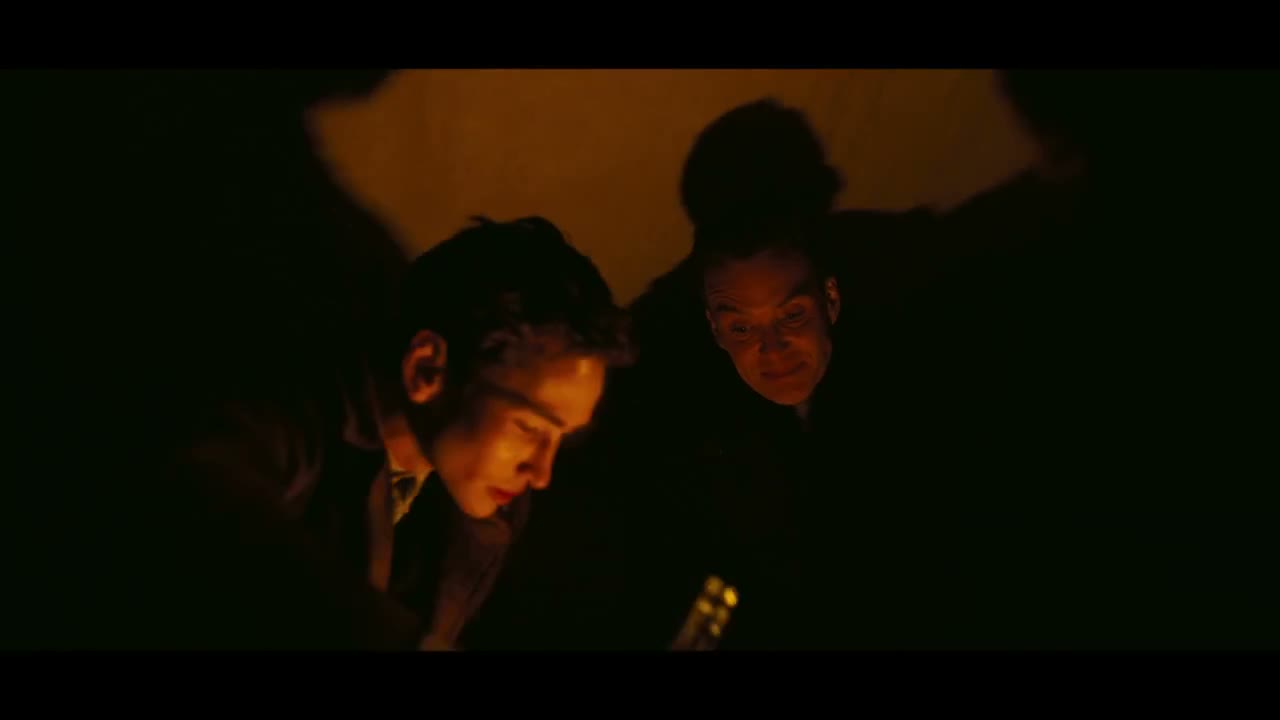
At a party, Oppenheimer is introduced to Chevalier and Jean, and the small talk quickly becomes a debate about communism, Spain and free thinking. He insists he is not a Party member, mentions reading Das Kapital, and refuses to commit to one line, ending with a joke about wanting wiggle room.
The scene sets the terms of a fight that will run through the whole film: whether Oppenheimer can hold private views without being claimed by a side. The party is full of people who want him to commit — to Spain, to the Party, to a line — and he keeps slipping away, answering with wit and a refusal to be pinned down. His line "I like a little wiggle room" is the clearest statement of who he is. Someone else cuts through it: "It's about the ideas. And you sound uncommitted." That accusation is the seed of everything the security board will later use against him. Even the earlier small talk, about stars that collapse when their gravity swallows everything, quietly previews how the film treats a man at the center.
A1–C2 es la escala MCER. Las tarjetas por encima del nivel elegido se atenúan y la reproducción no se pausa en ellas.
“A democratic republic being overthrown by fascist thugs, who wouldn't?”
A rhetorical question that closes the debate: who wouldn't stand against that?
Formal
“They think that socialism is a bigger threat than fascism.”
A flat report of a warped priority, left to indict itself.
Formal
“The gravity gets so concentrated it swallows everything.”
Physics told as devouring: concentration so extreme it swallows everything.
Formal
“But right now, all I have is theory, which can't impact people's lives.”
The scholar's helplessness stated plainly: theory can't touch a life yet.
Formal
“It's about the ideas. And you sound uncommitted.”
A verdict followed by a pointed accusation, closing the distance fast.
Formal
“Well, I'm committed to thinking freely about how to improve our world.”
A creed of allegiance to free thought rather than any party.
Formal
Well, if they do, they'd cool, then collapse. In fact, the bigger the star, the more violent its demise. The gravity gets so concentrated it swallows everything. Everything, even light.
 Siguiente · 06wring your neckLa escena: Oppenheimer Names Los Alamos
He says he is not a Party member, though he has read Das Kapital and supports causes like the Spanish Republic. He insists on thinking freely rather than following one line.
Because Oppenheimer refuses to commit to the Party's ideas outright. His host tells him it is about the ideas and that he sounds uncommitted, which is meant as a challenge.
It means space to maneuver. Oppenheimer says he likes a little wiggle room, meaning he wants to keep his own judgment instead of accepting a single doctrine whole.
Among them are his brother Frank, his friend Chevalier, who studies languages, and Jean. The conversation moves from introductions to politics within a few minutes.