
“What do any of you have in common with farm laborers and dock workers?”
Por qué es buena
A question that reveals the asker's own blind spot about class.
Registro
Formal
Úsala tú
What do a poet and a plumber have in common with each other?
Capítulo 8 de 28 · 1'51"
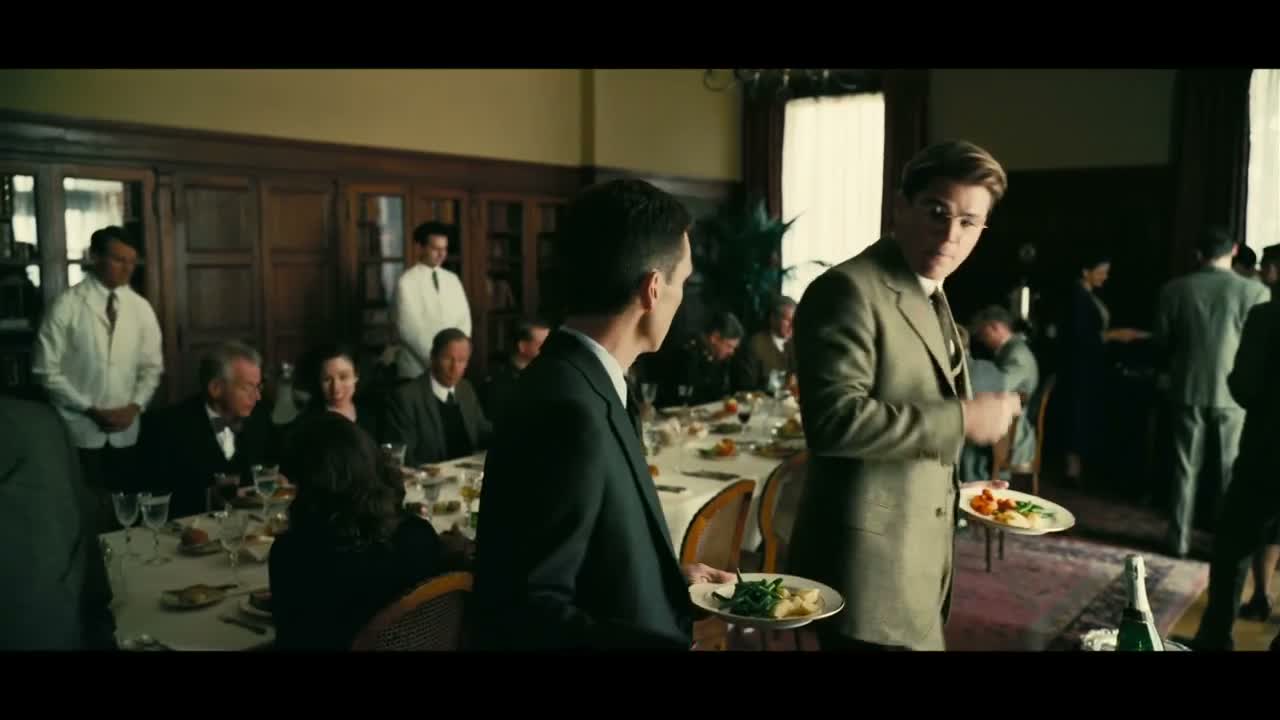
Lawrence corners a young colleague over his ties to a union full of Communists and tells him it is why he cannot be brought onto the project. The argument turns personal: "It's not your people they're herding into camps." It ends less with agreement than with a warning to wake up.
❝ Monólogo · 2 frases Comrades on the Project
❝ Monólogo · 3 frases Look in the Rearview Mirror
Lawrence clears the room and confronts Lomanitz about the union, which he says is full of Communists, saying it is why he cannot be brought onto the project. The two men argue about politics and about who is really at risk, and Lawrence warns him to check his rearview mirror and stop being naive. Lomanitz agrees to settle things, and Lawrence welcomes him to the war.
The scene is a friendship being tested by the machinery of security. Lawrence has just thrown a meeting out of the room, and the fight that follows is not really about politics but about access: the union makes Lomanitz a liability, so Lawrence cannot bring him onto the secret project. Their exchange keeps cutting to something rawer - whose people are being rounded up - and the line "It's not your people they're herding into camps" shows how personal the political has become. Lawrence's answer is both a defense and a warning: he tells Lomanitz to check the rearview mirror and stop being naive, as if the surveillance were simply weather. The scene ends in a truce rather than a resolution, with the friend reluctantly welcomed to the war.
A1–C2 es la escala MCER. Las tarjetas por encima del nivel elegido se atenúan y la reproducción no se pausa en ellas.
“What do any of you have in common with farm laborers and dock workers?”
A question that reveals the asker's own blind spot about class.
Formal
“Listen to the sounds on your phone line and stop being so goddamn naive.”
Surveillance made audible, naivety dismissed: a warning with no cushioning.
Informal
“It's not your people they're herding into camps.”
One pronoun shift separates distant sympathy from personal stakes.
Informal
“They won't even let me tell you what the project is.”
Secrecy so tight that even naming the project is forbidden.
Informal
You think that I tell them about your politics. The next time you're coming home from a meeting, why don't you take a look in the rearview mirror? Listen to the sounds on your phone line and stop being so goddamn naive.
We've all heard about Einstein and Szilard's letter to Roosevelt warning him the Germans could make a bomb, and I know what it means for the Nazis to have a bomb.
 Siguiente · 09point takenLa escena: Groves Offers Oppenheimer the Job
Because of his ties to a union that is full of Communists. The people running the project treat that as a security risk, which is why Lawrence cannot bring him on.
A federation of architects, engineers, chemists, and technicians that Lomanitz belongs to. Lawrence says it is full of Communists, which makes membership dangerous for his career.
He tells him to look in his rearview mirror and listen to the noises on his phone line, meaning he is likely being watched, and to stop being naive about the danger.
Because Lawrence notes that the people being herded into camps are his people, not Lomanitz's, which makes the political dispute a question of identity and survival.
Lomanitz agrees to talk to the others and says the matter will be handled, and Lawrence answers, "Then welcome to the war."