“You drop in and out of my life, and you don't have to tell me why.”
Freedom named as asymmetry: coming and going without ever owing an explanation.
Informal
Capítulo 14 de 28 · 3'26"
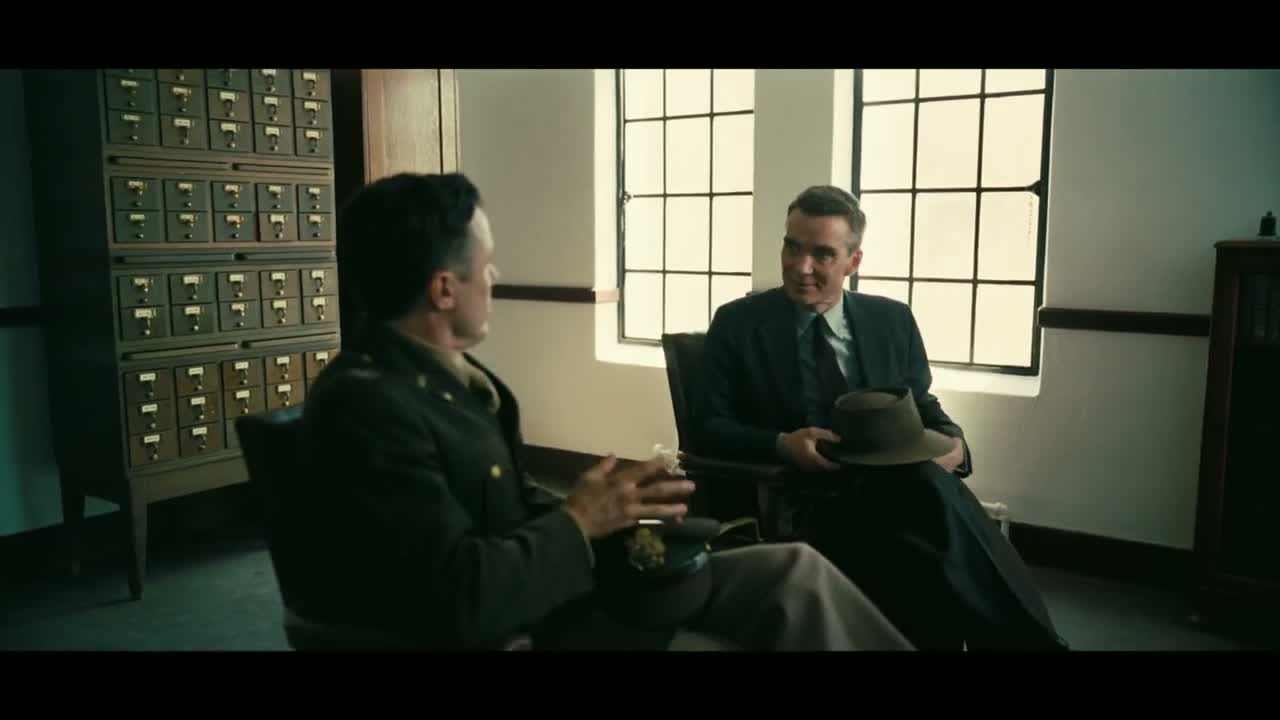
A security hearing keeps pressing Oppenheimer about his Communist contacts and his secrets, and against that interrogation the film cuts to his last night with Jean. Her charge is precise: "You drop in and out of my life, and you don't have to tell me why." He answers that he cannot see her again.
Not a Word
❝ Monólogo · 5 frases He builds a reason to go
Desire, treatment, extreme distress: he stacks private need until the visit sounds unavoidable.
❝ Monólogo · 5 frases You Drop In and Out of My Life
While a board questions Oppenheimer about his associations and the secrets he has carried, the film returns to the night Jean asked to see him. She accuses him of drifting in and out of her life without explanation, and though he admits he is glad he came, he tells her he cannot see her again.
The film wants the private and the public to comment on each other, and this scene is the clearest example. The board's questions are about loyalty and disclosure; the Jean flashback is about a man who gives as little of himself as possible and still expects to be loved. Her accusation—"You drop in and out of my life, and you don't have to tell me why"—lands as both a lover's complaint and the theme of his career: presence without obligation. His answer is the same kind of move the hearing keeps exposing, affection offered and then withdrawn, "But I can't see you again." The tender scene and the interrogation are the same story told twice.
A1–C2 es la escala MCER. Las tarjetas por encima del nivel elegido se atenúan y la reproducción no se pausa en ellas.
“You drop in and out of my life, and you don't have to tell me why.”
Freedom named as asymmetry: coming and going without ever owing an explanation.
Informal
“But what if I need you?”
A four-word objection that reopens a door the other person just closed.
Informal
“What did you think that would do to me?”
A question that skips blame and goes straight to consequence.
Informal
“But I can't see you again.”
An ending said plainly: no drama, no explanation, just a closed door.
Informal
“I've had a lot of secrets in my head for a long time.”
Long silence described as weight carried in the head, not a virtue.
Informal
Because she had indicated a great desire to see me before we left. At that time, I couldn't, but I felt that she had to see me. She was undergoing psychiatric treatment. She was extremely unhappy.
You drop in and out of my life, and you don't have to tell me why. Now that's power. Not that I enjoy. I'd rather be here for you as you need. But you have other priorities now.
Siguiente · 15a cock-and-bull storyLa escena: Oppenheimer's Cock-and-Bull StoryThe board wants to know whether his social contacts with known Communists were dangerous, and how he handled secrets during and after the war.
She says he drops in and out of her life and never has to explain why, which is a complaint about how little he commits to her.
He admits he left without a word and only wrote pages of nothing, which Jean says made his leaving even worse.
He says he is glad he came but tells her he cannot see her again, ending the relationship even as she asks what she should do if she needs him.
It refers to his silence: he left her, and did not say a single word about it, which he then claims was consistent with good security.