
“Well, somehow I have graduated to housewife.”
Por qué es buena
Irony by word choice: a biologist who 'graduated' into being a housewife.
Registro
Informal
Úsala tú
Well, somehow I have graduated to full-time babysitter.
Capítulo 7 de 28 · 2'57"
A physicist explains quantum mechanics with whatever is on the counter: the glass, the drink, the body. "It's mostly empty space," he says, held together by forces strong enough to stop two bodies passing through each other. Then the talk turns to her marriages and the husband she lost in Spain.
❝ Monólogo · 11 frases Mostly Empty Space
❝ Monólogo · 18 frases I Was Lost and He Was Kind
At the Tolmans' house, Oppenheimer talks with a biologist who jokes she has "graduated to housewife." He explains quantum mechanics with the objects around them, saying matter is mostly empty space held by forces. The conversation shifts to her past, including the husband killed in Spain.
The scene works as a private lecture and a confession at the same time. Oppenheimer explains that a glass, a counter, a body are "mostly empty space," held together by forces that only feel solid — the same trick the film performs on the audience. The woman answers with her own version of the lesson: a life that looks settled is also mostly absence, a lost husband and a marriage of convenience. Her line "I was lost and he was kind" says plainly what the physics only implies, and "That's the definition of nothing" turns the abstraction back into grief.
A1–C2 es la escala MCER. Las tarjetas por encima del nivel elegido se atenúan y la reproducción no se pausa en ellas.
“Well, somehow I have graduated to housewife.”
Irony by word choice: a biologist who 'graduated' into being a housewife.
Informal
“I was lost and he was kind.”
A marriage explained in two clauses: she was lost, he was kind.
Informal
“That's the definition of nothing.”
Nothing given a definition: the coldest possible verdict on a death.
Informal
“My husband offered both our futures to stop one fascist bullet from embedding itself in a mudbank.”
The scale of a sacrifice measured in one bullet lodged in a mudbank.
Neutral
Well, this glass, this drink, this countertop, uh, our bodies... all of it. It's mostly empty space. Groupings of tiny energy waves bound together. By what? Forces of attraction strong enough to convince us that matter is solid. Stop my body passing through yours.
But my second husband was Joe Dallet. He was, um, from money, like me, but... he was a union organizer in Youngstown, Ohio. Fell hard. How hard? Hard enough to spend the next four years living off beans and pancakes, handing out the Daily Worker at factory gates. Quit the Party and a year later, I wanted him back, so... Him, not the Daily Worker. And he said, "Swell, I'll meet you on my way to Spain." He went to fight for the Loyalists? And then he went to the brigades and I waited. And... Joe got himself killed first time he popped his head out of the trench. Ideology got Joe killed. For nothing. Spanish Republic isn't nothing. My husband offered both our futures to stop one fascist bullet from embedding itself in a mudbank. That's the definition of nothing.
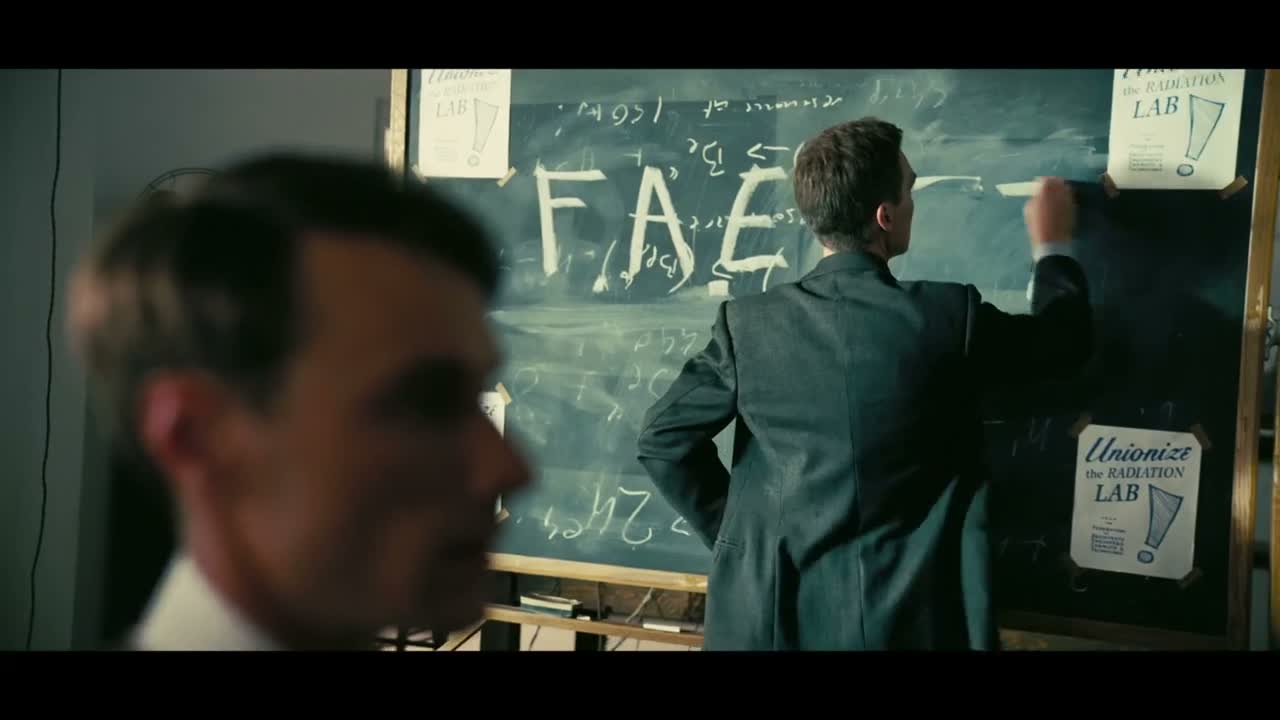 Siguiente · 08herd intoLa escena: Lawrence Shuts Down the Union
He uses ordinary things around them — a glass, a drink, a countertop, even their bodies — and says all of it is mostly empty space held together by forces.
She says she was lost and he was kind, after her previous husband, Joe Dallet, was killed. It sounds less like love than a refuge.
Joe Dallet, a union organizer, went to fight for the Spanish Republic and was killed the first time he looked out of a trench.
She believes he traded both their futures for nothing, and that stopping one fascist bullet did not justify the loss.
He keeps the talk on physics and abstraction, while she answers with plain facts about her marriages and her grief, and the two languages do not quite meet.