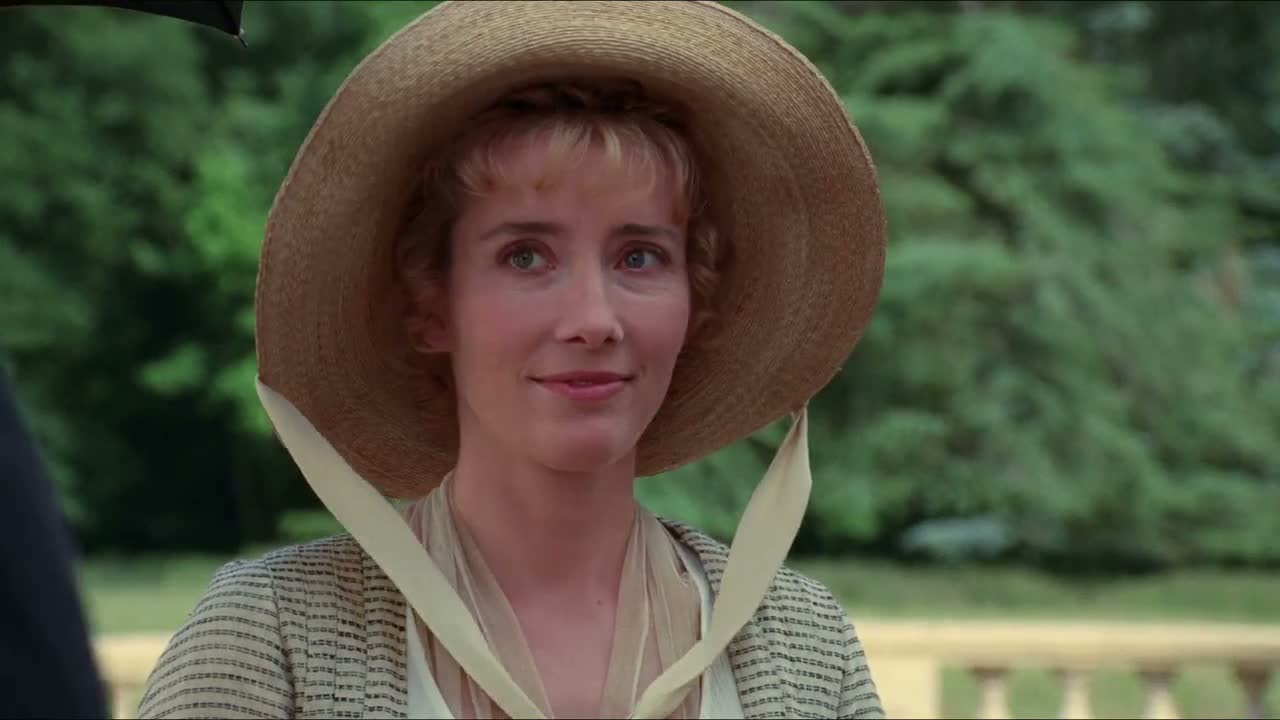
“If there was any true impropriety in my behaviour, I should be sensible of it.”
It surrenders nothing while sounding gentle: if I were wrong, I would already know it.
Formal
Chapter 11 of 27 · 3'41"
Colonel Brandon calls to invite the Dashwoods to a picnic at Delaford and makes a point of including Willoughby. Earlier, Marianne defends her openness with Willoughby — 'If there was any true impropriety in my behaviour, I should be sensible of it.' Brandon privately warns Elinor that a woman like Marianne can be ruined by the world.
Marianne Defends Her Openness
❝ Monologue · 5 lines Brandon Wants to Warn Marianne
On the road, Marianne and Elinor argue about her behaviour with Willoughby, and Marianne insists she would know if she had done anything improper. Colonel Brandon then arrives to invite them to a picnic at his estate at Delaford, naming Willoughby among the guests. Later he gently warns Elinor that a woman like Marianne may be ruined by experience.
The chapter is built on two conversations that never quite meet. In the first, Elinor and Marianne argue about propriety, and Marianne refuses the whole logic of it: 'If there was any true impropriety in my behaviour, I should be sensible of it.' She is not defending a specific act but her right to feel openly, and to her the rules only exist to be ignored. Brandon's invitation then quietly puts Willoughby back at the centre of everything, and the picnic becomes a stage for a courtship nobody has admitted to. His warning to Elinor — the story of a woman who was forced into 'a better acquaintance with the world,' whose end was 'only ruination and despair' — is the film saying out loud what Marianne cannot hear. He is describing her future, and she is not in the room to take it in.
A1–C2 is the CEFR scale. Cards above the level you pick fade, and playback will not auto-pause on them.
“If there was any true impropriety in my behaviour, I should be sensible of it.”
It surrenders nothing while sounding gentle: if I were wrong, I would already know it.
Formal
“Do you not begin to doubt your own discretion?”
Instead of accusing, it asks whether you still trust your own judgment, which stings more.
Formal
“The sooner she becomes acquainted with the ways of the world the better.”
The sooner the better turns hard-won experience into a proverb anyone can repeat.
Neutral
“The result was only ruination and despair.”
Two bare nouns close a whole life story, and the restraint is what makes it land.
literary
“You sly thing. It was the Dashwoods she wanted to see, not Delaford.”
A teasing jab lands first, then the real motive is named: she came for the people, not the place.
Informal
“There are no funds for such luxuries at home, poor thing.”
It dresses poverty in polite words and slips in a stab of condescension.
Informal
“You are quite rude today. He used to be an M. P.”
A scolding followed by a rank reminder: two short sentences do all the social work.
Informal
I knew a lady very like your sister... the same impulsive sweetness of temper... who was forced into, as you put it, "a better acquaintance with the world." The result was only ruination and despair. Do not desire it.
Up next · 12swallow one's bonnetThe scene: Colonel Brandon Leaves the PicnicHe comes specifically to issue the invitation for a picnic on his estate, and he makes a point of saying that Willoughby will be included in the party.
Marianne's openness with Willoughby, which has caused gossip. Elinor asks whether she doubts her own discretion, and Marianne refuses to accept the criticism.
He tells of a lady like Marianne who was forced into a better acquaintance with the world and ended in ruination and despair, implying Marianne risks the same fate.
Lucy is the cousins' relation who arrives unexpectedly with Charlotte. Mrs. Jennings teases that it was the Dashwoods Lucy wanted to see, not Delaford.
Brandon's insistence on inviting him shows how completely Willoughby now dominates Marianne's world, even as Brandon quietly warns against exactly that attachment.