
“My affections have long been engaged elsewhere.”
Why it's great
The passive voice hides the cruelty of the decision behind polished manners.
Register
Formal
Use it yourself
I must tell you my heart has long been engaged elsewhere.
Chapter 19 of 27 · 3'55"
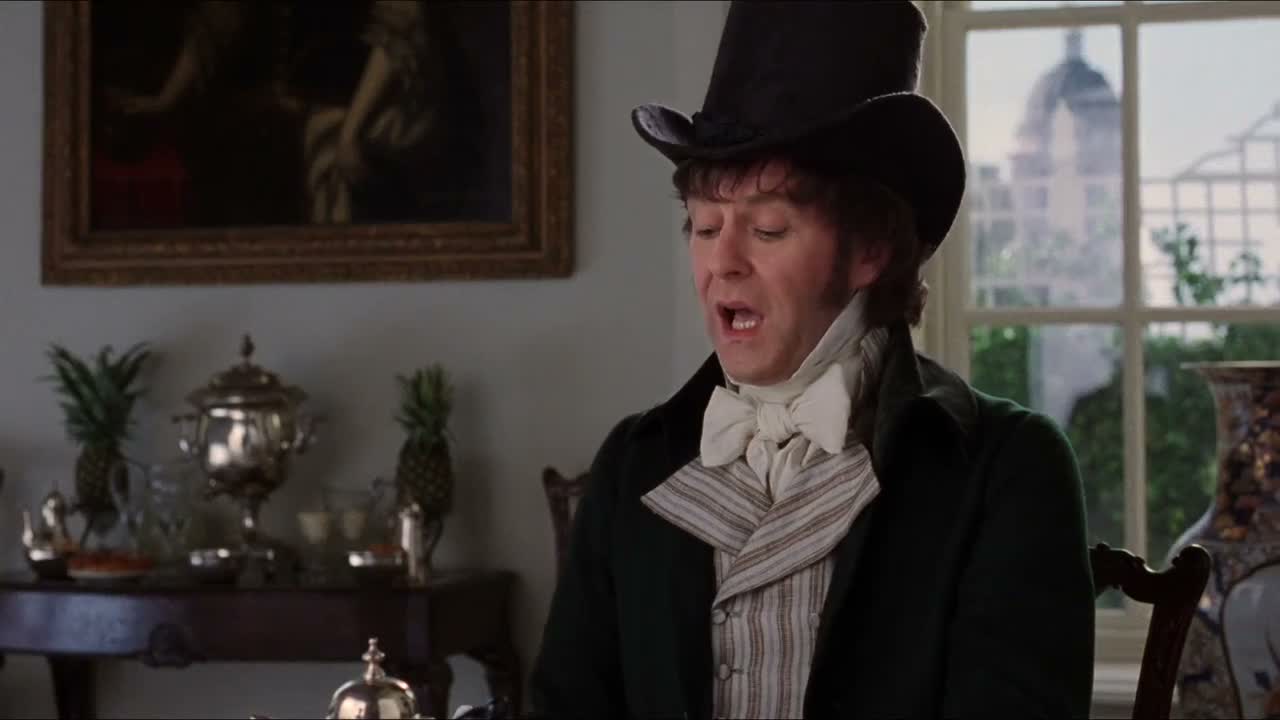
Willoughby's letter returns Marianne's letters and lock of hair and announces that his affections 'have long been engaged elsewhere.' Marianne insists they were never formally engaged — 'It was every day implied, but never declared' — while Mrs. Jennings brings word that he is to marry Miss Grey.
❝ Monologue · 9 lines Willoughby's Letter Is Read Aloud
Marianne Denies They Were Ever Engaged
Willoughby's letter is read aloud: he returns Marianne's letters and the lock of hair, says his affections have long been engaged elsewhere, and blames himself for not having been more guarded. Marianne refuses to accept it, insisting they were never engaged. Mrs. Jennings then reports that Willoughby is to marry Miss Grey, who has fifty thousand pounds.
The letter is the film's cleanest act of cowardice, and the scene around it is about the different ways people refuse to see it. Willoughby writes that his affections 'have long been engaged elsewhere,' which turns a betrayal into a formality, and he offers regret instead of apology. Marianne's response is not denial of his guilt but a defence of her own dignity: she insists they were never engaged, that it was 'every day implied, but never declared,' so that she cannot be said to have been jilted. Elinor will not let her have that comfort — 'He's broken faith with all of us!' — because she can see the plain fact of the abandonment. Then the world arrives with its accounting: Miss Grey has fifty thousand pounds, Marianne has nothing. The chapter holds both truths at once, that Marianne is right about the words and her family is right about what they mean.
A1–C2 is the CEFR scale. Cards above the level you pick fade, and playback will not auto-pause on them.
“My affections have long been engaged elsewhere.”
The passive voice hides the cruelty of the decision behind polished manners.
Formal
“It was every day implied, but never declared.”
The contrast between implied and declared names the exact pain of an undefined romance.
literary
“He's broken faith with all of us! He made us all believe he loved you: He did.”
The repeated He did turns a statement into a verdict no one can soften.
Informal
“He loved me as I loved him.”
The plain symmetry shows how completely she still believes in the match.
literary
“He's not the only young man worth having.”
It comforts by arithmetic rather than sympathy, which is exactly this speaker.
Informal
“With your pretty face, you'll never want for admirers.”
A blunt compliment turns into comfort, grounded in something the girl can see.
Informal
“It is perhaps fortunate that none of them knows of your engagement.”
Calling it fortunate turns an embarrassment into a quiet piece of strategy.
Formal
"My dear madam, I'm at a loss... to discover how I could have offended you. My esteem for your family is very sincere... but if I have given rise to a belief of more than I felt or meant to express... I shall reproach myself for not having been more guarded. My affections have long been engaged elsewhere. It is with great regret that I return your letters and the lock of hair... which you so obligingly bestowed upon me. I am..." Etcetera. "John Willoughby."
 Up next · 20imagine the worstThe scene: Brandon Confesses His Past to Elinor
He says he cannot understand how he offended her, that he regrets not being more guarded, that his affections have long been engaged elsewhere, and that he returns her letters and the lock of hair.
No. Marianne insists they were never formally engaged, that his love was every day implied but never declared, so there was no vow for him to break.
Because he made the whole family believe he loved Marianne. She says he has broken faith with all of them, regardless of any formal engagement.
Miss Grey, a woman with fifty thousand pounds. Mrs. Jennings brings the news, comparing her wealth with Marianne's poverty.
Clumsily. She tells her that Willoughby is not the only young man worth having and that with her pretty face she will never want for admirers.