
“Not unlike a well-groomed jungle and, frankly, a little terrifying.”
Why it's great
A garden described as a groomed jungle: elegance and menace in one breath.
Register
literary
Use it yourself
The office was not unlike a library, and just as quiet.
Chapter 3 of 27 · 2'25"
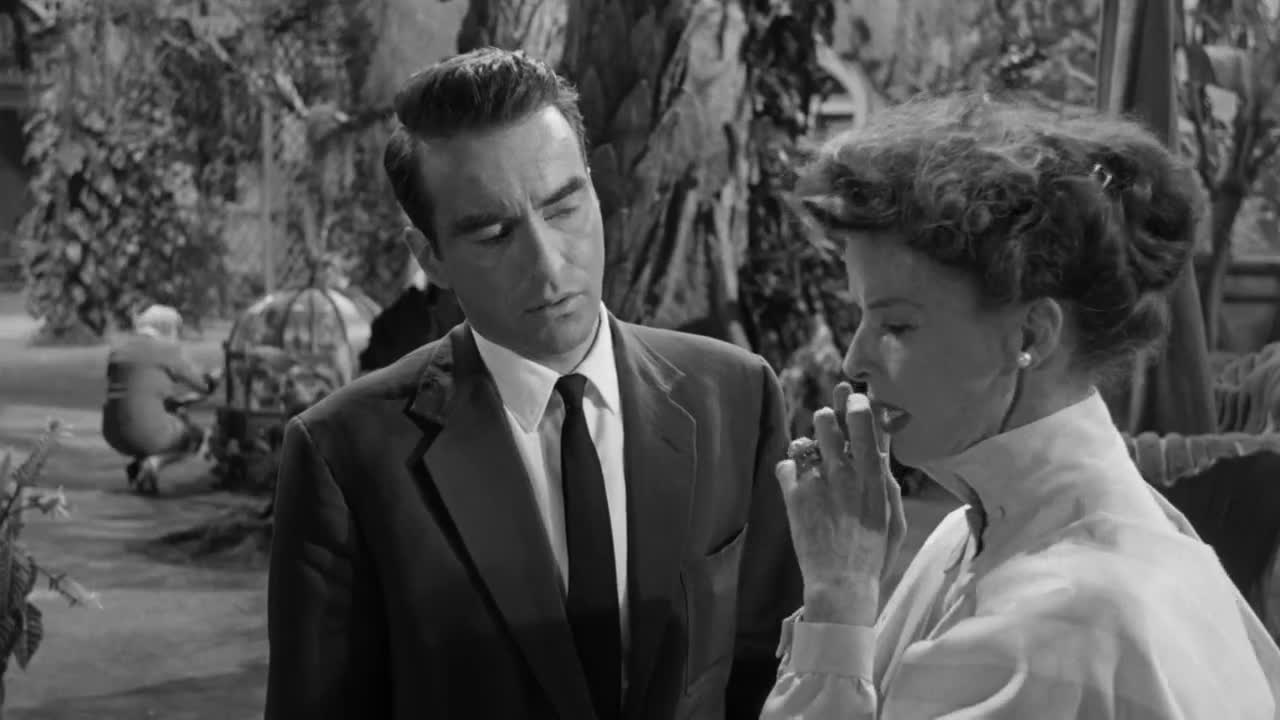
Mrs. Venable walks the doctor through her dead son's garden, admiring a well-groomed jungle and a Venus flytrap that lures and devours its prey. Then she casually drops the word "Lobotomy," and talks about her son the poet, whose life, she insists, was his work.
Mrs. Venable Tours the Garden
❝ Monologue · 4 lines Mrs. Venable on Sebastian the Poet
❝ Monologue · 5 lines The Poet's Life, Going in Circles
She repeats and reverses until the idea sounds less like logic and more like a prayer.
Mrs. Venable takes Dr. Cukrowicz through Sebastian's garden, showing off ancient plants and a Venus flytrap that traps flies in its chalice. She asks him about the operation he performs — lobotomy — then turns to praising her dead son, the poet whose 'life was his occupation,' and insists a poet's life and work cannot be separated.
The garden is the scene's real argument. Mrs. Venable shows the doctor a world she controls: plants so old no one can read their labels, a Venus flytrap 'aptly named for the goddess of love,' and a jungle that is 'well-groomed' only because she prunes it. The flytrap, which lures and then never releases its prey, is a quiet image of her household. She slides the word 'lobotomy' in as if it were part of the tour, and only later does the doctor understand why he was invited. Her talk of Sebastian as 'a poet whose life was his occupation' is both grief and a performance of taste; she uses art to make her control sound noble. The scene ends with her claim to be 'right as rain,' a line whose self-mockery hides how much she is managing.
A1–C2 is the CEFR scale. Cards above the level you pick fade, and playback will not auto-pause on them.
“Not unlike a well-groomed jungle and, frankly, a little terrifying.”
A garden described as a groomed jungle: elegance and menace in one breath.
literary
“- Your son was a poet? - His life was his occupation.”
It makes poetry sound like a life without hours or holidays.
Formal
“...aptly named for the goddess of love.”
Naming a flesh-eating plant after the goddess of love makes cruelty elegant.
literary
“Because the work of a poet is the life of a poet. And vice versa.”
An equation that sounds like a riddle states the artist's whole creed in two clauses.
literary
As many times as I've had to answer that question... ...it still shocks me a little to realize... ...that Sebastian Venable the poet was quite unknown... ...outside of a small coterie of friends, including his mother.
That's what I meant when I said his life was his work. Because the work of a poet is the life of a poet. And vice versa. I mean, you can't separate them. I mean... ...a poet's life is his work. And his work is his life, in a special sense.
 Up next · 04mad as a hatterThe scene: Violet Talks About Her Dead Son
It was his creation: ancient plants, a well-groomed jungle, and a Venus flytrap he clearly prized. The garden mirrors his taste — beautiful, controlled, and quietly predatory.
She is testing and recruiting the doctor. Her letter called it an 'urgent matter,' and naming the operation suggests she is planning one for her niece Catherine.
She refuses to separate the man from the art: she says Sebastian's life was his occupation, and that the work of a poet is the life of a poet, and vice versa.
An insectivorous plant that lures flies with scent and traps them in its 'chalice' so they never escape. Mrs. Venable notes it is 'aptly named for the goddess of love.'
It was her dead son's creation, and she keeps it exactly as he left it—ancient plants, a well-groomed jungle, a flytrap he prized. Tending it is how she keeps hold of him.