
“- You're very like him, doctor. - In what way?”
Why it's great
A compliment that is really a comparison, and the doctor asks which part he is being measured against.
Register
Neutral
Use it yourself
You're very like your father when you argue.
Chapter 4 of 27 · 4'16"
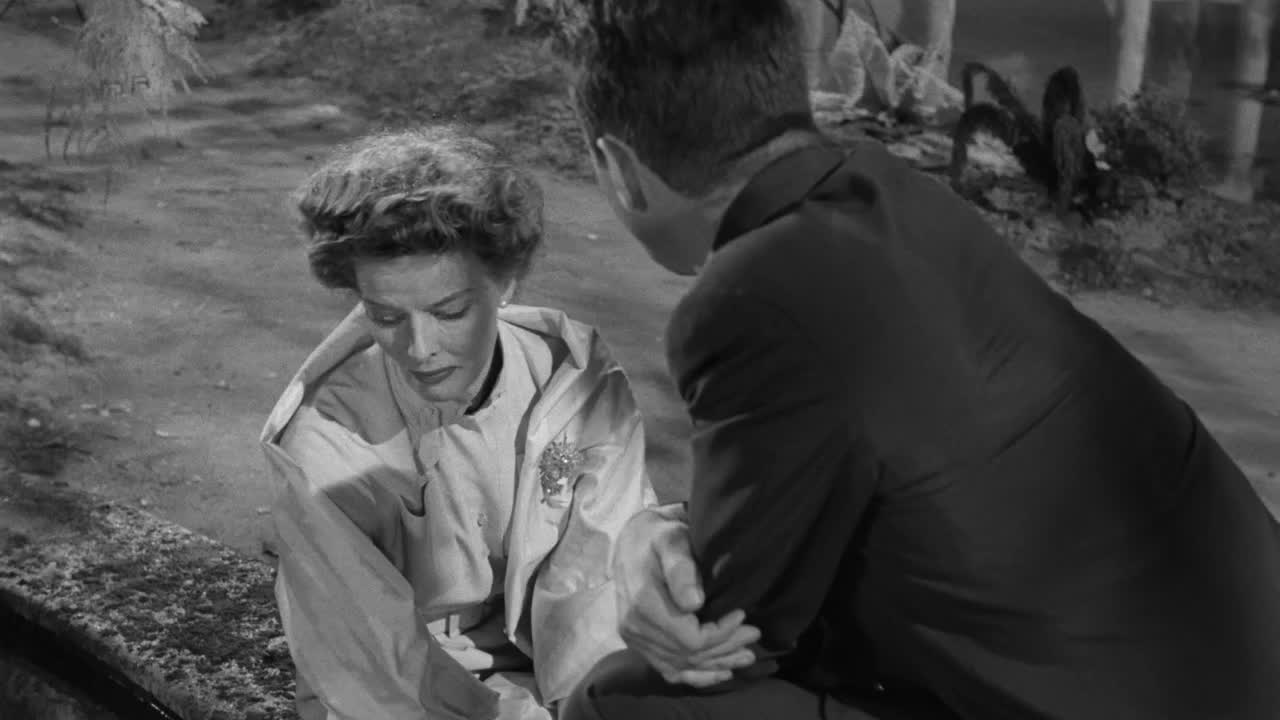
Violet Venable welcomes a young surgeon and turns the conversation into a seduction of sympathy. She flatters him, mentions her mad niece Catherine, then walks him to her dead son's studio and speaks of him as an artist: "quiet desperation is the word for most lives. But ours were different." The charm is the trap.
❝ Monologue · 9 lines Violet on Ordinary Lives
❝ Monologue · 8 lines The Famous Couple
She calls it vanity, then savours every detail of being watched.
At her New Orleans mansion, Violet Venable receives Dr. Cukrowicz. She praises his newspaper words as 'almost poetic,' tells him her niece Catherine is shut up at St. Mary's and 'mad as a hatter,' and shows him her dead son's studio. There she describes Sebastian and herself as a famous pair whose days were carved like sculpture, unlike ordinary lives.
The scene is a long, elegant seduction. Violet wants the doctor to operate on Catherine, but she never asks directly; she flatters him, compares him to her dead son, and shows him the studio where Sebastian worked. Her language turns people into art: 'Using people the way he did. Grandly, creatively. Almost like God.' The doctor answers, 'I'm afraid my art is to help. Not to use, but to be used.' That exchange is the whole conflict in miniature — she treats others as material, he refuses to. When she calls ordinary life 'trails of debris' and says most lives are 'quiet desperation,' she reveals a world view that justifies almost anything. And the title line lands here: 'until suddenly, last summer.'
A1–C2 is the CEFR scale. Cards above the level you pick fade, and playback will not auto-pause on them.
“- You're very like him, doctor. - In what way?”
A compliment that is really a comparison, and the doctor asks which part he is being measured against.
Neutral
“...what are they but trails of debris?”
One rhetorical question turns ordinary lives into litter under her feet.
literary
“...quiet desperation is the word for most lives.”
She borrows a famous phrase to define everyone else, and it flatters her own exception.
literary
“I'm afraid my art is to help.”
One line separates the artist who uses people from the doctor who serves them.
Neutral
Most people's lives... ...what are they but trails of debris? Each day more debris, more debris. Long, long trails of debris... ...with nothing to clean it all up but, finally, death. I guess... ...quiet desperation is the word for most lives. But ours were different. Sebastian's and mine.
I know it sounds hopelessly vain to say... ...but we were a famous couple. People didn't speak of Sebastian and his mother... ...or Mrs. Venable and her son. They said, "Sebastian and Violet. Violet and Sebastian are at the Lido. They're at the Ritz." And every appearance, every time we appeared... ...attention was centered on us.
 Up next · 05at one's wits' endThe scene: Violet Describes Catherine's Madness
She is planning a foundation in memory of her son Sebastian, and she is interested in the doctor's experimental surgery. Her real aim is to have him treat her niece Catherine.
Catherine is Violet's niece by marriage, kept at St. Mary's, a custodial home. Violet says she has dementia praecox and is 'mad as a hatter,' though the doctor questions the label.
It means completely insane. The phrase comes from hatmakers, who once worked with mercury and were rumoured to go mad, so a 'mad hatter' became a byword for craziness.
As a poet who refused fame, hated false values, and lived as her partner. She says they were a famous couple whose days were carved like sculpture, unlike ordinary lives.
He says his art is to help, not to use people, and that he would rather be used than use others. It is a direct answer to Violet's praise of using people 'almost like God.'