00:00 / 04:11
00:00 / 04:11

General Wynne-Candy Is Taken Prisoner, Explained

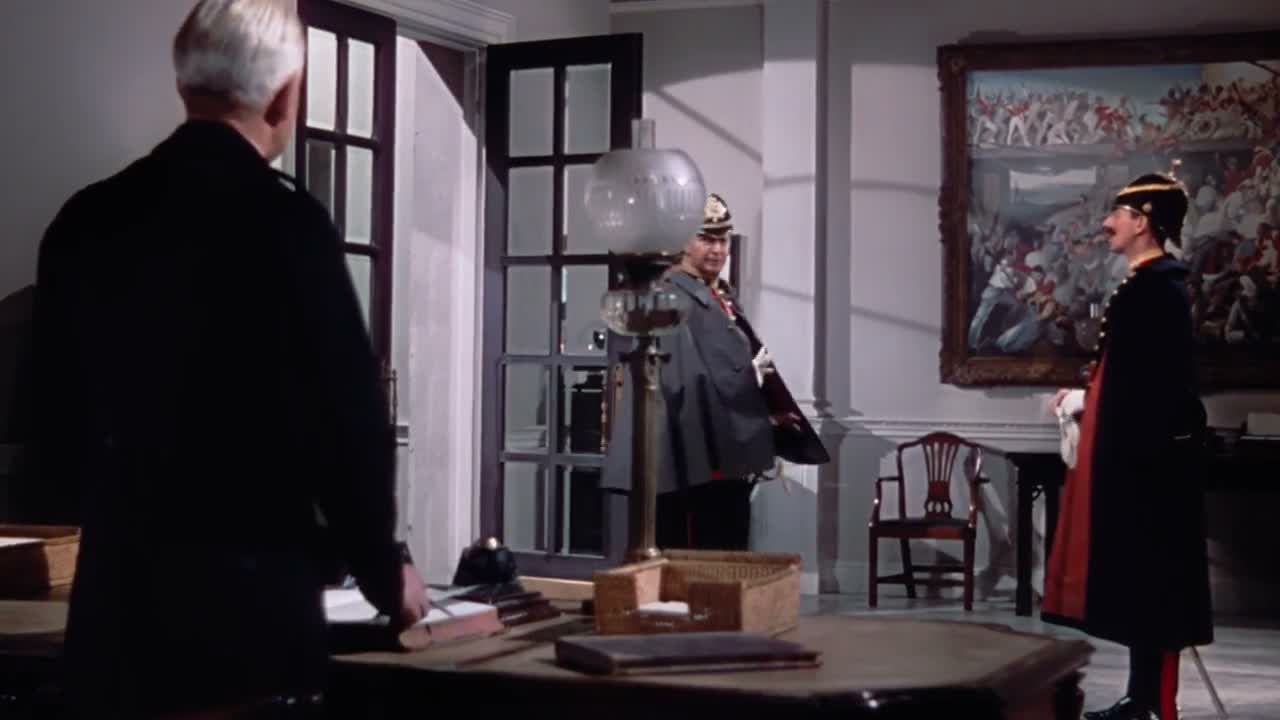
The exercise is called off before it begins: young soldiers storm the baths and take the general prisoner hours early. When he protests that "war starts at midnight," he is told the rules do not matter — "On the authority of these guns and these men."

ArgumentsAccusationsConfrontingComplainingBoss & employeeB2mediumbritish

Key moments

Start here, then watch the full scene
  1. The General Is Told the Rules Don't Matter

    1:15–2:25
    70s
  2. ❝ Monologue · 5 lines The general's lecture

    It corrects the name, lists the medals and quotes Napoleon, so wounded pride dresses up as authority.

    2:44–3:03
    19s
  3. The Old Man and the Impertinent Lieutenant

    3:08–4:08
    61s
  1. ❝ MonologueThe general's lecture5 linesPractice page ↗

General Wynne-Candy Is Taken Prisoner, explained

What happens

Young officers burst into the steam room and arrest General Wynne-Candy as a prisoner of the exercise, hours before it is due to start. He objects that war begins at midnight; they answer that the timetable is just a rule the enemy will ignore. The argument becomes a lecture on how wars are really won.

What's really going on

The scene is a generational argument staged as a military exercise. Wynne-Candy, the old soldier, believes in the agreed rules — war begins at midnight, so no one may move before then. The young officer answers with the logic the film keeps returning to: the enemy never honoured those rules, so "we agree to keep to the rules, and they go on kicking us in the pants." What is really being contested is not the timetable but the idea of war itself: the general's notion of a fair, rule-bound contest against the younger man's willingness to win by any method. Wynne-Candy's reply, that he promised only to defend his country, by every means since Cain killed Abel, is the film's central question. The two of them circle each other with insults and dignity, and the exercise turns into a rehearsal for a much larger change.

Key lines & what they mean

“On the authority of these guns and these men.”
The young officer's answer to a demand for legitimate orders: his authority is simply force, which is exactly the logic the old soldier cannot accept.
“We agree to keep to the rules, and they go on kicking us in the pants.”
The argument against fighting fair: one side keeps its promises while the other keeps breaking them, which is framed as self-defeating honour.
“I was fighting for my country when your father was still in bumfreezers!”
An age-based put-down: the general measures the younger man's inexperience by his own service, invoking a childhood image to make the point sting.
“If your belly keeps pace with your head, you'll have a bigger one than any of us.”
A backhanded insult about the young man's confidence: if his pride grows as fast as his mind, he will end up the biggest of them all.
“You're an extremely impudent young officer, but let me tell you that in 40 years' time you will be an old gentleman too.”
The general's warning that youth does not last: the young officer will some day be the old man being mocked, so he should watch how he treats one.

Theme

  • Generations — The old soldier and the young officer argue about rules and honour, with Wynne-Candy defending an older code and the lieutenant insisting that code is why they keep losing.
  • Duty — Wynne-Candy's own claim is duty, not rules: he says he swore only to defend his country 'by every means,' which puts him and his critic closer than either admits.

What this chapter teaches

Teaching points

Review right after watching
My level5/12

A1–C2 is the CEFR scale. Cards above the level you pick fade, and playback will not auto-pause on them.

The Life and Death of Colonel Blimp: your progress

Chapter 3 of 30 · about 97 min to go

← Previous
Up next · 04by heartThe scene: Candy Scolds Two Young Officers

Takeaways

What you walk away with
  1. My foot flatly denies the word before it.
  2. Kicking us in the pants means being treated badly.
  3. Beg your pardon can ask for a repeat or apologise.
  4. Authority repeated becomes pure scorn.

People also search

Questions, then the lines
Why do the soldiers arrest the general before midnight?

Because they treat the exercise as real war, not a game with agreed rules. Attacking early is their whole point: the enemy would never wait for a scheduled start.

What does "my foot" mean?

It is a dismissive reply, close to 'nonsense' or 'no way,' used to reject what someone has just said. Here it tears up the claim that the rules were agreed on.

Why does the general refuse to accept the early attack?

Because for him war is a contest with rules. If both sides simply do whatever they like, he argues, the exercise — and the whole idea of honour — becomes a farce.

What is the general's real objection?

He is defending a code, not a schedule. He admits his oath was only to defend his country, which suggests the dispute is really about how war should be fought, not when it starts.