
“You are not now in England.”
Why it's great
It states a plain fact, and the threat lives entirely in 'not now', which makes it colder than a shout.
Register
Formal
Use it yourself
You are not now in your old office, so the rules here apply.
Chapter 8 of 30 · 2'46"
In a Berlin cafe, Kaunitz makes a scene and the room turns on the Englishman. Candy gives as good as he gets, and when he calls the Alldeutsche Verband shameful, the warning comes back: "You are not now in England." From there, the argument only escalates.
Kaunitz Makes a Scene
Calling That Skunk a Friend of Mine
At a Berlin cafe, Kaunitz spots Candy and deliberately makes a scene. Candy tells him to stop, then handles the man himself; the German crowd blames the English visitor. When Candy says the Alldeutsche Verband should be ashamed of itself, a voice reminds him he is no longer in England.
The scene is a diplomatic quarrel played out in a cafe, where manners matter more than fists. Kaunitz turns a personal grudge into a public performance, and Candy refuses to lower himself to it — until he does, and then the room turns his act of self-defence into an insult to Germany. The key line is the cold reminder, "You are not now in England," which tells him that his assumptions about fair play do not travel. Candy answers with the logic that will define his whole life in the film: if the officers belong to that organisation, then they should be ashamed of it too. He is not arguing about the facts on the table; he is insisting that some standards apply everywhere. What the others hear is provocation, and what follows will be a duel.
A1–C2 is the CEFR scale. Cards above the level you pick fade, and playback will not auto-pause on them.
“You are not now in England.”
It states a plain fact, and the threat lives entirely in 'not now', which makes it colder than a shout.
Formal
“It's going a bit far to call that skunk a friend of mine.”
Going a bit far sounds measured, then skunk lands the insult, so politeness and contempt share one line.
Informal
“Then the officers of the Imperial German Army ought to be ashamed of themselves, too.”
Ought to turns an insult into a moral claim, and the closing 'too' throws the charge straight back.
Formal
“This gentleman and Herr Kaunitz are old friends.”
It is a calm lie that rescues the room, dressing open hostility as old friendship.
Neutral
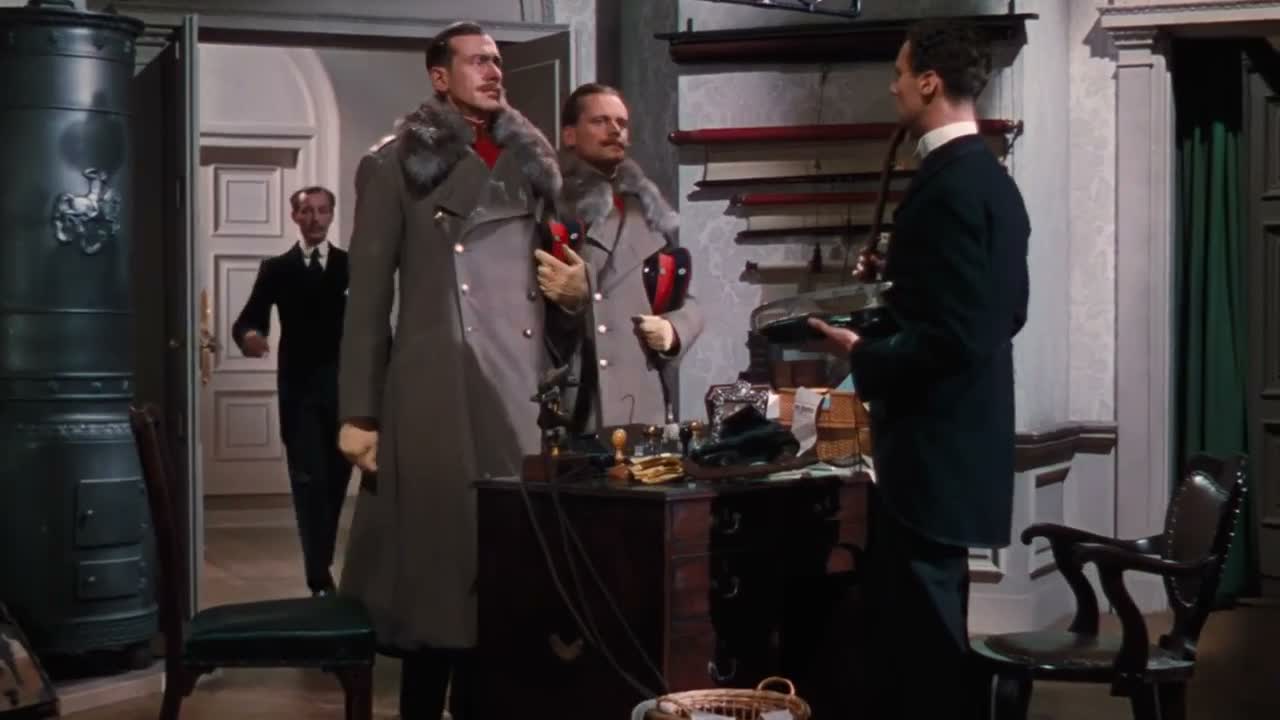 Up next · 09draw lotsThe scene: German Officers Demand a Duel
To humiliate Candy in public. He turns a private grudge into a performance for the room, counting on the crowd to side with him against the foreigner.
It means someone brought the trouble on themselves and deserved what came. Candy uses the idea to justify his response to Kaunitz's provocation.
Because he humiliates a German in front of other Germans. The crowd reads his self-defence as an insult to the country, and they tell him he is not protected by English rules here.
Because they belong to the same organisation he has just condemned. His point is one of principle: if the group spreads lies, its members share the blame, whatever their uniform.