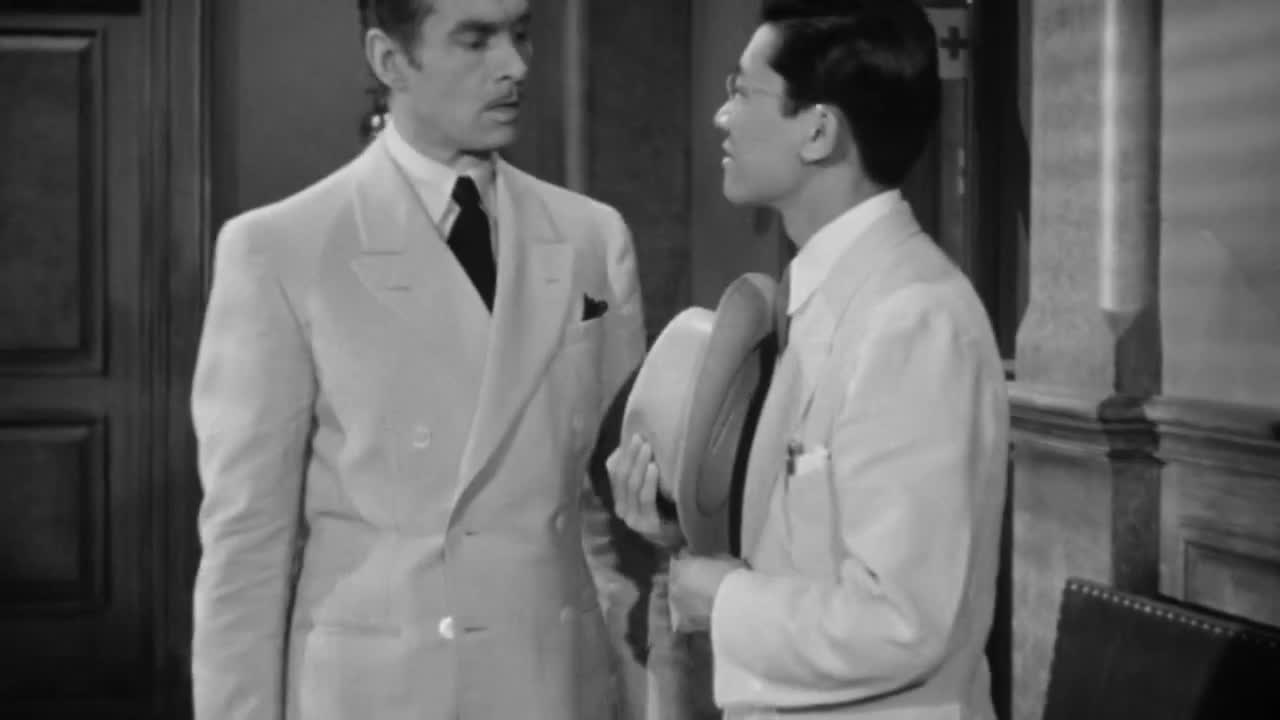
“It's the duty of counsel to defend his client, not to convict her, even in his own mind.”
A quiet creed for his profession, and at the same time an answer to the woman across from him.
Formal
Chapter 9 of 15 · 5'00"
Howard tells Leslie the letter has changed everything: the prosecution can now prove Hammond came at her urgent invitation. Cornered, she asks him to buy the letter from Hammond's widow. He refuses—"You're asking me to do something which is no better than suborning a witness"—then agrees to do what he can.
Howard Refuses to Bribe for the Letter
Howard Reflects on Robert's Trust
Howard shows Leslie how much the letter changes the case: the prosecution can prove Hammond was invited, and a jury might doubt self-defence. Leslie faints. Once they are alone she admits she has made a mess of things and asks who holds the letter—Hammond's wife. Then she urges Howard to buy it.
The letter turns a comfortable acquittal into a threat, and Leslie's response is to reach for money. Howard first sets a boundary—"I don't want you to tell me anything but what is needed to save your neck"—then draws his own: buying the letter is "no better than suborning a witness." Leslie presses exactly where she knows it will hurt, asking whether he could save her and simply won't. Howard calls the idea insane, yet the scene ends with him agreeing to "do what I can," planning to keep Robert from ever seeing the letter. The last line is the coldest: "It's strange that a man can live with a woman for 10 years and not know the first thing about her."
A1–C2 is the CEFR scale. Cards above the level you pick fade, and playback will not auto-pause on them.
“It's the duty of counsel to defend his client, not to convict her, even in his own mind.”
A quiet creed for his profession, and at the same time an answer to the woman across from him.
Formal
“I don't want you to tell me anything but what is needed to save your neck.”
He draws the line before he helps: no confession needed, only what will save her.
Formal
“That's neither here nor there, Leslie.”
An old phrase waves her accusation away without a fight and without a lie.
Neutral
“Are you going to let them hang me?”
She puts her own life on the table, and the question leaves him no polite exit.
Informal
“Do you think it's so easy to do away with unwelcome evidence?”
Another question, not for information but to puncture the ease of her plan.
Neutral
“I don't know if you'll understand this, but I've always looked on myself as an honest man.”
He claims his own honesty while being asked to do something corrupt: the contradiction is the man.
Formal
“You're asking me to do something which is no better than suborning a witness.”
He names her request as a crime, turning a favour into an offence in one line.
Formal
“It's strange that a man can live with a woman for 10 years and not know the first thing about her.”
The scene closes on a sigh: ten years of marriage, and he never knew her at all.
Formal
Up next · 10go to the devilThe scene: Ong Chi Seng Names His PriceHe says paying to remove evidence would be no better than suborning a witness, and he wants to keep seeing himself as an honest man.
She assumes the only obstacle is cost and offers Robert's savings, not realizing Howard's objection is to the act itself.
He agrees to "do what I can": he will try to buy the letter and keep Robert from ever seeing it, while still defending her at trial.
She says that if Robert loses his trust in her he loses everything, so she needs the letter hidden to protect him as much as herself.
It points to the distance between Robert's faith in Leslie and the truth about her, which Howard has now seen for himself.