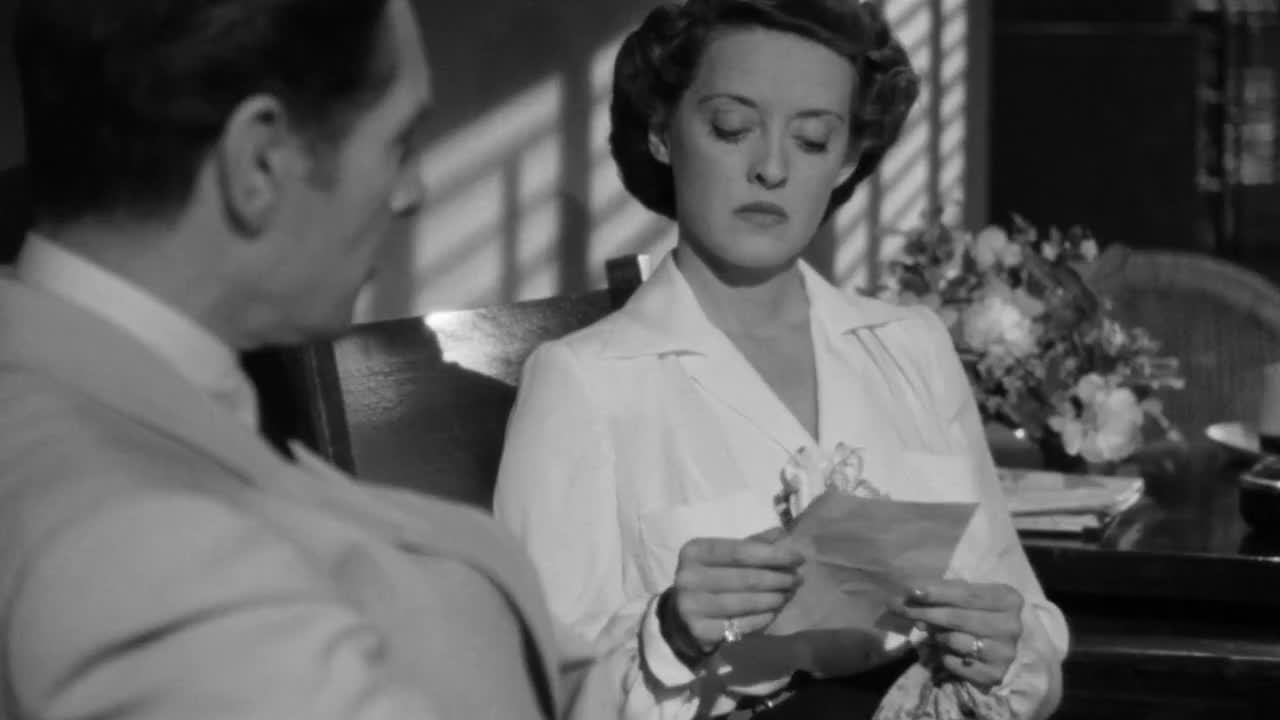
“Oh, fine, thanks. It's a different place since Mrs. Crosbie's been here.”
A compliment that keeps its distance: warm enough for the matron, guarded enough for a prisoner.
Neutral
Chapter 7 of 15 · 3'21"
On the surface it's a lawyer checking on his client before trial. Underneath, Howard is testing Leslie's story, and it holds: she repeats it “in exactly the same words.” Then he produces a letter in her handwriting asking Hammond to come. “But that's not my handwriting,” she insists — a denial the rest of the film will test.
Her Story Never Changes by a Hairsbreadth
Leslie Denies the Letter in Her Handwriting
At the prison where Leslie awaits trial, her lawyer Howard Joyce pays a visit. They chat about her garden and her husband Robert, then Howard turns to the case: he asks whether she had any contact with Hammond and reminds her how identical her account has been. Finally he shows her a letter and tells her to read it herself.
The visit looks like kindness — flowers, small talk, concern for Robert — but it is really an interrogation, and Howard runs it gently. “Every time you've told your story, you've told it in exactly the same words,” he observes; that could mean honesty or rehearsal, and he lets Leslie hear both. Her answers are smooth until the letter appears. The scene's real subject is the gap between Leslie's composed performance and the evidence against her. When she says “But that's not my handwriting,” the audience has to decide whether she is innocent, lying, or simply unable to admit what she did.
A1–C2 is the CEFR scale. Cards above the level you pick fade, and playback will not auto-pause on them.
“Oh, fine, thanks. It's a different place since Mrs. Crosbie's been here.”
A compliment that keeps its distance: warm enough for the matron, guarded enough for a prisoner.
Neutral
“Oh, how lovely. I do miss my garden.”
The line pulls her back to a lost garden; the plainer it sounds, the heavier it lands.
Neutral
“He's much more anxious about you than you seem to be about yourself.”
A single comparison measures two anxieties and quietly speaks for the absent husband.
Neutral
“One of the things that's impressed me is that every time you've told your story, you've told it in exactly the same words.”
He never calls her a liar; he only notes the words never change, which is sharper.
Formal
“Well, we didn't have anything much in common.”
A flat, believable reason that hides the real one behind it.
Informal
“Horrible. She was all covered with gold chains and bracelets and spangles, her face like a mask.”
A rush of ornaments plus one mask image carries both disgust and envy at once.
Informal
“But that's not my handwriting.”
She denies only the handwriting, and the shortest possible line sounds the most rehearsed.
Neutral
Up next · 08talk very plainlyThe scene: Howard Confronts Leslie About the LetterHe wants to see how she reacts and to prepare her: if the letter can be traced to her, the defense has to deal with it before it surfaces in court.
She insists it isn't, but Howard calls it an exact copy of one written the day Hammond died, so her word is set against the evidence.
It means the smallest possible amount. “You've never varied a hairsbreadth” means her story never changed even slightly.
An old friend the Crosbies used to see socially, according to Leslie; Howard suspects the two were once much closer and is pressing her on it.
She denies the handwriting, and the question of whether the letter is hers hangs over the coming trial and her defense.