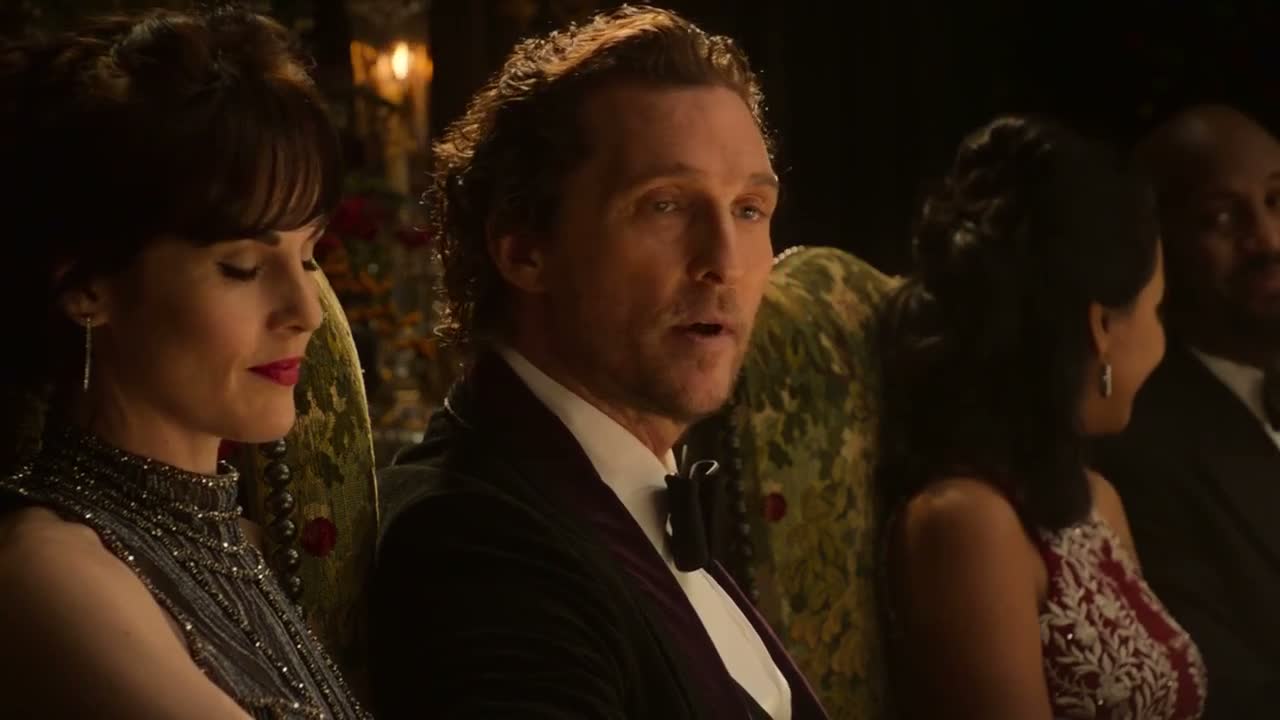
“And I want you to join me on this cinematic journey, 'cause it is cinema, Ray.”
He wraps a threat inside an invitation to cinema, so menace starts to sound like showmanship.
Informal
Chapter 1 of 15 · 2'10"
Fletcher, drinking a bottle of scotch worth a fortune, refuses to lower his price and turns his pitch into a movie. He asks Ray to imagine a character, insists on film, grain and old-school cinema, and invites him along on the 'cinematic journey' — while insulting him with a smile.
❝ Monologue · 11 lines Fletcher Turns His Pitch Into a Movie
At Mickey Pearson's mansion, the journalist Fletcher shares an expensive scotch with Ray and refuses to lower his price. He proposes a game: Ray must imagine a dramatic character, on actual film, not digital. Fletcher calls it a 'cinematic journey,' names the old-school format, says 'roll camera,' and starts narrating his protagonist.
The scene is the film explaining its own method. Fletcher refuses to just tell Ray the story; he makes Ray watch it the way he wants it told — on film, with grain, in the old-school format — and his insistence on 'cinema' is both an aesthetic credo and a power move. He controls the frame, so he controls the deal. The language slides between threats and flirtation — he calls Ray lucky, jokes about talking dirty, and says that what he could ask for is bigger than what he is asking — and the charm is the trap. The line "And I want you to join me on this cinematic journey" is the invitation that is really a demand, and the cut to "roll camera" turns an extortion pitch into a movie. It is the film telling you exactly how it will be told.
A1–C2 is the CEFR scale. Cards above the level you pick fade, and playback will not auto-pause on them.
“And I want you to join me on this cinematic journey, 'cause it is cinema, Ray.”
He wraps a threat inside an invitation to cinema, so menace starts to sound like showmanship.
Informal
“Yeah, but I would argue that you're lucky, because that is nothing”
Flipping an extortion into you're lucky turns the victim into the one who owes thanks.
Neutral
“Now, I want you to imagine a character.”
A director's command that quietly takes over the room and the listener with it.
Neutral
“Analog. Chemical process. Keep the grain in the picture, I say.”
A film-purist creed delivered mid-threat, insisting texture still matters here.
Informal
Now, I want you to imagine a character. a dramatic character, like in a book or a play or a film. But not digital, not on a memory stick. Analog. Chemical process. Keep the grain in the picture, I say. Now I'm seeing this through a lens, I am. It's not TV, Raymond. As I said, old school cinema format. And I want you to join me on this cinematic journey, 'cause it is cinema, Ray. It's beautiful, beautiful cinema. Now, roll camera. Enter our protagonist.
The Gentlemen: your progress
Chapter 1 of 15 · about 42 min to go
Up next · 02pull the plug onThe scene: Mickey and Matthew's Dinner StandoffIt keeps him in control of how the events are framed and lets him move between charm and threat. By casting it as cinema, he decides what Ray sees and when.
He says his quote is his quote and argues Ray is lucky, because what he is asking is small compared to what he could demand. The refusal is part of the pressure.
He wants Ray to imagine a dramatic character, as if in a book, play, or film, and he insists it be played on film rather than digital — a storytelling game that is really a power play.
He mixes insults with flattery on purpose. The crude jokes and the expensive scotch are all part of the same performance, keeping Ray unsettled while the deal is negotiated.