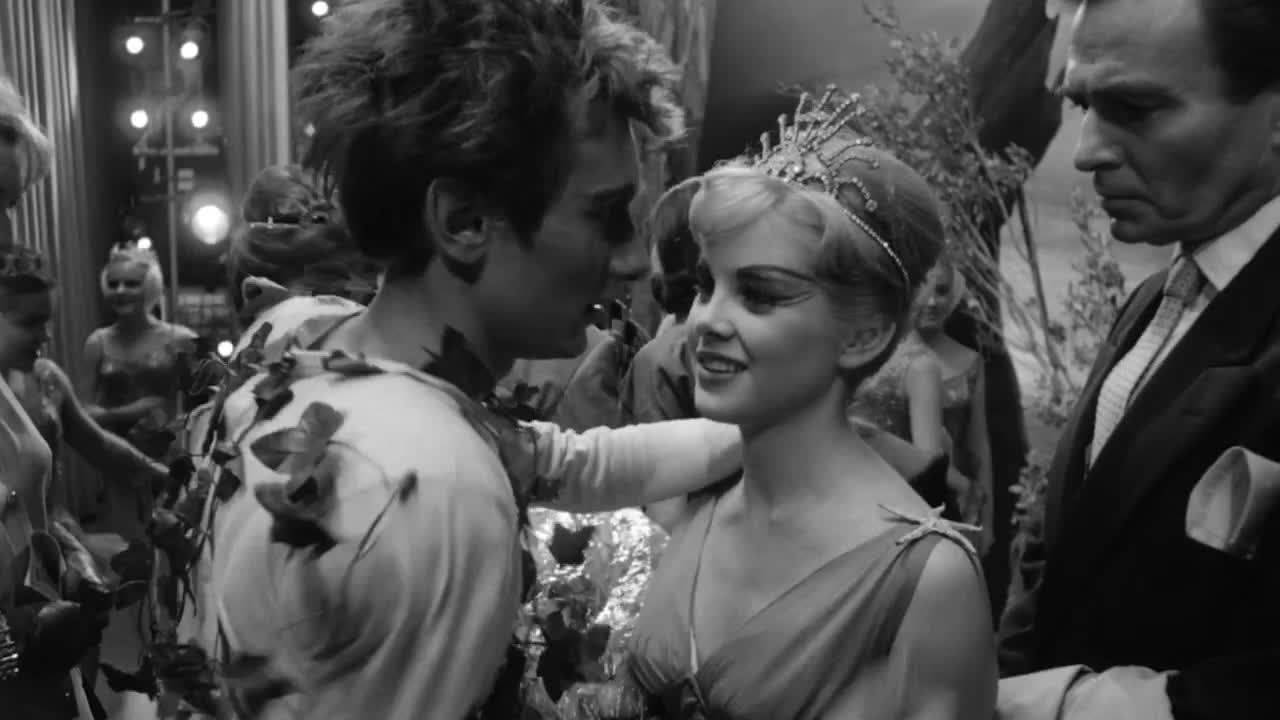
“I sat in the dark so as to save you the expense of the electricity. Ha-ha-ha.”
He dresses up sitting uninvited in the dark as kindness, then tops it with a dry laugh.
literary
Chapter 23 of 30 · 4'33"
A school psychologist, Dr. Zemph, calls at Humbert's house to raise concerns about Lolita: has anyone taught her "the facts of life," and why is she so restless in class? He proposes a home visit by a district psychologist, and Humbert grows colder with every word.
❝ Monologue · 15 lines The Psychologist Asks About Lolita
Reading Lolita's School Report
Dr. Zemph introduces himself as the Beardsley High School psychologist and says Lolita let him in. He asks whether anyone has instructed her in the facts of life, reads out her school reports, and warns that her behavior suggests repression. His solution is a visit from a district psychologist and a three-member board.
The visit is an inspection dressed as concern. Dr. Zemph is polite and faintly sinister, sitting in the dark to save the electricity and then asking, "has anybody, uh, instructed Lolita in the facts of life?" From there he moves to evidence: the class reports, the gum, the lipstick word on a health pamphlet, and a diagnosis of repression. His proposal is the real threat — a district psychologist and three colleagues coming into the house to investigate the home. Humbert answers with polite stalling and one blunt denial, "But she's not being repressed, Dr. Zemph." The scene works because both men keep smiling while negotiating over a girl neither of them treats as a person in the room.
A1–C2 is the CEFR scale. Cards above the level you pick fade, and playback will not auto-pause on them.
“I sat in the dark so as to save you the expense of the electricity. Ha-ha-ha.”
He dresses up sitting uninvited in the dark as kindness, then tops it with a dry laugh.
literary
“Dr. Humbert, would you mind if I am putting to you the blunt question?”
A polite request that is really an interrogation, made stranger by his broken tense.
Formal
“You and I, what are we?”
Naming the two of them before the question stages a shared identity he can preach from.
literary
“We are symbols of power, sitting in our offices.”
He crowns them both as power before asking, a soft way of pressing Humbert to agree.
literary
“"She either has exceptional control or she has no control at all."”
The either-or traps her between two extremes, and the calm symmetry makes it cruel.
Neutral
“But she's not being repressed, Dr. Zemph.”
He rejects the doctor's favorite word outright, the polite name at the end making it harder.
Formal
Well, Dr. Humbert, to you she is still the little girl what is cradled in the arms... ...but to those boys over there at the Beardsley High... ...she is a lovely girl, you know... ...with the swing, you know, the jazz... ...and she has got the curvatures which they take a lot of notice of. You and I, what are we? We are symbols of power, sitting in our offices. We are making the signatures, writing the contracts... ...and decisions all the time. But if we cast our minds back.... Just think, what were we only yesterday? Yesterday, Dr. Humbert... ...you and I were little High School Jim... ...and we were carrying High School Jane's schoolbooks. You remember those days?
Up next · 24have a nerveThe scene: Humbert Grills Lolita After the PlayHe is the Beardsley High School psychologist, and Lolita let him in on her way to a piano lesson. He has school reports about her restlessness and wants to talk about her behavior with Humbert.
It is a polite old phrase for sexual knowledge. Zemph uses it to ask whether anyone has explained such things to Lolita, which is the question Humbert least wants to answer.
Dr. Cudler, the district psychologist for the Board of Education, and his three-member board of psychologists. Zemph proposes that the four of them visit the home and investigate the source of Lolita's supposed repression.
An official investigation of the home is the one thing he cannot allow. He answers politely but refuses to cooperate, denying that Lolita is repressed at all.
He listens politely and keeps pressing. When Humbert says Lolita is not repressed, Zemph asks whether to take that as a refusal to cooperate, and the exchange becomes a standoff.