
“Sweetheart, I don't want any secrets between us.”
Why it's great
It defines closeness as having no secrets, which sounds tender but works as a demand.
Register
Neutral
Use it yourself
I don't want any secrets between us, so ask me anything.
Chapter 11 of 30 · 2'33"
Married only a day, Charlotte talks to Humbert through the bathroom door, asking whether he kept secrets, whether he feels as insecure as she does, and how many women came before her. "I think it's healthy for me to be jealous," she says, while he answers as little as he can.
❝ Monologue · 6 lines Humbert Marries Charlotte
Charlotte Interrogates Humbert
Charlotte, now Humbert's wife, follows him to the bathroom door and will not let the conversation wait. She wants no secrets, says his distance makes her insecure, and asks about the women in his life before her. Humbert answers coolly and finally sends her off to make his coffee.
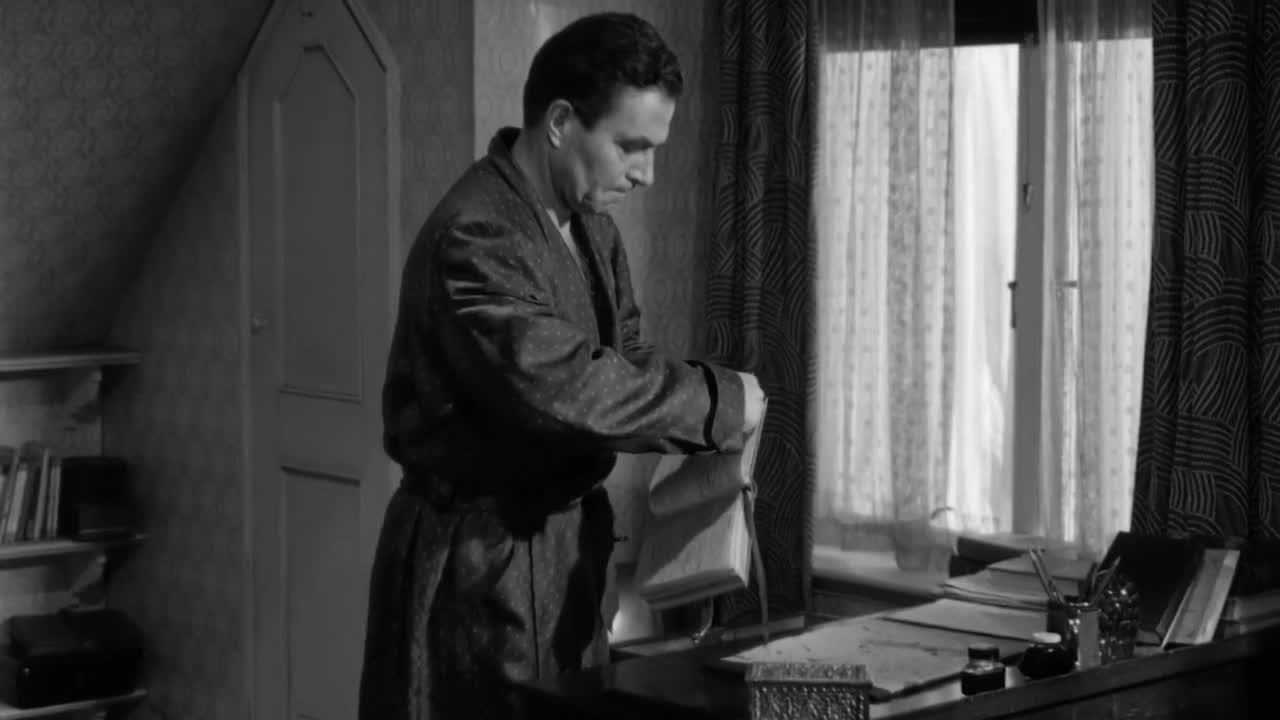
The marriage has just begun, and Charlotte already understands that she is being kept at a distance. She does what insecure people do: she asks for total honesty. "Sweetheart, I don't want any secrets between us," she says through the door, and then admits the real fear — it makes her feel insecure. Humbert, on the other side, gives nothing. He answers with a sarcastic offer to write out a list of every woman he has known, and with the cool order to bring him coffee "like a good little wife." The film plays the scene as comedy, but the balance is already clear: she is pleading for intimacy and he is managing her, and the door between them is the point.
A1–C2 is the CEFR scale. Cards above the level you pick fade, and playback will not auto-pause on them.
“Sweetheart, I don't want any secrets between us.”
It defines closeness as having no secrets, which sounds tender but works as a demand.
Neutral
“Can't this wait till I come out of here?”
A negative question postpones the talk without a flat refusal, keeping the door open.
Informal
“I think it's healthy for me to be jealous.”
Calling jealousy healthy flips a fault into a virtue, and the calm delivery makes it bold.
Neutral
“Were there a lot of women in your life before me?”
A past-tense question that sounds like curiosity but is really an inventory of rivals.
Neutral
“You know how happy I can make you.”
It opens with you know, which turns a promise into something the listener is not allowed to doubt.
Informal
The wedding was a quiet affair... ...and when called upon to enjoy my promotion from lodger to lover... ...did I experience only bitterness and distaste? No. Mr. Humbert confesses to a certain titillation of his vanity... ...to some faint tenderness, even to a pattern of remorse... ...daintily running along the steel of his conspiratorial dagger.
 Up next · 12sacred and profaneThe scene: Charlotte Shows Humbert the Gun
She wants to talk right away and cannot wait for him to come out. The locked door also keeps him at a distance, which is exactly what the scene is about.
She knows Humbert keeps part of his life hidden, and she fills the silence with questions about the women before her. She says she is lonesome and insecure rather than angry.
It means to write out a full list. Humbert offers to list every woman he has known, but as sarcasm — a way to end the questioning rather than answer it.
He is dismissing her and the whole conversation. The phrase turns her into a servant he can send for coffee, and shows how little respect he has for the marriage.
No. He deflects her questions, offers a sarcastic list instead of real answers, and tells her almost nothing about his past.