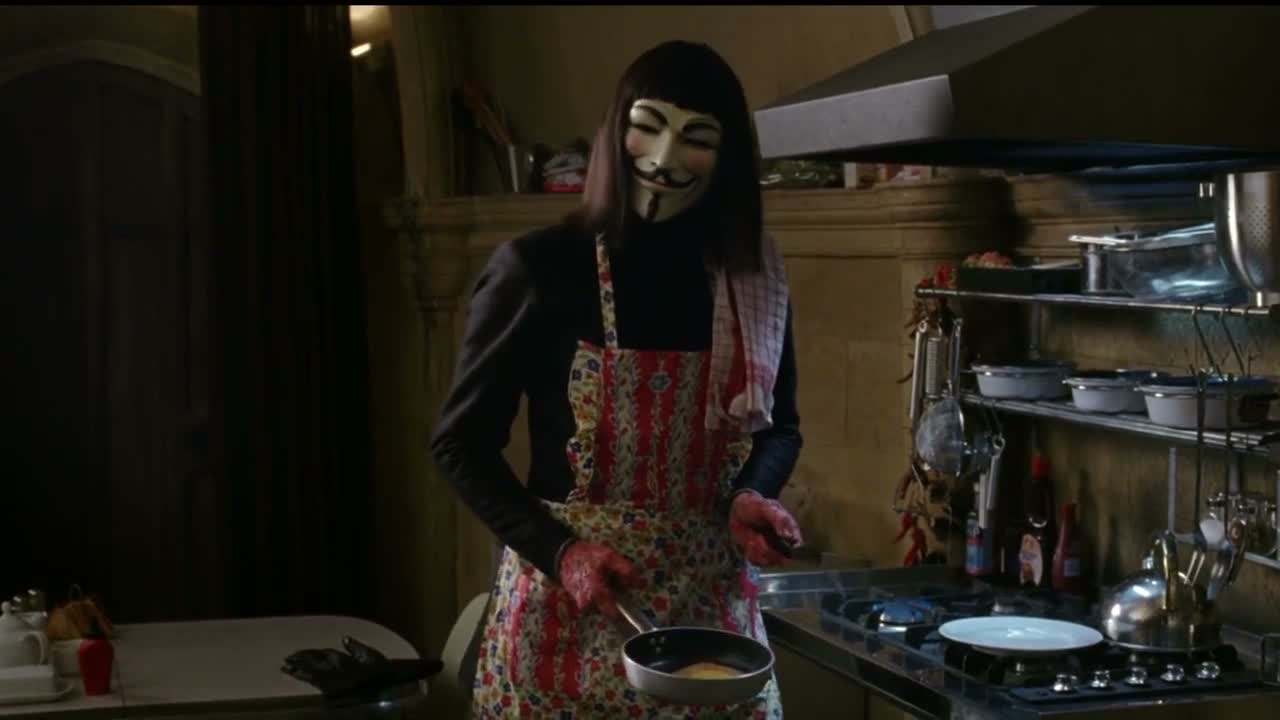
“I suspect if they do, a few bits of art will be the least of my worries.”
It names a huge danger only to call it the smallest problem, which makes the threat land harder.
Neutral
Chapter 6 of 25 · 2'29"
V isn't just showing Evey his hideout; he's telling her she can't leave. "Stealing implies ownership" sounds like a joke about art, but everything here is a claim about who has the right to decide her life. When he says he "couldn't see any other way," it lands less like rescue and more like a sentence.
V's Hideout: Where Stolen Art Lives
❝ Monologue · 9 lines Is It Your Guilt or Theirs?
You Should've Left Me Alone
Evey wakes up in a strange underground room packed with paintings, books and records. V tells her it's his home, the Shadow Gallery, and that he brought her here after she was knocked out. She wants to go home; V refuses, explaining that leaving would put her in Creedy's interrogation rooms.
Officially, V is hosting a guest. Actually, he's holding one. The room is full of art the state called obscene, and V's line — "Stealing implies ownership" — isn't just a quirk. It's the logic he lives by: he refuses to grant the government the ownership it claims, over objects or over people. Evey, meanwhile, is caught between two stories about herself. She says she must have been "out of my mind" for spraying a detective; V asks whether that's what she thinks or what they'd want her to think. Her guilt is exactly what the regime counts on. When she asks to go home and he answers with "I can't take that risk," his protection and her imprisonment turn out to be the same gesture. He saved her life and took her freedom in one move, and he knows it.
A1–C2 is the CEFR scale. Cards above the level you pick fade, and playback will not auto-pause on them.
“I suspect if they do, a few bits of art will be the least of my worries.”
It names a huge danger only to call it the smallest problem, which makes the threat land harder.
Neutral
“Is that what you really think, or what they'd want you to think?”
One either-or question separates what a person truly believes from what power wants them to believe.
Neutral
“They'd imprison you, torture you, and, in all probability, kill you...”
Three verbs pile up and a formal phrase closes it, so the warning sounds like a report rather than a plea.
Neutral
“You should've left me alone.”
It turns a rescue into a regret, and the quiet delivery makes the blame cut deeper than shouting.
Informal
“Why didn't you just leave me alone?!”
The little word just turns a question into an accusation of being cornered against her will.
Informal
“So we know her story. Now we need his.”
Two clipped sentences mirror each other, and the bare his closes the scene like a case note.
Neutral
You have to understand, Evey, I didn't want this for either of us... ...but I couldn't see any other way. You were unconscious and I had to make a decision. If I had left you there, right now you'd be in one of Creedy's interrogation cells. They'd imprison you, torture you, and, in all probability, kill you... ...in the pursuit of finding me. After what you did, I couldn't let that happen... ...so I picked you up and carried you to the only place I knew you'd be safe: Here, to my home.
Up next · 07put someone offThe scene: Breakfast and a Debate With VHe says that if he had left her behind, Creedy's men would pick her up and imprison and torture her to find him. Letting her walk out could expose the Shadow Gallery and get her killed.
Both, and the scene lets both read true. He did save her life after she helped him, but he also decides for her that she can't be trusted to keep quiet, and keeps her underground.
V's argument that theft only exists if you accept that someone owns the thing. Since the state censors and confiscated the art, he says he merely reclaimed what was taken from him.
She used Mace on a detective who was following V. In the scene she calls it madness — "I must have been out of my mind" — while V insists she did what she thought was right.
Evey's parents. They were interned at Belmarsh; her mother died in a hunger strike, her father when the military retook the shed, and her brother was at St. Mary's.