
“But who was he really?”
Why it's great
The film opens its real question: behind the mask, was there a man at all?
Register
Neutral
Use it yourself
But who was she really, behind all those posts?
Chapter 1 of 25 · 4'51"
V's voiceover insists that "an idea can still change the world," yet he admits he misses not the idea but the man. Across town, Lewis Prothero whips up a TV audience with the same rhetoric of faith and judgment, and the Fingermen hunt anyone caught after curfew.
❝ Monologue · 14 lines The narrator's opening
It sets an idea against a mortal man, then quietly turns into longing.
Prothero Rants About America
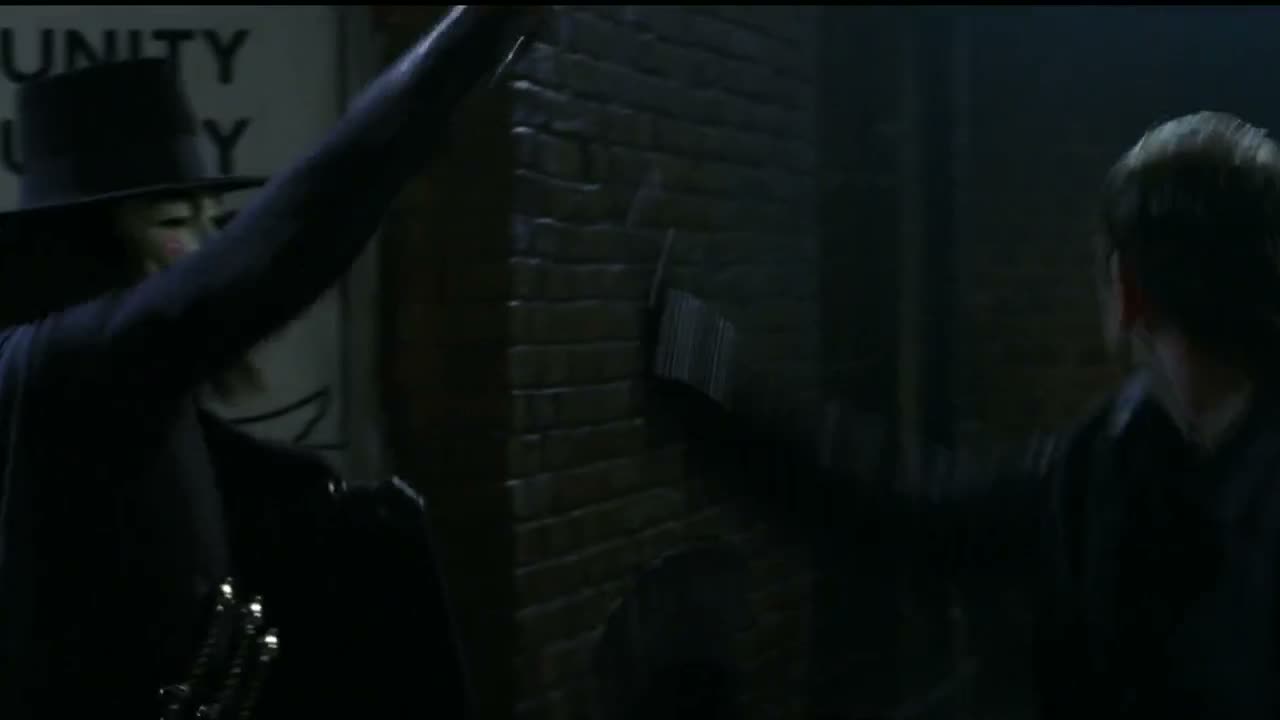
The film opens with V's voiceover over a masked figure: a man, he says, can be caught, killed and forgotten, but an idea cannot. At the BTN studio, broadcaster Lewis Prothero rants about America and whips up his audience. Later that night, Evey is stopped past curfew by the Fingermen — and V arrives to cut them down.
The scene sets up the film's central argument: an idea is dangerous because it cannot be arrested, but it is also incomplete because it cannot be loved or hurt. V says as much when he insists "it is not an idea that I miss. It is a man." Prothero shows the same mechanism from the other side: he wraps hate in the language of faith — "Strength through unity. Unity through faith" — and the crowd cheers. The curfew announcement right after makes the connection plain: state violence and broadcast rhetoric run on the same schedule. When the Fingermen decide to beat Evey because "she just threatened us," they are performing the regime's logic of judgment in miniature. V's rescue is not just heroism; it is the idea meeting a body that can still act.
A1–C2 is the CEFR scale. Cards above the level you pick fade, and playback will not auto-pause on them.
“But who was he really?”
The film opens its real question: behind the mask, was there a man at all?
Neutral
“He can be caught, he can be killed and forgotten.”
Three flat passives stack up to show how easily a man can be erased.
Neutral
“Ideas do not bleed. They do not feel pain.”
It gives an abstraction a body only to strip it of every human feeling.
literary
“No one escapes their past. No one escapes Judgment.”
The repeated sentence leaves no exit: the past and judgment always catch up.
literary
“We did what we had to do.”
A flat confession that hides its weight: they did what they felt they had to.
Neutral
We are told to remember the idea and not the man. Because a man can fail. He can be caught, he can be killed and forgotten. ...an idea can still change the world. I have witnessed firsthand the power of ideas. I've seen people kill in the name of them... ...and die defending them. But you cannot kiss an idea... ...cannot touch it or hold it. Ideas do not bleed. They do not feel pain. They do not love. And it is not an idea that I miss. It is a man. A man that I will never forget.
V for Vendetta: your progress
Chapter 1 of 25 · about 76 min to go
 Up next · 02in lieu ofThe scene: V Introduces Himself to Evey
He is telling Evey that ideas are powerful but impersonal; the person behind them still matters to him, which hints the masked figure has a personal history.
It is British slang for nonsense or rubbish; he is dismissing Evey's story about her sick uncle.
He is the regime's loudest broadcaster, using his show to blame America for the world's collapse and to whip up patriotic anger in support of the government.
She is out after curfew and, when they corner her, she threatens them. Under the regime's rules that lets them act as judge and punish her on the spot.
The film leaves it open: he kills the Fingermen who were about to hurt Evey, but he does it masked, quoting Macbeth, as an act of his own design.