
“...and what I am is a man in a mask.”
Why it's great
After all the wordplay, he lands on the plainest possible self-description.
Register
literary
Use it yourself
What I am is a person who keeps his promises.
Chapter 2 of 25 · 4'40"
V isn't just showing off his vocabulary. "I'm merely remarking upon the paradox of asking a masked man who he is" is his answer to Evey's simple question of who he is — and a warning that his identity is doing the talking. The alliteration and the fireworks are theater: he wants an audience.
❝ Monologue · 13 lines You May Call Me V
V Blows Up Parliament to the 1812 Overture
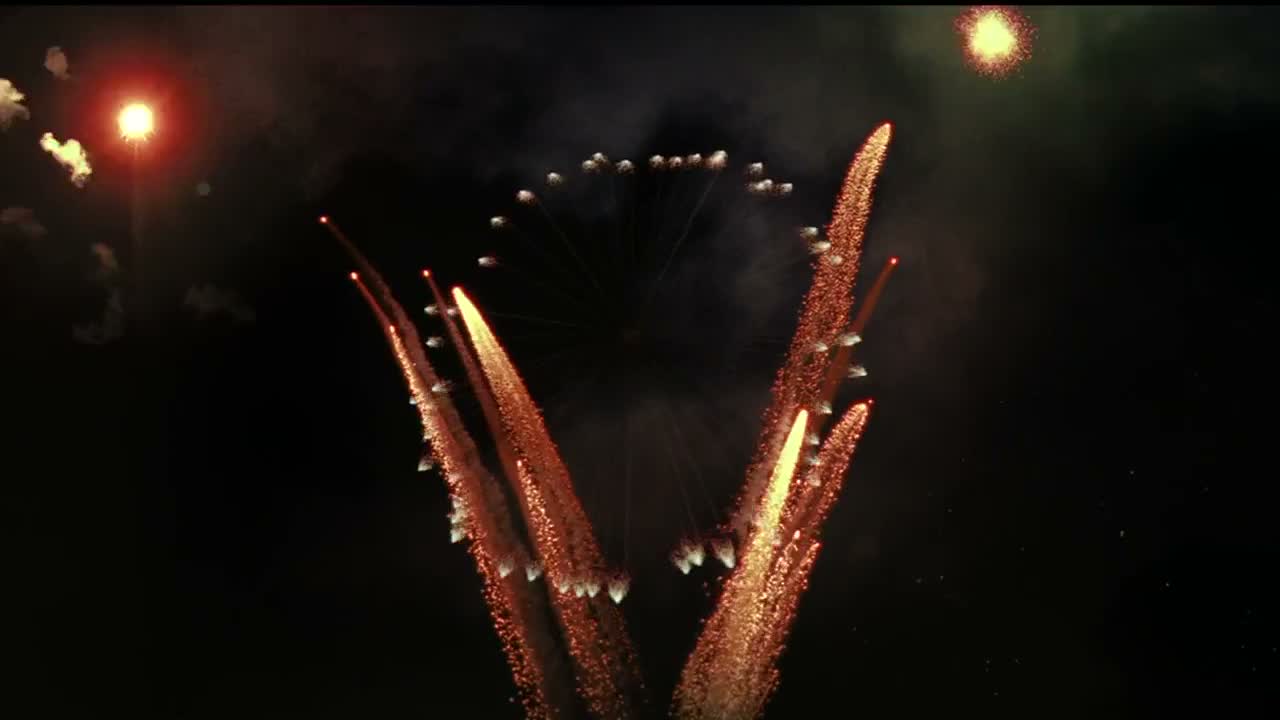
After breaking up an assault in a London street, V leads Evey to a rooftop to watch the Houses of Parliament explode on Guy Fawkes Night. There he introduces himself in a torrent of alliteration — "you may call me V" — dedicating the fireworks to a justice that has gone missing, and invites her to stay and see it.
Evey asks the obvious question — who are you? — and V answers with a riddle: identity is performance. "I'm merely remarking upon the paradox of asking a masked man who he is." He isn't dodging; he's telling her that the mask is the point. The mask hides a man and carries an idea, and an idea, unlike a face, can't be arrested. Notice how carefully he stages everything: a rooftop, an orchestra, an audience of one. When he jokes that his speech is a "vichyssoise of verbiage," he's inviting her into the performance rather than lecturing her. By the end she stops being a bystander and says "I can hear it" — the fireworks are already working on her. He offers safety and spectacle, but what he's really recruiting is a witness.
A1–C2 is the CEFR scale. Cards above the level you pick fade, and playback will not auto-pause on them.
“...and what I am is a man in a mask.”
After all the wordplay, he lands on the plainest possible self-description.
literary
“I'm merely remarking upon the paradox of asking a masked man who he is.”
Polite phrasing makes the other man's question look absurd without a hint of anger.
Formal
“Verily, this vichyssoise of verbiage veers most verbose.”
He admits he is rambling, and the alliteration makes the confession funny.
literary
“I promise you, it'll be like nothing you've ever seen.”
It sells the unknown rather than the thing itself, which is exactly what hooks her.
Neutral
“I know of no reason Why the gunpowder treason Should ever be forgot”
A rhyme older than the plot itself, it turns a historical grudge into ritual.
literary
In view, a humble vaudevillian veteran... ...cast vicariously as both victim and villain by the vicissitudes of fate. This visage, no mere veneer of vanity... ...is a vestige of the vox populi, now vacant, vanished. However, this valorous visitation of a bygone vexation stands vivified... ...and has vowed to vanquish these venal and virulent vermin vanguarding vice... ...and vouchsafing the violently vicious and voracious violation of volition. The only verdict is vengeance, a vendetta... ...held as a votive not in vain, for the value and veracity of such... ...shall one day vindicate the vigilant and the virtuous. Verily, this vichyssoise of verbiage veers most verbose. So let me simply add that it's my very good honor to meet you... ...and you may call me V.
 Up next · 03spinThe scene: Sutler's Cabinet Spins the Explosion
He insists the mask is his identity, not a disguise: 'what I am is a man in a mask.' A name would make him a person the regime could hunt; the idea behind the mask cannot be arrested.
He times it to Guy Fawkes Night, when the 1605 gunpowder plot failed. This time it succeeds — his punishment for a government he calls venal, and a spectacle for a city that has forgotten how to feel.
She has nowhere safer to go, and he promises she will be unharmed and see something she has never seen. Curiosity, and his strange charm, win her over.
In this scene, yes: he keeps his word and she returns home safely. But he is already using her as the witness to his first act, which quietly complicates that promise.
It's French for a cold potato-and-leek soup; here it's a self-mocking joke that his speech is a 'soup of words,' absurdly wordy. V is laughing at his own alliteration.