
“You said you wanted to live without fear. I wish there'd been an easier way...”
Why it's great
It traces the whole ordeal back to one simple wish she once voiced.
Register
Neutral
Use it yourself
You said you wanted to change careers.
Chapter 19 of 25 · 3'25"
Evey finally sees who kept her in that cell: the same man now offering comfort. “You tortured me,” she says, and V doesn't deny it — he insists the ordeal was a lie built to free her. “Your own father said that artists use lies to tell the truth.”
❝ Monologue · 5 lines V's confession
He binds his own suffering to her resistance, making the excuse feel honest.
❝ Monologue · 13 lines V Explains Why He Tortured Evey
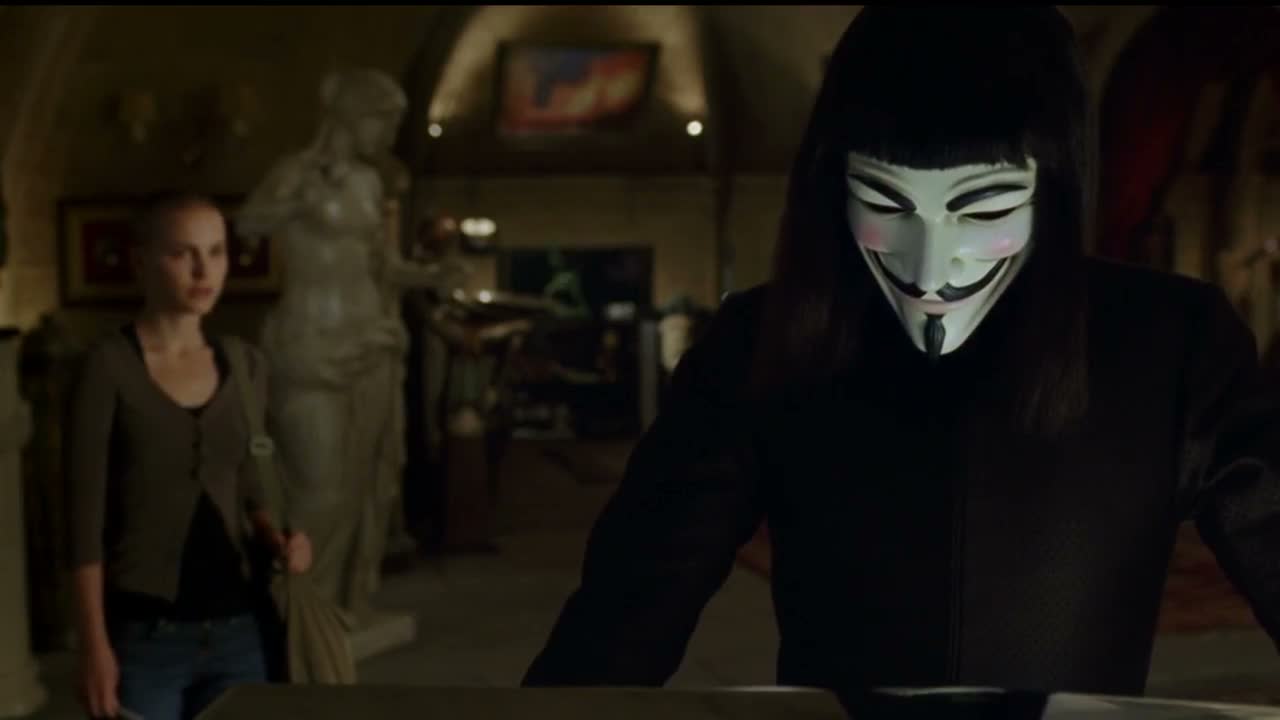
After surviving the fake prison, Evey confronts V and realizes he was the one who shaved her head and tortured her. She calls him sick; V explains that he built a lie so she could find something in herself that mattered more than life. She breaks down, and he leads her toward the roof for air.
This is the film's hardest idea in one room: a lie can be the tool that exposes a truth. Evey's fury is real — “You tortured me” — and V never pretends it didn't happen. His defense is that she refused to break: “But each time you refused to give in, I knew I couldn't.” He argues the fear she conquered was genuine even if the cell was staged, and that what she found there “has nothing to do with me.” Whether that excuses him is left open; the scene makes Evey's pain and V's rationale both audible, then ends with her asking for air.
A1–C2 is the CEFR scale. Cards above the level you pick fade, and playback will not auto-pause on them.
“You said you wanted to live without fear. I wish there'd been an easier way...”
It traces the whole ordeal back to one simple wish she once voiced.
Neutral
“But each time you refused to give in, I knew I couldn't.”
Her refusal is what kept his plan alive; the two are bound together.
Neutral
“Your own father said that artists use lies to tell the truth.”
He defends his lie with her father's own idea, making it almost beautiful.
literary
“But because you believed it, you found something true about yourself.”
It claims a lie can still lead to a genuine discovery about oneself.
Neutral
“What you felt in there has nothing to do with me.”
He separates her inner discovery from his own role in causing it.
Neutral
“Don't run from it, Evey. You've been running all your life.”
It names her whole life as flight, in only two short sentences.
Informal
“This may be the most important moment of your life. Commit to it.”
A two-word command turns a long speech into a decision point.
Formal
I know you may never forgive me... ...but nor will you understand how hard it was for me. Every day, I saw in myself everything you see in me now. Every day, I wanted to end it. But each time you refused to give in, I knew I couldn't.
Listen to me, Evey. This may be the most important moment of your life. Commit to it. They took your parents from you. They took your brother from you. They put you in a cell and took everything they could take... ...except your life. And you believed that was all there was, didn't you? The only thing you had left was your life, but it wasn't. -Oh, please. -You found something else. In that cell, you found something that mattered more to you than life. When they threatened to kill you unless you gave what they wanted... ...you told them you'd rather die. You faced your death, Evey. You were calm. You were still.
 Up next · 20getting back atThe scene: Evey Says Goodbye to V
Yes. He staged the prison, had her shaved and subjected to a mock execution. He doesn't deny it; he argues it was a lie designed to make her lose her fear of death.
Because Evey refused to give in even when she believed she would die. He sees that courage as proof the made-up ordeal revealed something true she already carried.
Her own courage. Facing death calmly, she discovered something she valued above survival, and V argues that discovery is real even though the prison was fake.
That a made-up story can tell a deeper truth than literal facts. V uses it to defend the prison: the setting was invented, but what Evey felt inside it was genuine.