
“Gentlemen, you have had four hours. You had better have results. Mr. Creedy.”
Why it's great
He never raises his voice, yet had better puts the whole room on notice.
Register
Formal
Use it yourself
You had better send me the draft by noon.
Chapter 3 of 25 · 2'13"
The cabinet isn't investigating a bombing; it's managing a story. 'We're calling it an emergency demolition' turns a disaster into routine maintenance, and the room's real work is spin: blacklist the recording, flood the networks, line up experts. Sutler's worry isn't the dead — it's doubt, which he says could undo everything they believe.
Sutler Demands Results After the Bombing
❝ Monologue · 7 lines Sutler's Speech on Doubt and Faith
After Parliament is destroyed, Chancellor Sutler summons his ministers for a crisis meeting. Creedy reports the area is quarantined and witnesses detained; Etheridge has found a recording device wired into the emergency broadcast system; Dascomb has a cover story ready. Sutler orders a blacklist, demands results, and tells the room that failure would let doubt bring the country back to chaos.
The room's language is doing the hiding. 'We're calling it an emergency demolition' is not a description of what happened — it's a decision about what people will be allowed to believe. Every item on the agenda is the same reflex: quarantine the area, detain the witnesses, blacklist the recording, and manufacture reassurance through spin coverage and bought experts. Nobody asks who died. Finch, the one investigator thinking like a detective, offers a professional compliment — 'he's very good' — and Sutler shuts him down: 'Spare us your professional annotations.' What frightens Sutler isn't the terrorist; it's doubt itself, which he calls a threat to faith. The scene ends on a staged chant, 'England prevails,' repeated like a prayer to cover the silence.
A1–C2 is the CEFR scale. Cards above the level you pick fade, and playback will not auto-pause on them.
“Gentlemen, you have had four hours. You had better have results. Mr. Creedy.”
He never raises his voice, yet had better puts the whole room on notice.
Formal
“We're calling it an emergency demolition.”
One calm sentence turns a bombing into routine maintenance; the ease of the lie is chilling.
Formal
“I want Prothero to speak on the dangers of these old buildings...”
A single instruction assigns both the speaker and the message; the control is total.
Formal
“Moments such as these are matters of faith.”
Calling a crisis a matter of faith shuts down every factual question.
Formal
“To fail is to invite doubt into everything we believe...”
It frames failure as an invitation to doubt, making retreat sound unthinkable.
Formal
“Doubt will plunge this country back into chaos, and I will not let that happen.”
It pairs a threat with a promise of control, fear and resolve in one breath.
Formal
Gentlemen, this is a test. Moments such as these are matters of faith. To fail is to invite doubt into everything we believe... ...everything we have fought for. Doubt will plunge this country back into chaos, and I will not let that happen. Gentlemen, I want this terrorist found... ...and I want him to understand what terror really means.
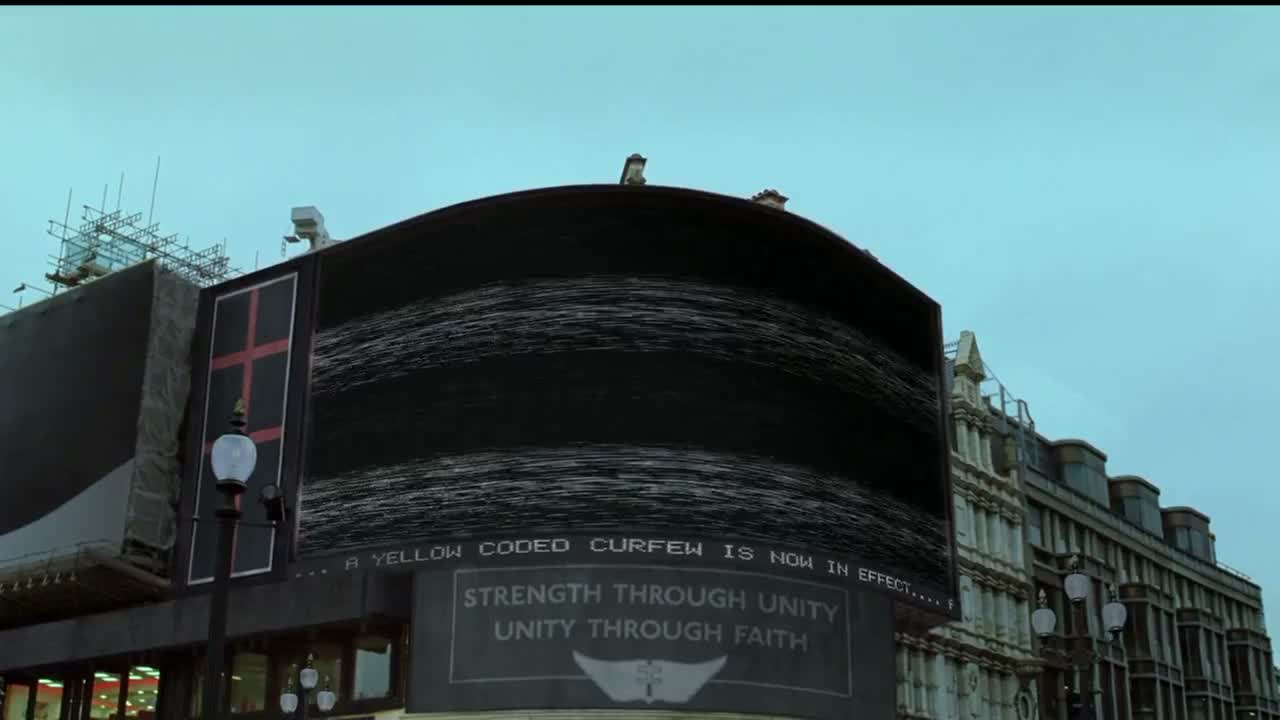 Up next · 04truth be toldThe scene: V Hijacks the Emergency Broadcast
It's the regime's cover story. Calling it a demolition makes the explosion look like routine safety work, so the public never connects it to V or to a successful act of rebellion.
Norsefire rules through faith, not evidence. If people doubt the government's version of events, they might doubt the whole system, which is exactly what V is trying to trigger.
Finch calls the bomber 'very good,' which sounds like respect. Sutler needs the man to be a monster, not a skilled opponent, so he cuts the comment off as irrelevant.
Spin is political manipulation of how a story is told. 'Spin coverage' means news reports shaped to push the government's version — here, that the explosion was planned demolition.
Finch has her picture, but when Sutler asks who she is, he says he is not sure yet and that they are working on several leads. The girl turns out to be Evey, and that lead matters later.