
“It's good, Ross. I didn't know you could cook.”
Why it's great
A compliment plus surprise makes the praise land as warm and personal.
Register
Neutral
Use it yourself
I didn't know you could bake like this.
Chapter 6 of 20 · 2'24"
Randall walks through the night of the killing minute by minute: a movie David wanted to finish, the drive back, cigarettes and a newspaper at the motel, a few words with a kid looking for work, then home to a sleeping brother. "He's acting strange," he says of David, a detail the case will lean on.
❝ Monologue · 19 lines Randall Offers the Kid a Job
Randall Comes Home and Sleeps
Randall describes the evening step by step: after a movie, he and David drive back to Dallas and stop at the motel, where Randall buys cigarettes and a newspaper. He chats with a kid looking for work and tells him to come by Monday. At home, his brother is asleep and the TV is on; Randall eats a sandwich and falls asleep.
This is an alibi delivered as routine, and its power is in the small, dull details. Randall narrates the night in order — the movie, the drive back, a pack of cigarettes, a newspaper — as if the point were to show he had nothing to hide. The one crack he notices is David: "He's acting strange, he wanted to watch the end." It is the only odd note in an evening of ordinary things. Then the story continues past the crime, quietly: he walks home, finds the television on and his brother asleep, makes a sandwich, watches the end of The Carol Burnett Show and fifteen minutes of news, turns off the TV, and goes to sleep. The later section, where a stenographer is brought in and the story is run through again, shows the same account being shaped into a record. Nothing here raises its voice; the whole case, as the film frames it, may hang on how flat it sounds.
A1–C2 is the CEFR scale. Cards above the level you pick fade, and playback will not auto-pause on them.
“It's good, Ross. I didn't know you could cook.”
A compliment plus surprise makes the praise land as warm and personal.
Neutral
“He's acting strange, he wanted to watch the end. Anyway, we left.”
It plants unease, then closes the moment, leaving you to wonder why.
Informal
“I told him that I would catch him Monday morning if he showed up.”
A plain promise with a condition quietly pins down the morning he must appear.
Neutral
“He had been home this whole time that I had been gone.”
The doubled past perfect quietly reveals he was home all along while I was away.
Neutral
“And that was it. I turned the TV off and went to sleep.”
Two flat everyday actions end the night, which makes the ordinariness the point.
Informal
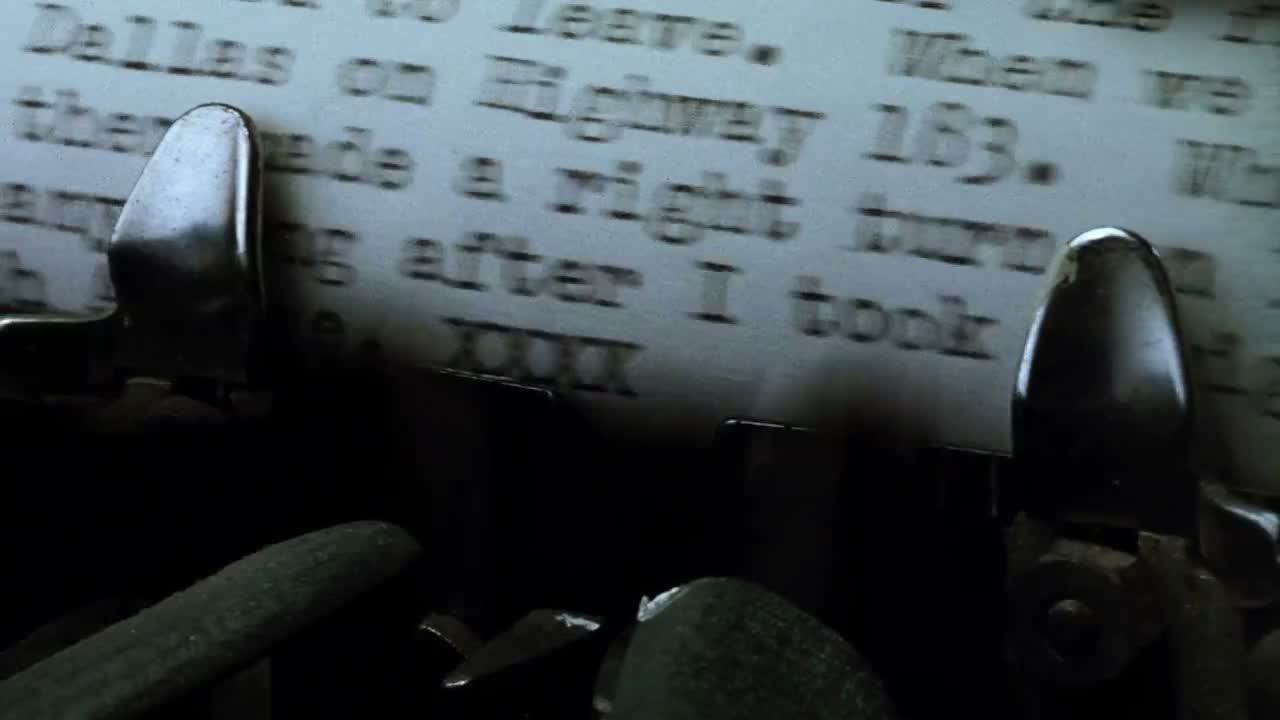
We drove back towards Dallas and we drove to the motel. There's a little store. I bought a pack of cigarettes... and a newspaper. And when I left, this kid was still sitting there. I leaned against the car and we talked to him for a few minutes... and I told him that since he was looking for a job... and there hadn't been anybody at work... that if he wanted to stop back Monday morning... that sure, he could ride out and follow me to work... and he could talk to the boss. And he would probably get a job. I told him that I would catch him Monday morning if he showed up. I told him what time I went to work. Why, I left. I walked around the store and went to the house. When I walked in, the television was on and my brother was sleeping. He had been home this whole time that I had been gone. So I made me a sandwich... and sat there and watched the end of The Carol Burnett Show. When it went off, the news came on and I watched 15 minutes of it. And that was it. I turned the TV off and went to sleep.
 Up next · 07went blankThe scene: Adams's Statement Labeled a Confession
By his account, he and David went to a movie, then drove back to the motel, where he bought cigarettes and a newspaper and talked to a kid looking for work. He says he was home asleep by the end of the night.
Randall points out that his brother had been home the whole time, which supports his story that he came in and found him asleep. It is a small check on an alibi built from ordinary details.
At the movie, David insists on staying to watch the end, even though Randall wants to leave. Randall calls it acting strange, and it becomes one of the odd details the case will seize on.
Someone is brought in to take down the account, and the story is run through again, telling them what happened that Saturday. The scene shows a spoken night turning into an official record.