
“Why don't you grow up, Baxter? Be a mensch.”
Why it's great
A blunt question plus one Yiddish word lands harder than a whole lecture on decency.
Register
Informal
Use it yourself
Why don't you grow up and stop playing games?
Chapter 9 of 15 · 4'37"
Baxter's neighbor turns out to be the doctor who saves Fran after her overdose. He keeps her walking and talking all night, then rounds on Baxter: "But as your neighbor, I'd like to kick you around the block." The medical emergency is over; the moral one is just starting.
Dreyfuss Walks Fran Through the Night
❝ Monologue · 8 lines Dreyfuss Scolds Baxter at the Door
After the office party, Baxter comes home to find Fran unconscious from an overdose. He fetches his neighbor, Dr. Dreyfuss, who forces coffee into her and marches her around the room to keep her awake. Sheldrake appears and offers only polite small talk, while Dreyfuss stays until she's out of danger — then turns his anger on Baxter.
The scene works because Dreyfuss does the job everyone else avoids. He is the only one who says plainly what happened — "you took too many sleeping pills" — and the only one who keeps treating Fran as a person rather than a problem. Sheldrake, by contrast, hides behind manners: "We work in the same building. We try to keep it quiet." Dreyfuss mocks that instantly with "Mr? Miss? Such politeness!" The real accusation lands later, aimed at Baxter: the borrowed apartment, the married boss, the girl left to clean up the mess. "Live now, pay later," Dreyfuss says, then the line that names the whole film: "Why don't you grow up, Baxter? Be a mensch." It isn't cruelty; it's a neighbor forcing him to see the cost of being liked by powerful men.
A1–C2 is the CEFR scale. Cards above the level you pick fade, and playback will not auto-pause on them.
“Why don't you grow up, Baxter? Be a mensch.”
A blunt question plus one Yiddish word lands harder than a whole lecture on decency.
Informal
“But you're not out of the woods yet, because most of 'em try it again.”
The forest image warns without insult: the danger is not over, and it usually repeats.
Neutral
“These cases are harder on the doctor than the patient. I oughta charge by the mile.”
Dry humor turns a night of emergency care into a taxi-meter joke, and the exhaustion shows through.
Informal
“But as your neighbor, I'd like to kick you around the block.”
Splitting the doctor from the neighbor lets him threaten and stay calm at once.
Informal
I don't know what you did to that girl... ...but it was bound to happen, the way you carry on. Live now, pay later. Diners Club! Why don't you grow up, Baxter? Be a mensch. - You know what that means? - I'm not sure. A mensch! A human being! So you got off easy this time. So you were lucky. But you're not out of the woods yet, because most of 'em try it again.
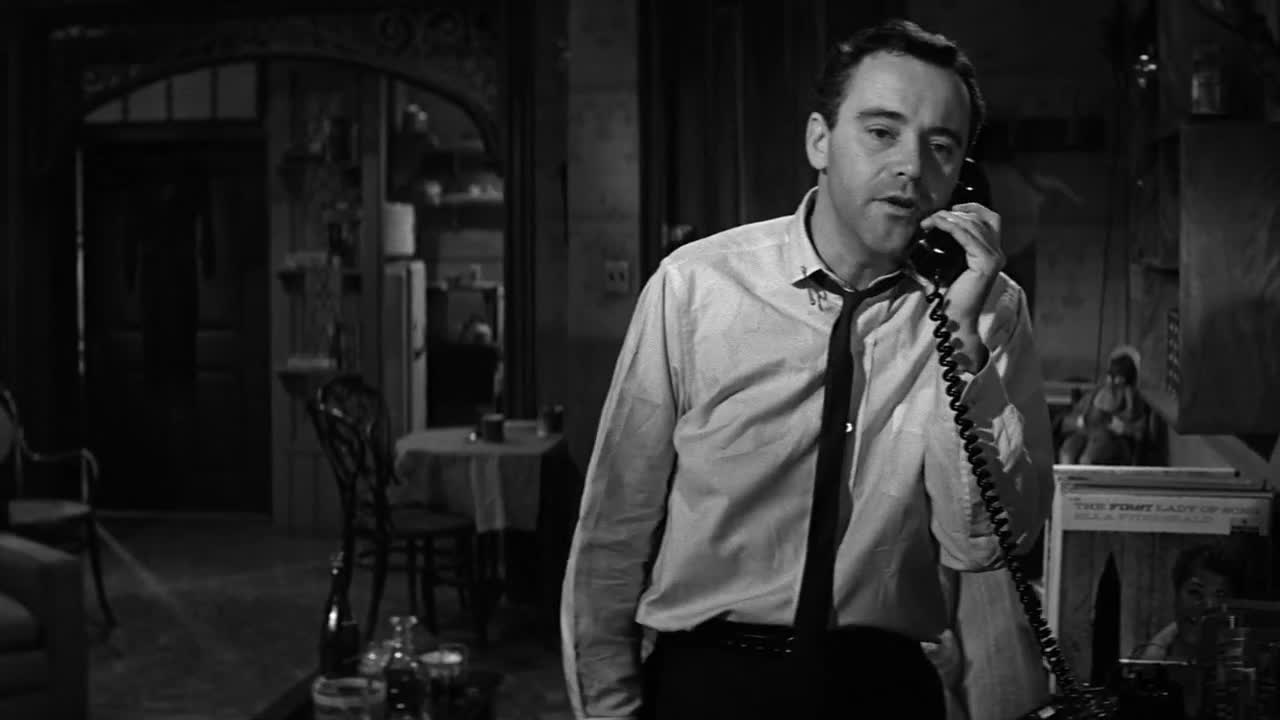 Up next · 10touch and goThe scene: Baxter Calls Sheldrake About Fran
It's Baxter who begs him to skip the report, arguing it was an accident and there was no suicide note. Dreyfuss refuses because reporting is "regulations" — and because he wants Baxter to face what happened.
It's a Yiddish word for a person of integrity, someone decent and responsible. When Dreyfuss says "Be a mensch," he's telling Baxter to stop being a helpful doormat and act like a grown man.
Baxter is his neighbor and the one he can reach. He also knows Baxter enables the affair by lending the apartment, so he treats him as an accomplice who should know better, not just a bystander.
The film keeps it ambiguous on purpose. Baxter insists she "had too much to drink" and there's "no suicide note," but Dreyfuss's warning that most of them try it again suggests he reads it as a real attempt.
He wants to keep the overdose off the books. Baxter argues it was an accident and there was no suicide note, then asks Dreyfuss to forget he is a doctor and say he was only visiting as a neighbor.