
“It requires only the will to do so.”
Why it's great
It shrinks a world-ending project down to a single human choice.
Register
Formal
Use it yourself
It requires only the will to start, and the rest follows.
Chapter 11 of 20 · 2'55"
Strangelove calmly presents a machine that runs itself: once triggered, it cannot be un-triggered. "Mr. President, it is not only possible, It is essential," he says. Someone in the room likes the idea so much he wishes America had one too.
❝ Monologue · 6 lines Strangelove Defines Deterrence
❝ Monologue · 7 lines how the machine works
Catastrophe is explained like a product manual, which is exactly what makes it frightening.
In the Pentagon War Room, Dr. Strangelove explains the doomsday machine: bombs buried in huge numbers, wired to a computer complex, and set to detonate automatically if certain conditions are met. Once triggered, the machine cannot be stopped. He insists it is essential, and the Soviet ambassador eventually admits such a machine already exists.
On the surface, this is a briefing: Strangelove explains a device, the President asks how it works, and the room listens. What's really going on is an argument about deterrence itself. Strangelove's point is that "Deterrence is the art of producing in the mind of the enemy... the fear to attack" — and a machine only works as deterrence if the enemy knows it exists. That is why the last exchange matters: if the whole point is lost when you "keep it a secret," then a doomsday machine nobody knows about protects no one. The scene ends with the absurd explanation that the Soviet premier simply "loves surprises," turning the end of the world into a public-relations plan.
A1–C2 is the CEFR scale. Cards above the level you pick fade, and playback will not auto-pause on them.
“It requires only the will to do so.”
It shrinks a world-ending project down to a single human choice.
Formal
“Mr. President, it is not only possible, It is essential.”
The parallel turn upgrades a possibility into a demand, without raising his voice.
Formal
“Gee, I wish we had one of them doomsday machines.”
Wishing for the very weapon he has just been told is uncontrollable lands as dark irony.
Informal
“Why didn't you tell the world, eh?”
One short question exposes the contradiction at the heart of the whole plan.
Informal
“As you know, the premier loves surprises.”
The throwaway tone treats global catastrophe as a small surprise for one man.
Neutral
“Deterrence is the art of producing in the mind of the enemy...”
It defines deterrence as work done in an enemy's head, not on a battlefield.
Formal
Deterrence is the art of producing in the mind of the enemy... The fear to attack. And so because of the automated and irrevocable decision-making process... Which rules out human meddling, The doomsday machine is terrifying... And simple to understand... And completely credible and convincing.
When you merely wish to bury bombs, There's no limit to the size. After that, they are connected... To a gigantic complex of computers. Now, then, a specific and clearly defined... Set of circumstances... Under which the bombs are to be exploded... Is programmed into a tape memory bank.
Dr. Strangelove or: How I Learned to Stop Worrying and Love the Bomb: your progress
Chapter 11 of 20 · about 25 min to go
← Previous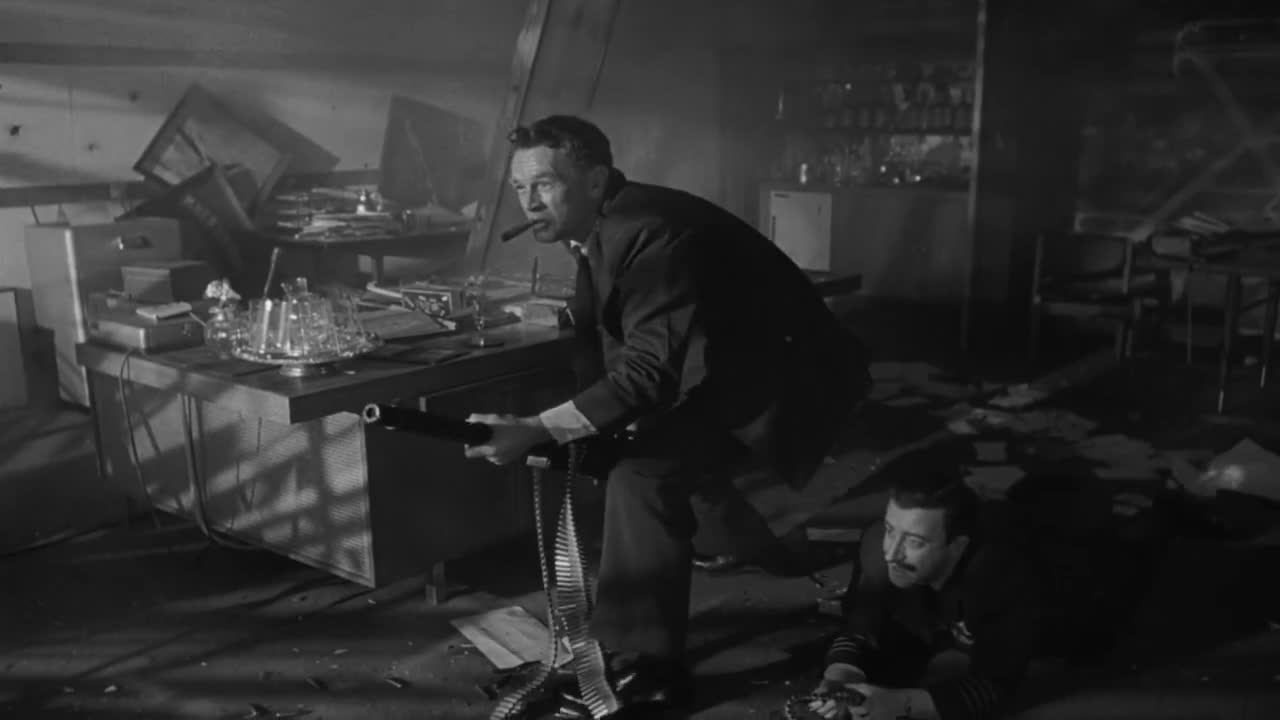 Up next · 12hard-coreThe scene: Ripper Rants About Fluoridation
Because deterrence only works if the enemy knows the threat exists. A machine nobody has heard of creates no fear, so it cannot stop an attack.
The ambassador says it was meant to be unveiled at the party congress on Monday. His excuse is that the premier loves surprises.
He argues it rules out human meddling: once a computer decides, no one can hesitate, change their mind, or call it back. To him that makes the threat more credible.
It is dark humor about the arms race. Instead of being horrified, the man in the room treats the Soviet machine as something to envy and copy.