
“It's time to burn some books.”
Why it's great
Six plain words turn a summer game into a book burning and land the film's warning.
Register
Informal
Use it yourself
It's time to clear these papers off the desk.
Chapter 1 of 18 · 3'41"
Captain Klenzendorf opens the training weekend with a speech that sounds patriotic and is actually a confession of defeat. He has lost an eye, he says the country is 'on the back foot,' and he rattles off the schedule with a smirk. The cheer around him is the joke: even the officer in charge knows the war is lost.
❝ Monologue · 7 lines Captain K Explains His Lost Eye
Boys Train for War, Girls Learn to Get Pregnant
❝ Monologue · 5 lines A Race Lesson Leads to the Book Burning
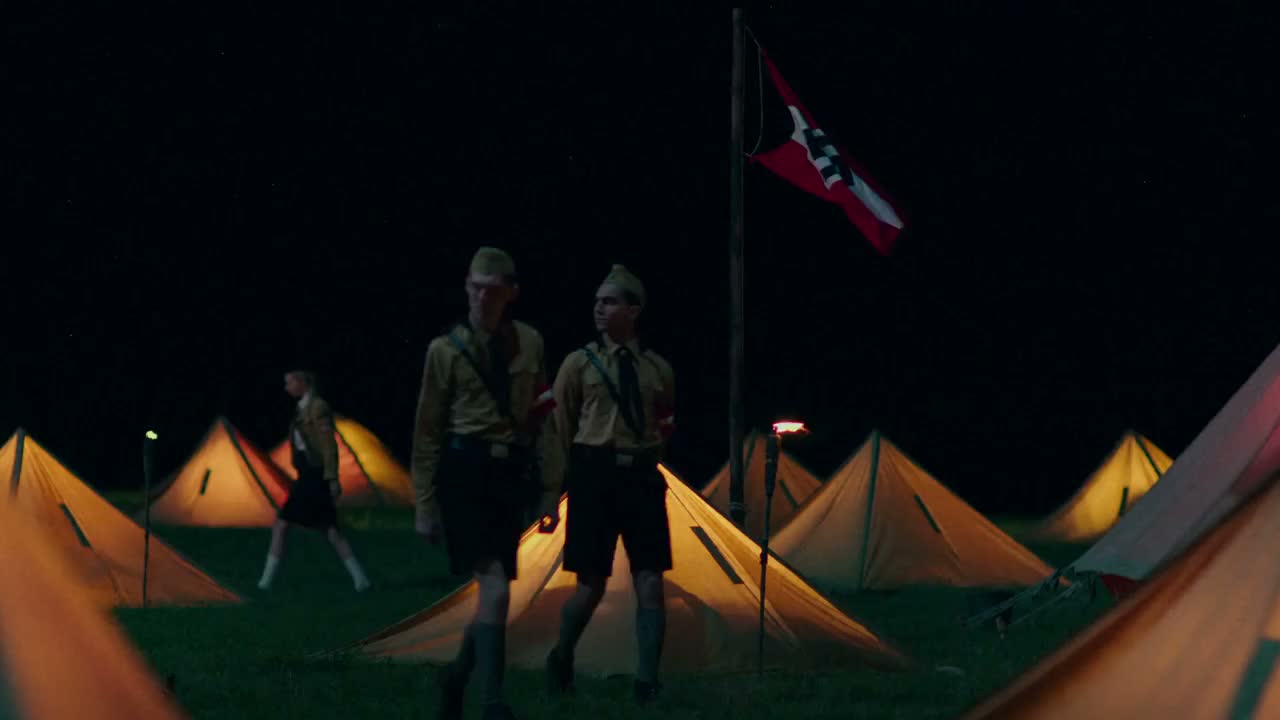
At a Hitlerjugend training weekend, Captain Klenzendorf introduces himself as 'Captain K' and launches into a bitter speech. He jokes about losing an eye, admits the country is losing the war, then lists the camp's activities: boys practice war, girls learn housework and pregnancy. The lecture ends with a lesson on Jews and a call to burn books.
The scene lets the adults say the quiet part out loud while a room full of children salutes. Captain Klenzendorf is supposed to be training soldiers, but his speech is a list of failures: a lost eye, a botched operation, a country 'on the back foot,' a war with almost no hope of being won. He covers it with jokes and a jaunty 'apparently we're doing just fine,' and the children laugh along because they do not yet know they are being recruited for a losing cause. The schedule is the darkest joke of all: boys get weapons and explosions, girls get 'learning how to get pregnant.' The scene keeps the tone light on purpose, and the ending — moving straight from propaganda about racial superiority to 'It's time to burn some books' — shows how ordinary the machinery of fascism is made to feel.
A1–C2 is the CEFR scale. Cards above the level you pick fade, and playback will not auto-pause on them.
“It's time to burn some books.”
Six plain words turn a summer game into a book burning and land the film's warning.
Informal
“You should never be without them.”
A gentle piece of advice that quietly tells children never to be unarmed.
Neutral
“We, Aryans, are one thousand times more civilized and advanced than any other race.”
The calm delivery of an absurd claim is exactly what makes the propaganda sound insane.
Formal
“Such a great year to be a girl.”
Praise that is really a complaint; one line exposes what the regime plans for girls.
Informal
“This is your first step towards being men.”
Turning a knife handout into a rite of passage is generous and chilling at once.
Neutral
“And according to my superiors, you need two eyes to be a meaningful part of the war effort.”
Bureaucratic phrasing makes an inhuman rule sound like a memo from the office.
Formal
So a little about me. Who am I? And why am I here talking to a bunch of little titty-grabbers instead of leading my men into battle towards glorious death? Great question. I've asked it myself every day since Operation Screw Up where I lost a perfectly good eye in a totally preventable enemy attack. And according to my superiors, you need two eyes to be a meaningful part of the war effort. Can two-eyed people do this?
Because, once upon a time, a Jewish man mated with a fish. Whoa! We, Aryans, are one thousand times more civilized and advanced than any other race. Now, get your things together, kids. It's time to burn some books.
Jojo Rabbit: your progress
Chapter 1 of 18 · about 58 min to go
 Up next · 02let you in onThe scene: Jojo Refuses to Kill the Rabbit
He lost an eye, and he says his superiors decided you need two eyes to be a meaningful part of the war effort. So instead of combat, he is stuck running a training weekend for children.
The boys are trained in marching, bayonet drills, grenades, guns and explosives, while the girls are taught duties like dressing wounds, making beds and learning how to get pregnant.
She is one of the instructors introduced at the camp. She greets the children, and she is the one who delivers the lesson about Jews and Aryan superiority.
Probably not. His speech is full of jokes and open defeatism, and he tells the children there is little hope of winning the war even as he pretends everything is fine.
The children are told to gather their things because it is time to burn books, turning an act of censorship into the next scheduled activity.