
“We don't want to start a nuclear war unless we have to, do we?”
Why it's great
A calm tag question makes insanity sound like common sense.
Register
Formal
Use it yourself
We don't want to escalate unless we have to, do we?
Chapter 3 of 20 · 2'08"
Mandrake has proof the attack is a mistake — civilian radio is still broadcasting — but Ripper will not bend. "The planes are not going to be recalled," he insists, and "my attack orders have been issued, and the orders stand." Mandrake's appeal to sanity, "we don't want to start a nuclear war unless we have to," changes nothing.
Mandrake Brings Ripper the Radio
Mandrake Cannot Stop the Launch
At Burpelson Air Force Base, Group Captain Mandrake brings General Ripper a radio and shows him that civilian stations are still broadcasting — proof, he argues, that no Soviet attack is under way. He urges Ripper to issue the recall code at once. Ripper refuses: the attack orders stand, and he tells Mandrake the officer exchange program gives him no right to question them.
The scene is a polite disagreement between a man who still believes in reason and a man who has left it behind. Mandrake builds his case carefully: the broadcasts prove there is no attack, so the orders must be wrong, so the recall code should be sent. Ripper answers not with arguments but with authority and, when pressed, with menace disguised as calm — "Why don't you take it easy, group captain?" The real horror is how ordinary the exchange sounds. Ripper never shouts; he simply states that "the orders stand," which is the logic of nuclear deterrence taken to its end: once launched, nothing may be stopped because stopping would admit a mistake. Mandrake's summing-up — "there was something dreadfully wrong somewhere" — is the film's quiet thesis. The system is not broken by madness; it merely runs on it.
A1–C2 is the CEFR scale. Cards above the level you pick fade, and playback will not auto-pause on them.
“We don't want to start a nuclear war unless we have to, do we?”
A calm tag question makes insanity sound like common sense.
Formal
“The planes are not going to be recalled.”
Six words and no explanation, the whole refusal sits in the flatness.
Formal
“My attack orders have been issued, and the orders stand.”
It states what was done and declares it still stands, closing the argument.
Formal
“Does not give you any special prerogatives to question my orders.”
He turns the rulebook into a weapon and draws the line of authority.
Formal
“Well, I would say, sir, That there was something dreadfully wrong somewhere.”
The polite frame makes the damning verdict land even harder.
Formal
“I'd better tell you, because if they do, it'll cause a stink.”
It turns a scandal into a smell, vivid and economical.
Informal
Dr. Strangelove or: How I Learned to Stop Worrying and Love the Bomb: your progress
Chapter 3 of 20 · about 51 min to go
← Previous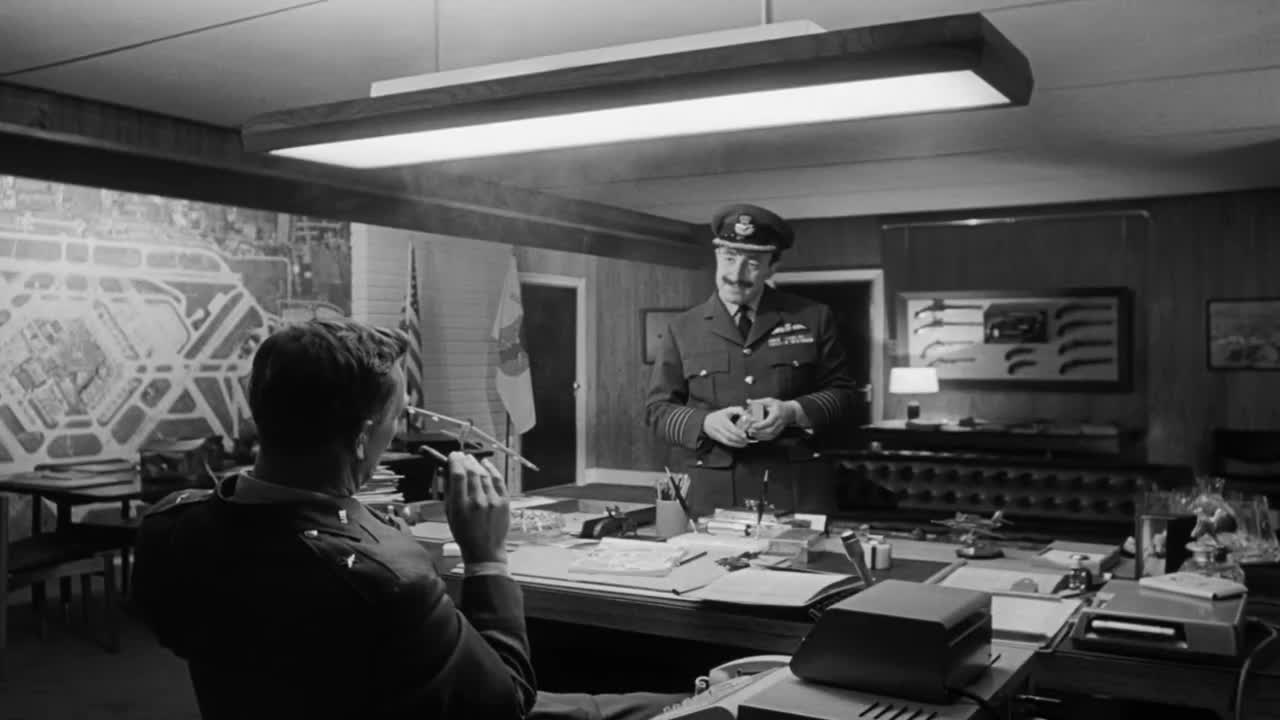 Up next · 04be left to someoneThe scene: Ripper Refuses to Recall the Wing
He believes the attack is a mistake. Civilian radio is still broadcasting, which suggests no Soviet attack is happening, so he urges Ripper to send the recall code immediately.
He says his attack orders have been issued and they stand. He treats the launch as irreversible and refuses to let Mandrake question his authority.
It means to create a scandal or a lot of angry public reaction. Mandrake warns that if the truth comes out, it will cause a stink.
It is the arrangement that brought the British officer Mandrake to the base. Ripper uses it to say it gives Mandrake no special right to challenge his orders.
He suspects it is a mistake. He tells Ripper that something is 'dreadfully wrong somewhere,' and worries that acting on the orders will start a nuclear war for no reason.