
“General Turgidson, I find this very difficult to understand.”
Why it's great
The President never raises his voice; saying it is hard to understand is enough.
Register
Formal
Use it yourself
I find this explanation very difficult to understand.
Chapter 5 of 20 · 2'45"
In the War Room, the president is told that armed bombers are heading for targets inside Russia and that no one can call them back. He insists he alone may order nuclear use; the general agrees, then explains that Plan R lets a lower commander fire first — "You approved it, sir."
❝ Monologue · 7 lines Turgidson's briefing
He reads the map like a weather report, and the calm makes the countdown worse.
❝ Monologue · 13 lines The President Questions the Nuclear Order
No Way to Recall the Bombers
In the War Room, the big board shows Soviet targets, and the president learns that bombers loaded with nuclear weapons are flying toward them. He says he thought he alone could authorize nuclear use. General Turgidson agrees, then reveals that Plan R allows a lower commander to launch retaliation if the chain of command is broken.
The scene is a masterclass in bureaucratic calm in front of catastrophe. The president's objection is not moral but procedural — "I was under the impression that I was the only one in authority" — and Turgidson's answer is the film's joke: the system that was meant to prevent accidental war is precisely what started one. His defence of Plan R is delivered as reassurance: it was a "retaliatory safeguard," designed to discourage the Russians, and the flaw is passed off as an accident of design — "I admit the human element seems to have failed us here." The horror is in the verbs. The planes "will continue until they reach their targets"; there is no second order, no recall, no radio. Every attempt to fix the crisis runs into another clause of the plan, and the men in the room keep describing annihilation as a matter of procedure.
A1–C2 is the CEFR scale. Cards above the level you pick fade, and playback will not auto-pause on them.
“General Turgidson, I find this very difficult to understand.”
The President never raises his voice; saying it is hard to understand is enough.
Formal
“You are the only person authorized to do so.”
One flat confirmation pins both the authority and the blame on him.
Formal
“It's beginning to look like general Ripper exceeded his authority.”
It softens a damning charge with begin to look like, the bureaucrat's way of drawing blood.
Formal
“They will continue until they reach their targets.”
A short flat sentence turns annihilation into a schedule item.
Formal
“Why haven't you radioed the planes, countermandering the go code?”
One question cuts to the heart and compresses the whole disaster into a why.
Formal
“I admit the human element seems to have failed us here.”
It blames a systemic failure on the human element, the coldest phrase in the room.
Formal
“I assume the planes will return automatically once they reach their fail-safe points?”
An easy guess makes the fate of armed bombers sound like a routine check.
Formal
It appears that the order called for the planes... To attack their targets inside russia. the planes are fully armed with nuclear weapons... The central display of russia will indicate the position of the planes. The triangles are their primary targets. The squares are their secondary targets. The aircraft will begin penetrating russian radar cover...
Perhaps you're forgetting the provisions of plan r, sir. Plan r? Plan r is an emergency war plan, In which a lower echelon commander may order... Nuclear retaliation after a sneak attack, If the normal chain of command has been disrupted. You approved it, sir. You must remember. Surely you must recall, sir, when senator beaufort... Made that big hassle about our deterrent lacking credibility. The idea was for plan r to be a sort of retaliatory safeguard. A safeguard? I admit the human element seems to have failed us here. But the idea was to discourage the ruskies from any hope... That they could knock out washington-- and yourself, sir-- As part of a general sneak attack... And escape retaliation because of lack of proper command and control.
Dr. Strangelove or: How I Learned to Stop Worrying and Love the Bomb: your progress
Chapter 5 of 20 · about 45 min to go
← Previous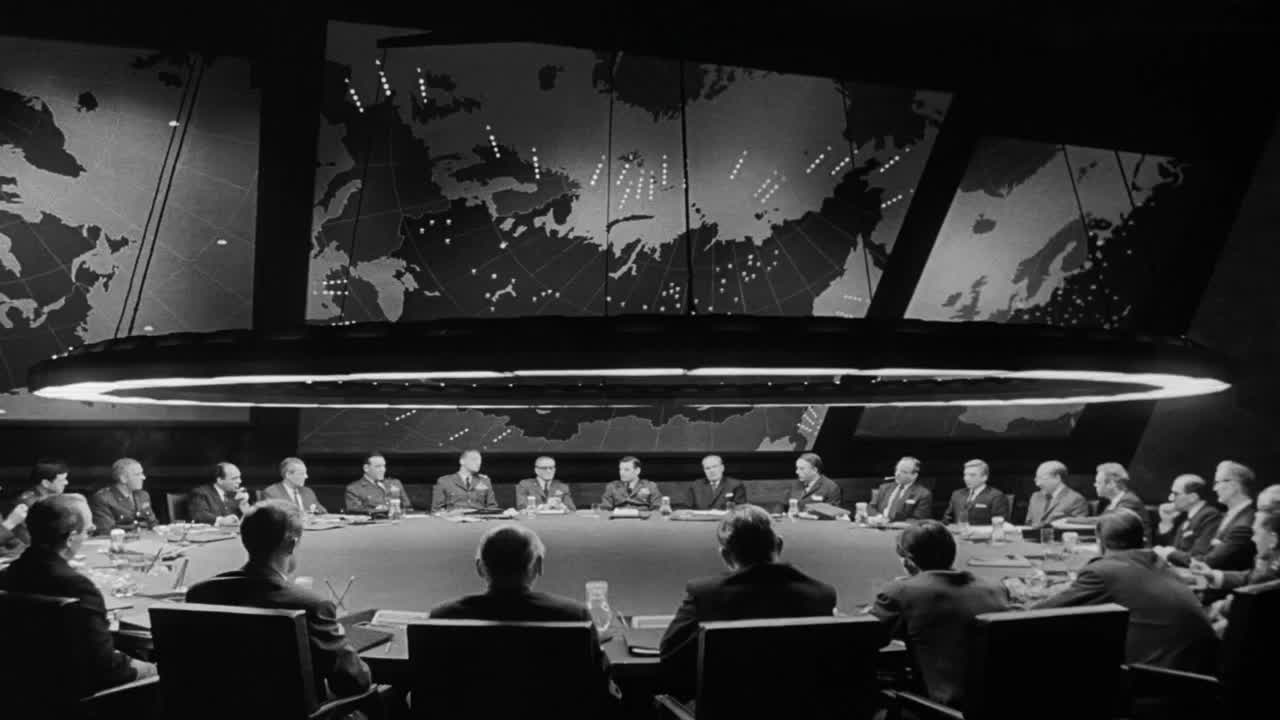 Up next · 06that's the size of itThe scene: No Way to Recall the Bombers
An emergency war plan that lets a lower commander order nuclear retaliation after a sneak attack, if the normal chain of command has been disrupted. Turgidson reminds the president that he approved it.
Once the bombers pass their fail-safe points, they need no second order to proceed, so they keep flying to their targets. On top of that, the base has cut off radio contact with them.
Under Plan R he could issue the order if the chain of command was broken. The president and Turgidson agree he has gone far beyond normal authority, but the plan is what allowed him to act.
It is the point a bomber reaches before committing to its target, where it would normally turn back without further orders. Once past it, the planes are committed.
He means the plan itself was sound and the failure came from the people carrying it out. It is his way of defending Plan R even as the crisis it caused unfolds.