
“That's how far jealousy can drive a man.”
Por qué es buena
A single line that explains cruelty away as the work of jealousy, half apology and half excuse.
Registro
Neutral
Úsala tú
That is how far anger can drive an honest person.
Capítulo 13 de 19 · 4'13"
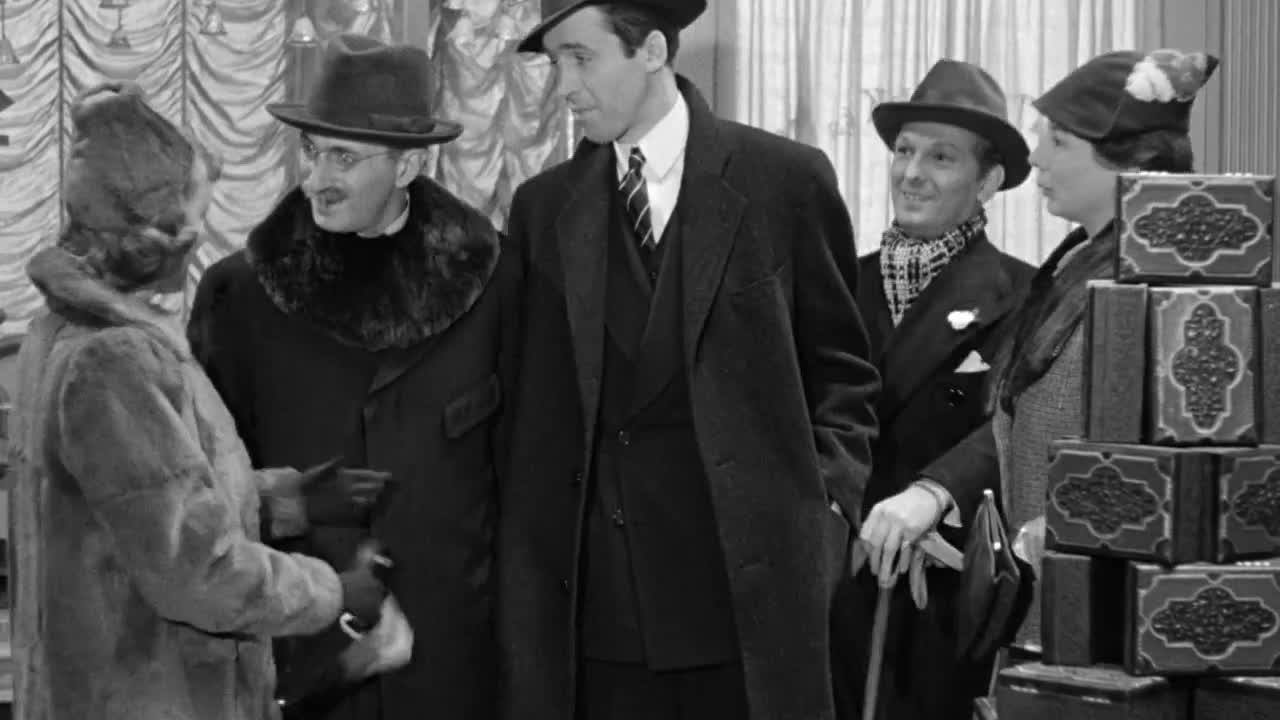
Matuschek accuses Kralik of an affair with his wife, then admits the truth: an anonymous letter planted the idea, and his own jealousy did the rest. "That's how far jealousy can drive a man," he says, before handing Kralik the keys to the shop.
Pepi Becomes a Clerk
At Matuschek's home, the shaken owner tells Kralik that an anonymous letter claimed his wife was having a secret rendezvous with an employee. He admits he suspected Kralik, then hands him the keys to Matuschek and Company and has Vadas quietly dismissed. Pepi, who saved Matuschek's life, talks his way into a clerk's job.
The scene is a proud man taking apart his own mistake in front of the employee he wronged. He confesses that the jealousy started as a joke — he laughed at the anonymous letter — and then took over: "That's how far jealousy can drive a man." The letter only said an employee; what turned suspicion into certainty was Kralik being the one who had visited the house and sent flowers. He offers Kralik the business as both apology and surrender, and even the order about Vadas ("as quietly as possible") shows a man protecting the last of his dignity. Kralik barely argues; he simply accepts the keys, which is its own kind of forgiveness.
A1–C2 es la escala MCER. Las tarjetas por encima del nivel elegido se atenúan y la reproducción no se pausa en ellas.
“That's how far jealousy can drive a man.”
A single line that explains cruelty away as the work of jealousy, half apology and half excuse.
Neutral
“And this is going to be the biggest Christmas in the history of Matuschek and Company.”
A big, almost reckless promise that turns a low point into a banner season.
Informal
“Well, sir, I'll talk it over with myself and if I don't ask for too much money I'll give it to myself. Thank you, sir.”
A dry, perfectly polite joke built by turning a formal phrase back on the speaker.
Informal
“Well, I have to get over it.”
A plain statement of resilience: no complaint, just the decision to move past it.
Neutral
 Siguiente · 14a yes manLa escena: Kralik Fires Vadas
An anonymous letter claimed his wife was having a secret rendezvous with an employee. Kralik was the only employee who had been to the house and had sent his wife flowers, so he became the obvious suspect.
No. He sent the flowers for innocent reasons, and the affair was between Matuschek's wife and Vadas. Matuschek realizes his mistake and hands Kralik the shop instead of firing him.
As an apology for the false accusation and because he is stepping back after his breakdown. He had once promised Kralik the manager's job if things went well, and now he keeps that promise.
He is dismissed as quietly as possible, with no scandal and no direct confrontation. The owner refuses to lower himself by bringing the affair up to his face.
Pepi, the errand boy. After saving the owner's life — "you saved my life," he's told — Pepi talks his way up from errand boy to clerk by the end of the scene.