“But it's up to you what you make of it.”
A short line that hands both freedom and responsibility to the one who hears it.
Neutral
Capítulo 18 de 19 · 3'11"
On Christmas Eve the shop owner keeps drifting back into his empty store. He offers one employee a bottle of champagne, asks a young worker about his family, and learns the boy has no relations in the city at all. "I just wanted to be sure that you weren't alone."
Matuschek Offers a Lonely Christmas Drink
Matuschek Learns Rudy Is Alone, Invites Him Home
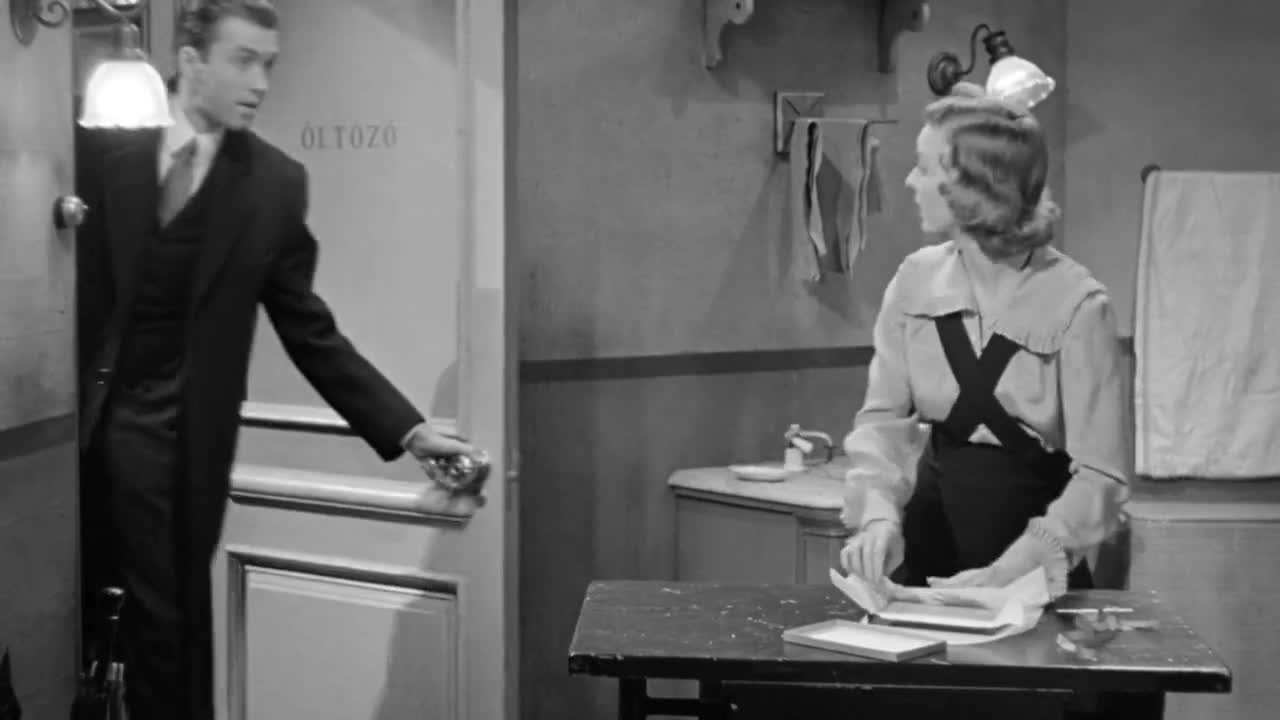
Late on Christmas Eve, Matuschek, the shop's owner, is still hanging around his store. He invites a young worker to Biro's for champagne, but the man has other plans. He wishes the others a merry Christmas, then turns to Rudy, the seventeen-year-old, and learns the boy has no family in Budapest. He asks him to dinner.
The store is closing and nearly everyone has somewhere to go; that is exactly what makes this scene sting. The owner keeps finding excuses to stay, inviting one man for champagne, asking another about his wife and children, and the repeated "Merry Christmas" starts to sound less like cheer and more like a man putting off an empty apartment. When he tells the youngest worker "You've got your whole life ahead of you," it is advice, but it also measures the distance between seventeen and his own age. The real turn is the quiet question about family, then the discovery that the boy has no one. He does not send him home; he offers him dinner and the food keeps coming — a Christmas feast listed item by item, ending in a taxi.
A1–C2 es la escala MCER. Las tarjetas por encima del nivel elegido se atenúan y la reproducción no se pausa en ellas.
“But it's up to you what you make of it.”
A short line that hands both freedom and responsibility to the one who hears it.
Neutral
“Oh, well, but Christmas only comes once a year.”
A warm excuse for indulgence: some occasions really do come only once.
Informal
“You've got your whole life ahead of you.”
A plain reassurance to anyone young: the road ahead is still long.
Neutral
“I just wanted to be sure that you weren't alone.”
Care that asks nothing and only checks you are not alone.
Informal
“- Yeah. - Well, I'm her Santa Claus.”
He hides a quiet good deed inside a childlike joke: I'm her Santa Claus.
Informal
Siguiente · 19swept me off my feetLa escena: Klara Confesses to KralikHe has nowhere he seems eager to be. He keeps finding people to talk to and things to ask, and he offers to take a man out for champagne rather than head home, so an empty evening is clearly what he is avoiding.
Once he learns the boy is alone in Budapest with no other relations, he stops treating him as just an errand boy. He asks about soup, then goose, then strudel, and before long he is calling a taxi to take him along.
Yes, and happily. He says he certainly likes chicken noodle soup and would love the rest of the menu, and the scene ends with the two of them leaving together in a taxi.
It means far beyond what he can afford. Biro's is a grand restaurant, and his reply is that such a place is out of his league, not that he cannot understand it.
It is the boy's Christmas present, and he assumes Rudy has a family to bring it to. The advice is meant kindly, a warning against squandering it, and it changes once he hears the boy has no relations in town.