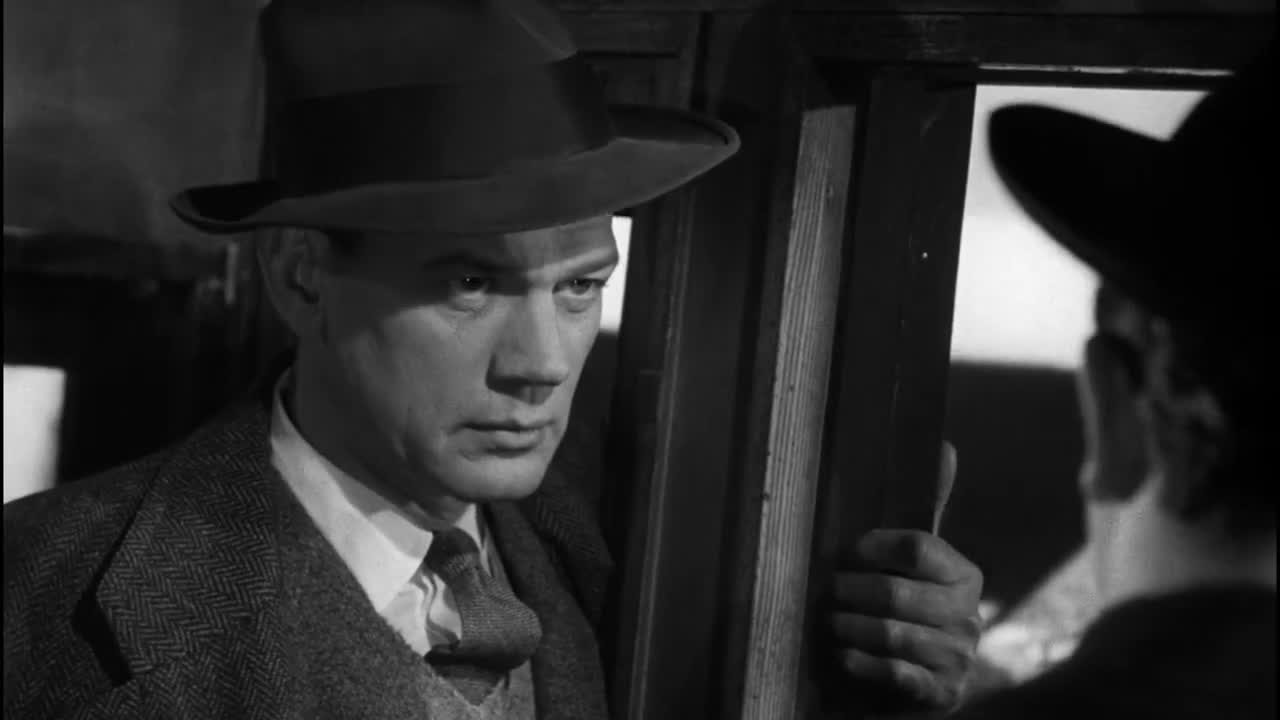
“Would you really feel any pity if one of those dots stopped moving forever?”
It turns murder into a dot that stops moving, and the calm delivery is what chills.
Neutral
Chapter 16 of 17 · 3'04"
High on the Prater wheel, the supposedly dead Harry Lime reveals himself and shows no concern that Anna has been arrested. He points at the people below: "Would you really feel any pity if one of those dots stopped moving forever?" When Holly threatens him, Harry answers that he carries a gun.
❝ Monologue · 5 lines The Dots on the Wheel
I Carry a Gun
On the great wheel at the Prater, Holly Martins meets Harry Lime, who is alive and entirely unbothered that Anna has been arrested and may be handed to the Russians. Harry asks whom Holly told, dismisses his answers as unwise, and defends himself with the image of the people below as dots that can be spent. Holly tells him his money will be no use in jail.
The scene is the film's moral centre, and it is built as a seduction that fails. Harry appears, charming and unrepentant, and answers every charge with a shrug: Anna's arrest is "Tough. Very tough." delivered with a smile. Then he makes his famous argument, looking down at the people on the streets and turning them into arithmetic: "Would you really feel any pity if one of those dots stopped moving forever?" The horror of the speech is its calm, and its logic is the logic of a man who has already stopped seeing other people as people. Holly's reply restates the ordinary moral fact Harry has abandoned — money will not help him in jail — and Harry's answer, that there is no proof except Holly, turns the friendship into a threat. The last exchange, about the gun and the bullet wound, ends the charm completely.
A1–C2 is the CEFR scale. Cards above the level you pick fade, and playback will not auto-pause on them.
“Would you really feel any pity if one of those dots stopped moving forever?”
It turns murder into a dot that stops moving, and the calm delivery is what chills.
Neutral
“The world doesn't make any heroes...”
A short flat line that dismisses heroism and quietly predicts the break between them.
Informal
“A lot of good your money will do you in jail.”
The inverted praise is a dry way of saying money will not save him.
Informal
“You don't care anything at all about Anna, do you?”
The trailing tag turns a flat statement into an accusation he cannot easily deny.
Informal
“I don't think they'd look for a bullet wound after you hit that ground.”
A calm remark about ballistics that lands harder than any shouted threat.
Informal
Would you really feel any pity if one of those dots stopped moving forever? If I offered you £20,000 for every dot that stopped, would you really, old man, tell me to keep my money? Or would you calculate how many dots you could afford to spare? Free of income tax, old man. Free of income tax.
Up next · 17cut you inThe scene: Harry's Cuckoo Clock SpeechBecause he does not intend to help her. He treats her danger as bad luck and refuses to act, even though she is being handed over to the Russians.
It is his defence of his crimes. Looking down at the people below, he argues that a single death among so many causes no real grief, and asks how many Holly would sacrifice for money.
It is his dark joke. He says the money from his racket is free of income tax, as if tax relief justified the deaths that produce it.
To warn Harry. Harry has said he would be easy to get rid of, and Holly replies that a bullet wound would be missed after a fall from the wheel.
Because Holly told the police and Anna that Harry was alive. Harry calls it unwise, and it turns the meeting into a threat between two old friends.