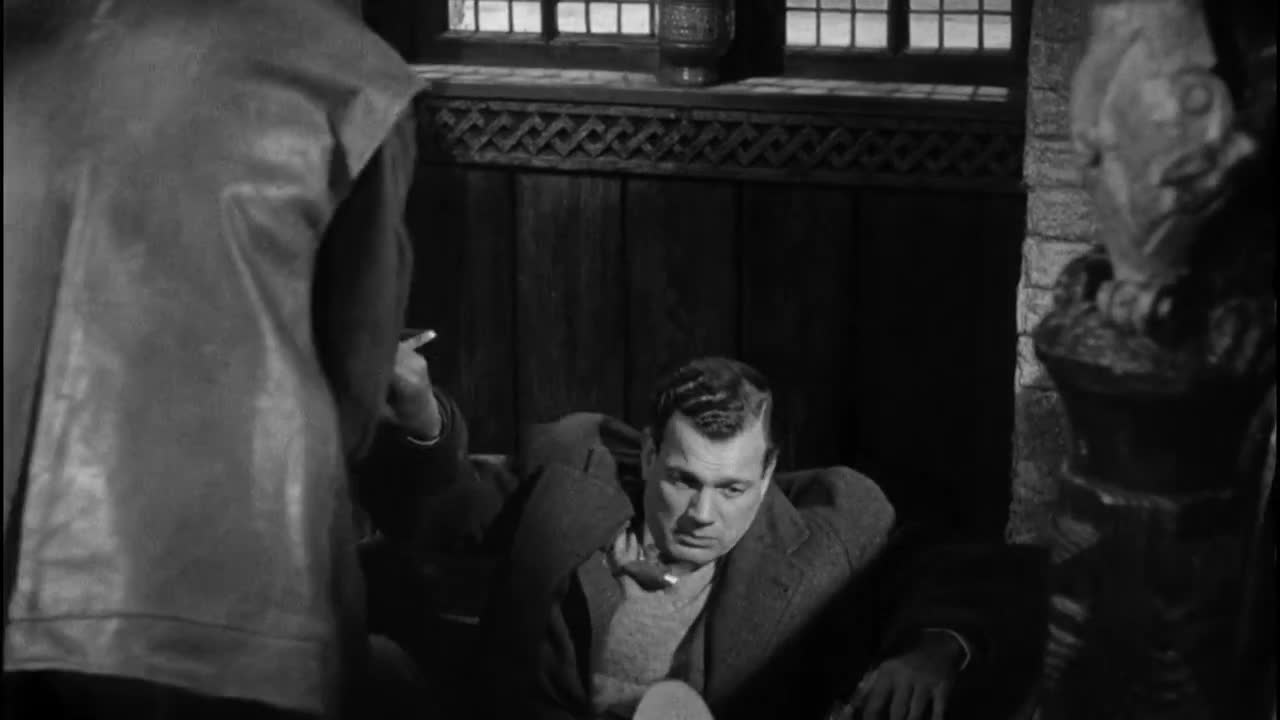
“You've had a bit of a shock, haven't you? You could do with a drink.”
It names the shock and prescribes the cure in one breath, without ever sounding like a doctor.
Informal
Chapter 1 of 17 · 3'01"
Calloway offers Martins a drink and then tells him the truth about his dead friend: Harry Lime was 'about the worst racketeer that ever made a dirty living in this city.' Martins, who insists Lime was the best friend he ever had, refuses to believe it, and the two men circle each other in a bar.
The Writer Defends His Dead Friend
The Worst Racketeer in Vienna
The Police Want Martins Out of Vienna
Calloway drives Martins into town and takes him to a bar. There he tells the shocked writer that Harry Lime, the friend he came to Vienna for, was the worst racketeer in the city. Martins defends Lime's memory, and Calloway answers with a drink, a warning, and a plane seat home.
The scene is an interrogation dressed as a drink. Calloway never raises his voice; he simply replaces Martins' grief with a fact, and the fact is worse than the death: 'He was about the worst racketeer that ever made a dirty living in this city.' Martins, still loyal, reaches for the language of his westerns, and Calloway turns that against him — friendship that 'sounds like a cheap novelette.' What Martins cannot yet see is the pattern Calloway is naming: a man who made his living by dirty dealings and could always 'pin it on a dead man.' The offer of army money and a seat on tomorrow's plane is not kindness so much as a deadline, and the warning 'you'll look so silly' is the real message.
A1–C2 is the CEFR scale. Cards above the level you pick fade, and playback will not auto-pause on them.
“You've had a bit of a shock, haven't you? You could do with a drink.”
It names the shock and prescribes the cure in one breath, without ever sounding like a doctor.
Informal
“- Best friend I ever had. - That sounds like a cheap novelette.”
Sincerity and mockery trade places in two short sentences; that is the whole film in miniature.
Informal
“He was about the worst racketeer that ever made a dirty living in this city.”
One word, racketeer, turns a dead friend into a case file and the whole city into a witness.
Formal
“You're not going to close your files at a dead man's expense.”
It calls a closed case a debt paid by the dead, and makes the paperwork sound obscene.
Formal
“When I'm finished with you, you'll leave Vienna, you'll look so silly.”
A threat delivered as a calm prediction; the flat tone is what makes it sting.
Informal
“Why don't you catch a few murderers for a change?”
A polite suggestion used as a jab; the everyday phrasing makes the insult land harder.
Informal
The Third Man: your progress
Chapter 1 of 17 · about 48 min to go
Up next · 02hunt someone downThe scene: Martins Checks Into a Military HotelBecause he wants Martins to leave Vienna and stop asking questions. The drink and the army money are meant to soften a message he intends Martins to take as final.
In this scene he presents it as established fact rather than opinion. The film treats Lime's racket as real, and Calloway's job is to shut it down, so the claim is not merely bait.
It means blaming someone who cannot defend himself. Martins accuses the police of closing the case cheaply by putting the guilt on Lime now that he is dead.
Because Lime was the best friend he ever had, or so he believes. He came to Vienna for Lime and cannot accept that the man he admired was a criminal.
He wants him to leave Vienna and stop digging. He gives him army money for a night at Sacher's Hotel and says a seat is being kept for him on tomorrow's plane.